Raspberry Cordial

This summer, I opted to reread the Anne of Green Gables series, partly because it’s been a while and partly because my WIP takes place in this world. I wanted a chance to re-immerse myself with this story and these people. I then plan to rewatch the CBC mini series – which is how I was first introduced to Anne (by my grandmother).

Seemingly unrelated, I’ve been watching a friend of mine post on Instagram all these fun drinks that she’s been experimenting with – one more delicious-sounding/looking than the next. I’ve enjoyed living vicariously through her feed, and one day, as I was taking a reading break to flip through insta, an idea sparked:

I wanted to make some raspberry cordial (which, if you’ve read the first book of the series or seen the CBC miniseries, you know where this idea sparked) to perhaps drink in celebration of finishing the series. (Now, in this scene, Diana is supposed to be drinking raspberry cordial…but she is accidentally drinking currant wine…oops…)
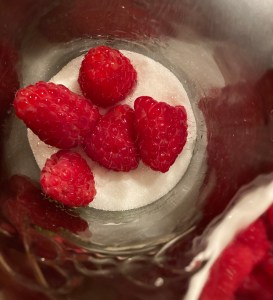
I’m opting to make two types of raspberry cordial – one like what might have existed in the story (i.e. non-alcoholic); the other a bit boozy. The boozy version is a bit easier to make – but it takes time.
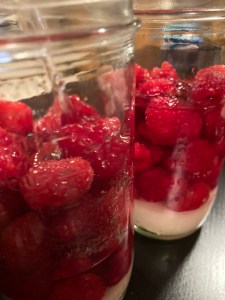
Using two one quart mason jars, I dropped a half cup of granulated sugar into the bottom of each, followed by a pint of fresh, rinsed raspberries in each, and then topped with vodka (you need a minimum of 80 proof for the alcohol to preserve the fruit – and remember that the taste of the vodka will affect the final product, so I recommend a good vodka – one that doesn’t taste like hairspray…looking at you, broke college-aged me). Store in a cool, dark place (mine are in my pantry), and give a bit of a shake once a week to help dislodge the sugar. Once the sugar has dissolved, you’re good to go – but, of course, the longer you let it sit, the strong the raspberry taste will be. 

For the young Diana Barry-friendly cordial, you’ll want a pint of fresh raspberries, rinsed, as well as one and a half tablespoons of lemon juice (can be from a bottle or fresh squeezed), 3/4 cup granulated sugar, and three cups boiling water. Coat the raspberries in the lemon juice – make sure they get good and coated (whenever you work with lemon juice, you’ll want to use a bowl that is not reactive – avoid things like aluminum, cast iron, or copper – aim instead for glass or ceramic). Boil the water and sugar until the sugar dissolves. Once this happens, pour the sugar/water over the raspberries and allow it all to cool on the counter to room temp – then cover and place in the fridge for at least a day.

In both instances, once the mixture is ready, you’ll want to use a mesh sieve to strain the liquid. Then you’re ready to enjoy! (You can drink the boozy version straight – or mix with lemonade or tea.)

Week One Check In:

As noted above, the recipe says to shake gently… The sugar was pretty stuck on there. It’s already a really pretty bright, red color. 🙂

Week Two Check In:
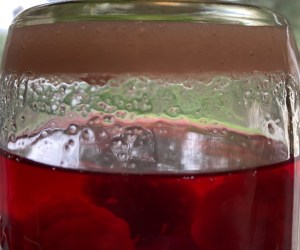
About half the sugar still solid last week has dissolved. The color has remained about as red, though the majority of the berries are now white.

Week Three Check In (minus one day) – the recipe does recommend one month minimum to infuse, so I’ve got another eight days to go before it’s ‘officially’ ready:
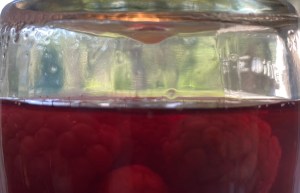
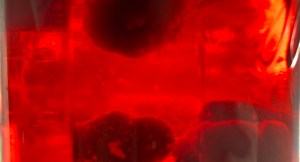
All of the sugar has been dissolved. The color has remained consistent – but look at the sun shining through! 😀

Now to finish reading the series. 🙂

Why Stories Matter

From my work with UntitledTown (so “last year” was actually several years ago by now):

Last year, I was given the task to write about why poetry matters, and it paralyzed me – because how does one put into words why poetry matters. As a writer, this frustrated me to no end. Words are supposedly my thing, after all. It took some time – and some reaching out to other poets – but I eventually found a way. So this year, I actually requested the opportunity to write about why stories matter. While poetry has become an important part of my life, stories have always been there.

You see, I grew up knowing the importance of stories, and I credit this knowledge to my maternal grandfather, my papa. Papa was the best storyteller I’ve ever known. He could take a single moment and turn it into an hour-long story – and we would all sit there with rapt attention. It’s been over a decade since I was able to last hear the story of his hole-in-one – but I can still tell you the exact blue of the sky – probably right down to its pantone number.

And though my father would never admit it, he is a storyteller, too. Thanks to him, I know what it was like to watch the Beatles live in concert, to travel the U.S. on the back of a motorcycle, and all the ways I am like his mother, a woman I never had the chance to meet.

Stories are escapeThey are magic.

I grew up on the opposite end of the block from my neighborhood’s public elementary school. Every week, I could be spotted with my arms full of books headed towards the school where the city bookmobile parked. I’d trade that pile of books for another and make my way back home – where I would blow through the entire stack before the day was over. I was a voracious reader because it allowed me to not only escape to places all around the world and meet all kinds of people, but also because it allowed me to escape from. No matter what was happening in my life, I had these portals to walk through.

My dear friend Laura Chiavini echoed these sentiments, noting that “stories matter to me because they transport me to other places, other times, other cultures, and inside other minds. When I open a book, I walk around in another’s shoes for a few hundred pages and learn something about people and about myself. The experience always changes me.”

My friend and fellow writer Jack Lelko says, “Stories matter to me because they’re an extension of what it means to be human. They’re able to touch a part of the human soul or the human psyche that nothing else can reach.”

The older we get, the less we tend to believe in magic – but that is what exactly stories are: real life magic.

And they matter for so many reasons.

Stories have the power to change us.

“When I was eight,” Laura recalls, “I saw a hard bound copy of Anna Sewell’s Black Beauty in the dime store, and I loved the drawing of Beauty’s face on the cover. Being horse-crazy, I asked for it for Christmas, and I got it. I traced the horse’s head for many days and then finally cracked the book open to read it. I was no longer in my little Illinois working-class town. I was in the streets of London with Beauty. I cried so hard I could not read the words on the page when Ginger died (a passage that still can make me cry). I smiled when Merrylegs was in the shady paddock with all the other horses. I was thrilled when Beauty’s old groom was reunited with her in the end. I read it about five times back to back. And then I wondered if there were other books that could make me feel so deeply. Joyfully, I discovered there were. I got a library card that spring. I have never been the same.”

Stories are lifeline

Confession time – when I was in high school, I snuck a book out of my school’s library without checking it out. I still feel guilty about it to this day – but I did it because I was in search of myself, and I was afraid of admitting it. Especially to the circulation desk. But back then, in a time before smartphones with a ready-made community at my finger tips, when the internet was just getting its start, and I was coming of age in a very tiny town, it was in books where I found others who were like me. And despite having easy access to the internet these days, it is still in books where many of us continue to look for our ever changing selves.

Stories are empowerment.

On June 16, 2014, I was aboard a plane headed for Africa. I was thirty-one and on my way out of the country for my first time. Ever. Four months previous to this, I had seen the end of an eight and a half year relationship – meaning I was single for the first time since my early twenties. The irony that I was headed to a small school for girls to teach the importance of telling their stories with their own voices when I was just learning that I had no idea what I even wanted my story to be was not lost on me. But the three weeks I spent there, with some of the hardest working students I have ever met, taught me more about the importance of my own voice than any other experience in my life thus far. Some of these women had already fought harder just to get an education than most people will ever have to fight in their entire lives. And they jumped at the opportunity to tell their stories in order to help other young women have access to education. They were able to opt into publishing their story in a collection that would then raise money for scholarships to the school

because the best part about loving stories? Getting to share them.

A few years ago, my two-year-old nephew saw me reading – he grabbed a book, opened it up, and stared down the page – in perfect imitation of me. I remember thinking – if he learns nothing else from his auntie, let him learn to love stories. And in the couple years since, I’ve been astounded at the stories this little boy comes up with. Some may call what he does fibbing – I call it imagination. 🙂

And just last December, I sat on my sister’s couch snuggled up with my tiny nephew, and I listened as he read. I can honestly say that no matter how long I live, this moment will forever remain one of my absolute favorite memories.

Blake Bley, my nephew – imitating me
Blakey Bley, my nephew – reading to me for the first time

Clue Path

As I’ve mentioned a few times on here, when I decided to finally start writing up the murder mystery I’d been thinking about, I started watching all my favorite detective procedurals as research. Fun research. 😉 But research, nonetheless.

One particular show gave me an idea for one of the murders that occurs within the book – one of the fake overdoses. I was watching an episode of Rizzoli and Isles, specifically episode nine of the third season titled “Hometown Glory.” In the episode, a young woman is dead by what looks like an overdose, specifically from crack. Maura (the show’s medical examiner) notes that the woman’s lips are burned from the crack pipe. For some reason, this detail caught my attention.

Next thing I knew, I was watching a video on YouTube called Antemortem vs Postmortem Burns – Forensic Medicine (FMT) – I wanted to know if you could tell the difference between a burn to the skin that happened before death or after death – and, according to this video (by a medical practitioner), it is.

Enter: woman’s death.

Because she appeared to be an overdose, the details of the burn on her lips were overlooked. Moz, however, notices.

I then fell down a rabbit hole of articles all about antemortem (occurring before death) and postmortem (occurring after death) burns and the effects on skin. Writing sure is a weird job sometimes. 🙂

Ancestors

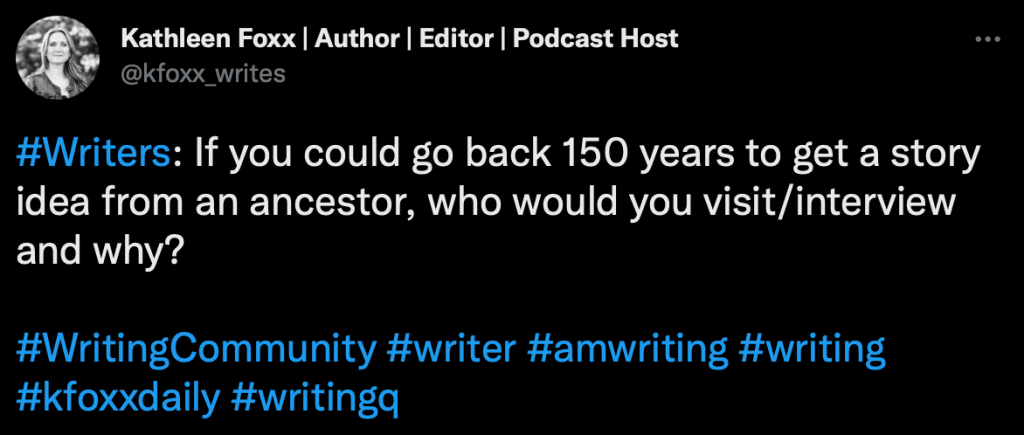
One of the best things I’ve done is to follow Kathleen Foxx on Twitter. For many reasons – great resources, great advice, her podcast (Badass Writers) – but also her question of the day. 🙂

A lot of the questions are geared toward writing – questions about our main characters or setting, other pieces of our stories. The questions often make me think about things I likely wouldn’t have otherwise. I’ve even realized similarities between my manuscripts (like how I’ve got two important characters in separate stories that are caterers and one in a third story that is a café owner – I certainly hadn’t gone into writing intending so many characters to be centered around food).

The questions aren’t always focused on our writing, though – and those can be just as interesting. Take this question for example:

This gave me pause. Without the time requirement, I would have said my maternal great-grandmother. I knew her as a kid, in the way kids know their elders – not all that well. I knew she had knit my baby blanket (and later would learn she did so while recovering from breast cancer surgery). I knew she could out-polka all of the men in my family (she was American-born to parents who had grown up in Poland). I knew how much she liked it when we’d pick her up from her assisted living facility and take her for ice cream. I was seven when she died, and I would love the opportunity to sit down with her when she was around my age now so that we could have a conversation as adults. But she wasn’t alive yet 150 years ago.

Depending which branch of my family tree you follow, I am anywhere from a fourth to a sixth generation U.S. citizen. An IL, U.S., citizen at that – my ancestors all made a beeline for the city of Chicago (though one came by way of Canada to Iowa to Chicago). Even so, 150 years ago, most of my ancestors probably didn’t speak English. At least not well. My best chance would be my great-great-great grandmother Bridgette Dignan who was born in Ireland and eventually moved to Chicago (and married that Canadian/Iowan ancestor). She would have been twelve 150 years ago.

I realize how lucky I am to know where my family was 150 years ago and, on some branches, further back. I also feel lucky to have had someone on both sides of my family that was interested in ancestry and did the work to gather all this information into the two books I have sitting on my shelf – so that I could just roll over and check who was around 150 years ago.

So now I turn the (amended) question over to you – is there a relative of yours from the last 150 years who is no longer around that you’d like to sit and have a conversation with?

A Story A Day: Month Eight

For this month, I chose stories from Missouri Review’s selected prose. As with the previous seven months, I have no idea what these stories are about – the goal is simply to experience new writing. Feel free to read along!

  1. Way Back, Well Before My Divorce” by Adam Prince
  2. Manifold Northeast Life & Trust” by Cat Powell
  3. Heart-Scalded” by Daphne Kalotay
  4. Keeping” by Thomas Dodson
  5. Bewilderness” by Karen Tucker
  6. If You’re So Smart” by Tim Loc
  7. Triumph” by Sahar Mustafah
  8. Wait for Me” by Katey Schultz
  9. A Cruel Gap-Toothed Boy” by Matthew Baker
  10. Chrome Thief” by Terrance Manning Jr.
  11. Treading Water” by Dionne Irving
  12. Café Misfit” by Dave Zoby
  13. The blood was the mountain and the mountain was the bear” by Rachel Yoder
  14. Exit Seekers” by Tamara Titus  
  15. Helpline” by John Hale
  16. Rachel’s Wedding” by Rose Smith
  17. Ronaldo” by Andrew D. Cohen
  18. The Wall” by Emma Törza
  19. The City of the Dead” by Jennifer Dubois
  20. Unintended” by Yuko Sakata
  21. Swarf” by Tyler Keevil
  22. Serpentine” by Ember Johnson
  23. Ordinary Time” by Carolyn Ogburn
  24. Salt Land” by Amanda Baldeneaux
  25. Relatable Influence” by Bradley Bazzle
  26. Awakening to Jake” by Jillian Weiss
  27. Deadwood Soldiers Take a Cruise!” by Jonny Diamond
  28. Joy” by John J. Clayton
  29. A Shapeless Thief” by Marin Sardy
  30. Afternoon with a Corpse” by Gulchin A. Ergun
  31. Book of the Generations” by Kelli Jo Ford


Moments of Character

For the last few months, I’ve been rewatching some of my favorite detective procedurals as “research” for the mystery I am working on. (I use the air quotes around research because it’s also just because I enjoy them.) At the moment, I’m working my way through Bones, and I love the bits of character development that come in the small moments.

For those of you who have never seen the show, Cam joins the show in the second season. She takes over for the previous head of the Forensics division; previously a coroner, she works with the flesh. Now, Cam is not even my favorite character (and I mean no disrespect to the actress, who is fabulous). Angela, Hodgins, and Sweets are my top three. But there are moments where Cam is just so…human? Funny? Relatable? That I can’t help but admire the writing.

Because Cam is, essentially, the regular duck in a pond of geniuses, she’s often the one most viewers, me included, can relate to easily. I’ve lost track of how many times I’ve watched this series, but this moment still gets me every time:

  • ANGELA: Then, I’ll recalibrate and get a digital rendering of the bones inside, which I can enhance. 
  • DAISY: You’ve found out how to show what bone damage came from the actual crushing of the car. 
  • ANGELA: Factoring in the pounds per square inch of force exerted by the car crusher. 
  • DAISY: Oh, I hope you’ve included the car’s frame and the tensile strength of the v*ctim’s skeletal structure. 
  • ANGELA: I’ll make a note. 
  • CAM: Well, I programmed my phone to get the five-day forecast.

One of her funniest moments, though, is when Booth is beating up a hockey player for playing dirty and taking hits on his guys: 

  • BRENNAN: I do not know how I feel about this. 
  • SWEETS: It’s very primal. 
  • CAM: I like it. Just a little too much.

Probably my favorite moment of Cam’s, the one I relate to the most, is when a body is brought in and suddenly erupts in tiny spiders (I’m incredibly arachnophobic). Hodgins explains that the cold clay that encased the body held the spider eggs, and the heat in the lab caused them to hatch. For the entirety of this scene, Cam is clearly uncomfortable. She’s scratching, she’s taking steps back.

  • HODGINS: These bad boys are Frontinella communis; they’re non-poisonous. 
  • CAM: Yeah, still with those gross spider faces and legs, though… 
  • HODGINS: This spider’s not found in the area where the body was discovered. 
  • CAM: (scratching) Any idea how to…uh…remove the body from the sediment? 
  • HODGINS: Well, I mean, if we remove the moisture from the clay, then it should just fall away without affecting the bones, at all. I just need four dehumidifiers. (notices CAM scratching) You okay, there, Dr. Saroyan? 
  • CAM: Yeah, I’m just…itchy all over. I’m gonna go burn all of these clothes. And maybe my hair.

I always tell my students that good writers are good readers/consumers. When we find something that works for us in what we are reading (or watching or listening to), pay attention. Then figure out how they did it so that we can create such moments in our own work. These are such small moments, but they reveal so much of the character.

Book Covers

I went down a rabbit hole recently. A Canva book cover design rabbit hole. I’ve decided that I want to self-publish my second manuscript (for a few reasons I’ll chat about in another post some time), and I was goofing around with covers. I played around with some of the templates, and then I went rogue. (Well, as rogue as one can go with a free account.)

I follow this wonderful artist on Instagram, Pascal Campion, and back in December of this last year, he reposted a drawing of his that at first glance I thought – that’s Lucy and Ciro! (Lucy is the main character of the book, and Ciro is her little brother.) I know there is no way I could afford to use this image, though – assuming he’d even be open to it.

As I continued to reimagine the cover, I still had this view of a wrap around, dark blue sky filled with stars. This one specifically comes from an edited template – me just trying to get my feet wet. I liked the colors…the concept not so much. I tried a few things with this background, but I couldn’t get anything to work the way I wanted. (This will come back around.)

This was a random sharp right curve away from my original idea because I was so frustrated and just needed to try something different. I didn’t hate it – I like the simplicity of it. But I was frustrated that I couldn’t really edit the silhouettes of the figures. It would require me creating brand new ones. So I moved on.

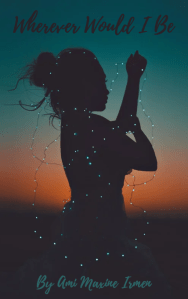
Then I stumbled upon this image, and I liked it. I liked the colors, I liked the figure, I liked the stance, and I liked the lights (though I wish I could erase the string between them to give the lights a bit more of a firefly feel (which play a prominent part in the story). But no go. I’d have to recreate it, which wasn’t the easiest thing to attempt.

But I did attempt it. [face palm] I ended up recreating the gradient using the highly sophisticated design program called PowerPoint. Maybe you’ve heard of it. [strained smile] Use what you got, am I right? I toned down the brightness of the colors a bit, and then I went on a looooong search for a figure to come even remotely close to the original image. No go. Also, every single firefly feature is part of the pro/paid Canva (I’m not saying they don’t deserve money – just that I’m not at a point where the money is worth it – I’m just goofing around). Then I saw this figure – the young woman on a swing (there’s another important story of her on a swing as a kid). Then I started playing around with stars and yellow glows and on and on and on. I still wasn’t fully happy with the background, so I swapped it with the stars again.

Like I said, I came back to them. [another face palm] I still couldn’t get it to be what I saw in my head (going to need access to a professional design program for that, which I don’t have on my laptop at home). I went to make one more attempt, another attempt, and so I deleted the background…and then I had another idea.

I actually really like where I ended up. Not sure if this will be it (or a fixed up version of it).

Overall, this was a fun exercise. (There are even a few other designs I created that I didn’t share here.) But now I need someone to come and take Canva away from me…

More Adventures in Homeownership

Sometimes, life throws a tree at you. With the help of a wicked storm, of course. Other times, life throws a second tree at you with the help of…seemingly nothing. Last week, Friday, I woke up and, without my glasses, noticed something in my backyard – something with lots of leaves that wasn’t there yesterday. It had rained most of the night, was raining still – but a gentle rain. A good soaking rain (we got over an inch) without showy thunder or epic winds.

I figured a branch broken in the previous storm just finally wiggled itself loose, and I readied myself to drag the thing around to the front yard for the pickup crew to turn into woodchips.

But then I put on my glasses and got (what I thought) was the whole picture – and then it became that I would hopefully be able to drag it. So I got dressed and put on my boots and went to explore…

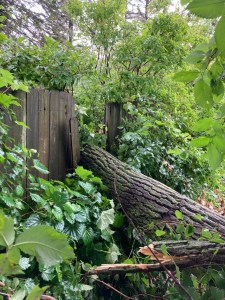
Folks, I will not be dragging the FULL TREE that has demolished a section of my fence (missing my shed by about a foot) and is taking up about a fifth of my backyard with it’s branches (I didn’t get the full view until I walked around to my neighbor’s side of the fence – pictured here; it’s their tree that fell). Most of the people in my life are already laughing over the likelihood of TWO trees even in a year – let alone the second one falling before the mess of the first is even fully cleaned up. I’m not laughing. Yet. You see – I love Mother Nature. And in return, she makes me sneezy and topples trees onto my things. This has become a rather expensive relationship.

A New Word

There are many odd things that a writer can learn when working on a story. In most cases, the learning is probably intentional – research for something specific that occurs in or relates to their plot or characters or setting.

In some instances, that odd thing is a word they’d never heard of before. Today, I learned one such word as I was editing a chapter. (When I sit down to start writing, I reread/edit the chapter or section that came before the scene or summary I am about to write – I find this helps me not only add in words or details that I hadn’t thought of during my last writing session, but it also helps get me into the right frame of mind for what I’m about to create.)

The word I learned today is ‘snigged.’ I stumbled across it as I was reading/editing, and my first thought was, “Why didn’t Word flag this?” My second was, “I wonder what it means – does it have anything to do with snigger?”

Well, reader, it does not have anything to do with ‘snigger’:

As my writing buddy, Jack, said, “That is a very specific word.”

A Story a Day: Month Seven

For this month, I chose to focus on Creative Nonfiction stories. As with the previous six months, I have no idea what these stories are about – the goal is simply to experience new writing. Feel free to read along!

  1. Writing Memoir and Writing for Therapy” by Tara DaPra
  2. Tell It Even More Slant” by Brenda Miller
  3. Tiny Truths” – from CNF, who “challenged writers to tell a story in a single tweet.”
  4. Introduction: On Staying at Home” by William Atkins
  5. The Steepest Places: In the Cordillera Central” by Ben Mauk
  6. Tala Zone” by Pascale Petit
  7. Confluences” by Kate Harris
  8. A Hunger” by Fran Lock
  9. The Sum of Life’s Troubles Makes a Whole Damn Dish” by Nuraliah Norasid
  10. A Series of Rooms Occupied by Ghislaine Maxwell” by Chris Dennis
  11. Confusion of Tongues” by Fernanda Melchor (Translated by Sophie Hughes)
  12. Tiki Girl” by Amanda Lee Koe
  13. The Safe Zone” from Small Bodies of Water by Nina Mingya Powles
  14. What’s in a Name?” by Victoria Princewill
  15. A Bleed of Blue” by Amy Key
  16. Bleak Midwinter” by Catherine Taylor
  17. Breast or Tooth” by Tishani Doshi
  18. On Mistaking Whales” by Bathsheba Demuth
  19. On Running” by Larissa Pham
  20. Mr Brown, Ms White and Ms Black” by Kei Miller
  21. Pipe Dream” by Joni Renee Whitworth
  22. The Geographical Cure” by JP Gritton
  23. Domestic Coffee” by Rachel Purdy
  24. The Coyote’s Dance” by Austin Gilkeson
  25. Of Floods and Ruination” by Amy Lee Scott
  26. F*ck ‘90s Nostalgia” by Vanessa Veselka
  27. Master Sauce” by Grace Hwang Lynch
  28. Her Tattoo is My Name & My Name is a Poem” by Amy Lam
  29. Punch Line” by Molly Tolsky (CW: suicide)
  30. This Truth About Chaos” by John Freeman
  31. Resident” by Elizabeth Miller-Reyes