Maybe you’re like me – you’ve got a healthy set of bookshelves back home, and you’ve got a TBR list longer than you can ever manage to complete in your lifetime. And it Just. Keeps. Growing. Maybe you’ve strolled through a bookshop, found a book you wanted to buy, but then thought…wait, do I already own this? (Yes, this has been me on more than one occasion.)
There are a lot of ways that technology has made us all a bit more lazy than we need to be. But then there are instances like this that can help us from buying a book – only to get home to shelf it and find its duplicate already sitting there. If you don’t already have an app for cataloging your shelves at home, I highly recommend checking out the link below and finding the best option for cataloging your shelves at home (some of these even have trackers for lending books):
I first became aware of the Battle of Culloden while in a Scottish Literature course in college, and the battle has cropped up in various other places over the years – in research, in art, in television and movies – and now in my book Wherever Would I Be. Thus, I thought it might be helpful for those unfamiliar with it for me to provide a bit of background of the battle.
The battle occurred on April 16, 1746, and it was the final confrontation between the Jacobites and the British. The Jacobites were led by Charles Stuart (son of the exiled James Stuart) who believed there was enough support to restore the Stuart line (meaning himself) to the throne. He raised his supporters in Scotland (known as the Jacobites) beginning in July 1745 and took Edinburgh by September of the same year.
After the Jacobites landed a victory in Falkirk, the two armies met up at Culloden for what would be the final battle, lasting only an hour. Over 1,500 Jacobites lost their lives in the bloody defeat (contrasted with only about 300 British soldiers). The leadership of the Jacobites took this moment to disperse, thereby putting an end to the uprising.
From here, the British worked to undermine the Scottish clan system, which had allowed the Jacobites to mobilize so quickly, right down to the banning of wearing tartan. A number of the surviving ranking members were tried and executed. On average, one in twenty soldiers stood trial, and almost all of them were sentenced to death; for most of the rest, they were instead transported to the British colonies as indentured servants. Once their sentences were complete, few could afford to return home.
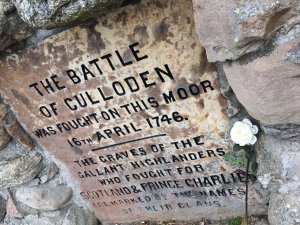
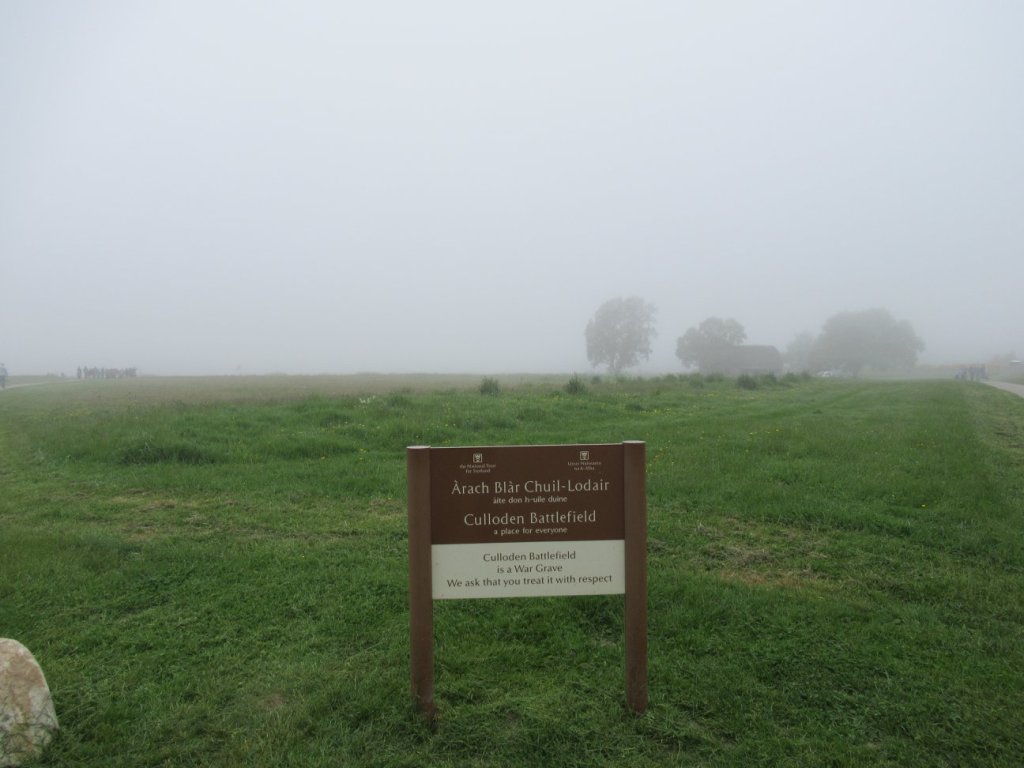
This is actually how Lucy’s ancestor came to be in the colonies – he was a Jacobite soldier who survived the battle but subsequently was tried and sent to the colonies to “serve his time.” Lucy does visit the Culloden field when she takes her trip to Scotland, as did we on our own trek. The morning we went, there was fog, which gave an extra eery sense to the grounds. After everything I learned about this battle and this field, it was something else to stand on the ground, to see the mounds where bodies were buried in mass graves, the stones set on top of them a guess at who might be buried underneath.
A few years ago, I went on a road trip through Scotland with my bestie. Dunvegan Castle was on our itinerary because this was my bestie’s ancestral home. We spent some time walking the grounds, took a seal tour (in a really tiny boat!), and then walked through the castle itself. I can only imagine the sense of history she felt knowing she was sharing a path with her ancestors. (I’ve yet to visit any of the many countries my own ancestors come from.)
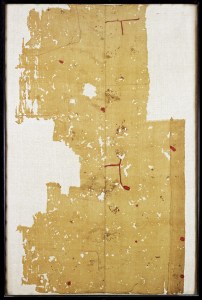
Am Bratach Sith (The Fairy Flag of Dunvegan)
One of the really neat things about this castle was the lore of the fairy flag. What is left of the flag (shown in the image to the left) is framed and hanging in the ‘fairy tower’ of the castle. The flag was woven in silk during the fourth century, and it was believed that when the flag was unfurled during battle, it would protect the clan MacCleod – they would be invincible. The magic, it is said, would only work three times, and it has thus far only been used twice. (The Dunvegan Castle website contains three possible origin stories for this flag.)
I knew early on that Lucy’s search for her birth family would land her in Scotland, but it took a little while for me to decide that she, like my bestie, would descend from this particular castle and this particular lore. I really loved playing around with magic realism, especially with it being grounded in actual lore (rather than creating my own). It’s also made me realize that even though I know where my family descends from, I don’t know much about who they were or if there might be lore like this in my own history. (As if I needed a reason to do more research… 👀)
Dunvegan Castle (taken from the tiny boat while on our seal tour)
I’m super excited for next month’s Lucy post – it’s almost cover reveal time!!
Let me preface this post by saying that I fully understand that not everyone has the time and/or the means to do so – but this is my plea post about shopping small – if you can.
I’m a big proponent of shopping local whenever I can, partly because I like to know my money is helping the people in front of me rather than being divided up into pieces, most of which will sit in a bank account of the corporate owners rather than circulating within the community.
With the holidays coming up, I would encourage you to check into the local shops in your own communities. I’ve listed some of my favorites on the Shop Small tab on the toolbar above. If you are looking for handmade art, I highly recommend checking out work by Ashley Megal, NinjaGrl, the Wondermakers, and the 35:35 Makers Collective. If you are shopping for a book lover, but you don’t have a local bookshop, check out BookShop.org.
In the comments, please share your favorite local shop (including their website if you can!).
For this month, I chose (kind of) at random stories from the Friday Flash Fiction series by Tin House, the “the singular lovechild of an eclectic literary journal and a beautiful glossy magazine” that got its start in 1999. I say ‘kind of’ because I scrolled through their list and chose any story that I came across. (This is serving two purposes – I do need some new flash fiction stories for the fiction course I teach.) As with the previous eleven months, I have no idea what these stories are about – the goal is simply to experience new writing. Feel free to read along!
It’s the Thanksgiving holiday, which means that I get a nice long weekend to…well, catch up on work. But also! Binge-watch (for the fourth…or fifth time?) what quickly became one of my most favorite shows: Ted Lasso.
I’m very much a character-driven storyteller and story consumer, so when everyone started talking about this show (a show about soccer), I ignored much of what they had to say. I’m not even sure what made me finally sit down and give it a shot – but I am so very glad that I did. This story, which, yes, is about soccer (I know, I know – football), is about so much more than that. This is by far the biggest storytelling head fake (a term I borrow from the late Rancy Pausch) I’ve ever experienced.
Between trainings and matches and jokes about how terrible Ted finds tea to be, we get to witness some really lovely character arcs for a number of these people. Some who discover who they really are. Other who reveal their true selves bit by bit – but somehow are always portrayed just as they have always been (with these new discoveries having us chime in with a “but of course!”). Some tackle mental health. Others try and figure out who they are when the one thing they’ve always identified as has been taken away. There are genuinely lovely friendships formed. And, yes, jokes.
I highly recommend checking it out if you haven’t yet (though I’ll give all kinds of advance warnings in case the f-word is a trigger for you).
I think the fact that I’m still typing away in blog format tells you all you need to know about my age and feelings on all of these new social media apps. I remember when TikTok first came around, and I said no – for the first time. Partly, I was too tired to deal with yet another social platform. But also – I’m an introvert who posts photos of her cats and niblings and books she’s read – never herself. So videos? No, thank you.
With the recent unrest over at the birdie app, though, I’ve opted to go about and claim my username on a few other platforms (including TikTok…) so that I can make sure everything continues to match. In one instance (looking at you Mastodon), it was such a struggle just to sign up that I almost threw in the towel completely. CounterSocial? Hive? I’m sure dozens of others still out there…? It’s all too much, isn’t it?
Especially when I get irrationally irritated by the ones that don’t have any web-based options, purely apps. I’m officially old. If the blog didn’t tip you off, the want of a full keyboard and a large screen surely should. (*shakes fist in ‘get off my lawn’*)
So why do it? Why bother? Because I’ve come to really enjoy the writing community on Twitter, and I want to make sure I can join them if the birdie officials flees the nest. How are you all doing with these new social media apps? If you want to come find me, I’m @ByAmiMaxine (on Twitter, Instagram, TikTok, CounterSocial, and Hive) (with the addition of @writing.exchange for Mastodon). Goodness…ten years ago, most of that last sentence would be complete gibberish…
Sometimes when I feel bad about a first draft I like to think about this behind-the-scenes sketch of the facehugger from Alien pic.twitter.com/5fVckkpmmV
When writing Wherever Would I Be, it was really important to me that Lucy’s adopted family be loving and as trauma-free as an adopted family could be. This family was to be a safe haven for these children.
Lucy’s father, Luca, was a foster child himself, bounced around from home to terrible home before he was finally adopted by Grandma Fran (who is named for my own adopted grandmother – a woman who showed me SO MUCH love and support, especially in times when others told me not to expect her to). In the story, Grandma Fran believed that kids needed to be kids – and in order to do that, they needed love, safety, and support. And that is exactly what she gave to Luca. Because of this, it’s always been Luca’s wish to pay that forward. Luca is a social worker; his wife, Donna, is a professor at the University of Chicago (where the two met as students). Together, they create a big, beautiful family.
Along with Lucy, four other children have joined this family before we get to page one of the story. Lucy is the first adopted – but not the oldest. Her first sibling is an older brother (Terrence). For a while, it’s just the two of them, and they are kindred spirits. Three years before the story begins, the family adopts a set of five-year-old fraternal twins (Samuel and Marie). And then a year before the story begins, the fifth child is adopted at age seven (Ciro) – so when the story starts, he is still feeling his way into this world, learning to trust it.
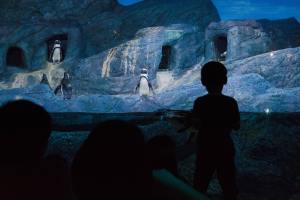
Ciro laughing at the penguin sneezing. Image, Unsplash, Duangphorn Wiriya
Unlike Lucy, all of her siblings know their birth families and the situations from which they were adopted. Because of their previous experiences (abuse, trauma, neglect), Lucy can’t help but wonder if it is indeed best that she doesn’t know where she comes from. (But, of course, she can’t help but be curious.)
I once had the extreme privilege of co-directing a study abroad to Costa Rica in 2015 (I had to look up the date, and my jaw fell at the realization this trip was that long ago!). I had always wanted to do a study abroad, but I didn’t have the money or the time in my undergrad schedule to do it. So when my colleague recommended I apply for the open position, I jumped at it. – and I am so very glad I did. My time in Costa Rica was so lovely. The people were so kind. The food (and fresh fruit juice) was beyond delicious. The students I was helping to oversee aided in some really important growth for myself. (I say that with a chuckle.)
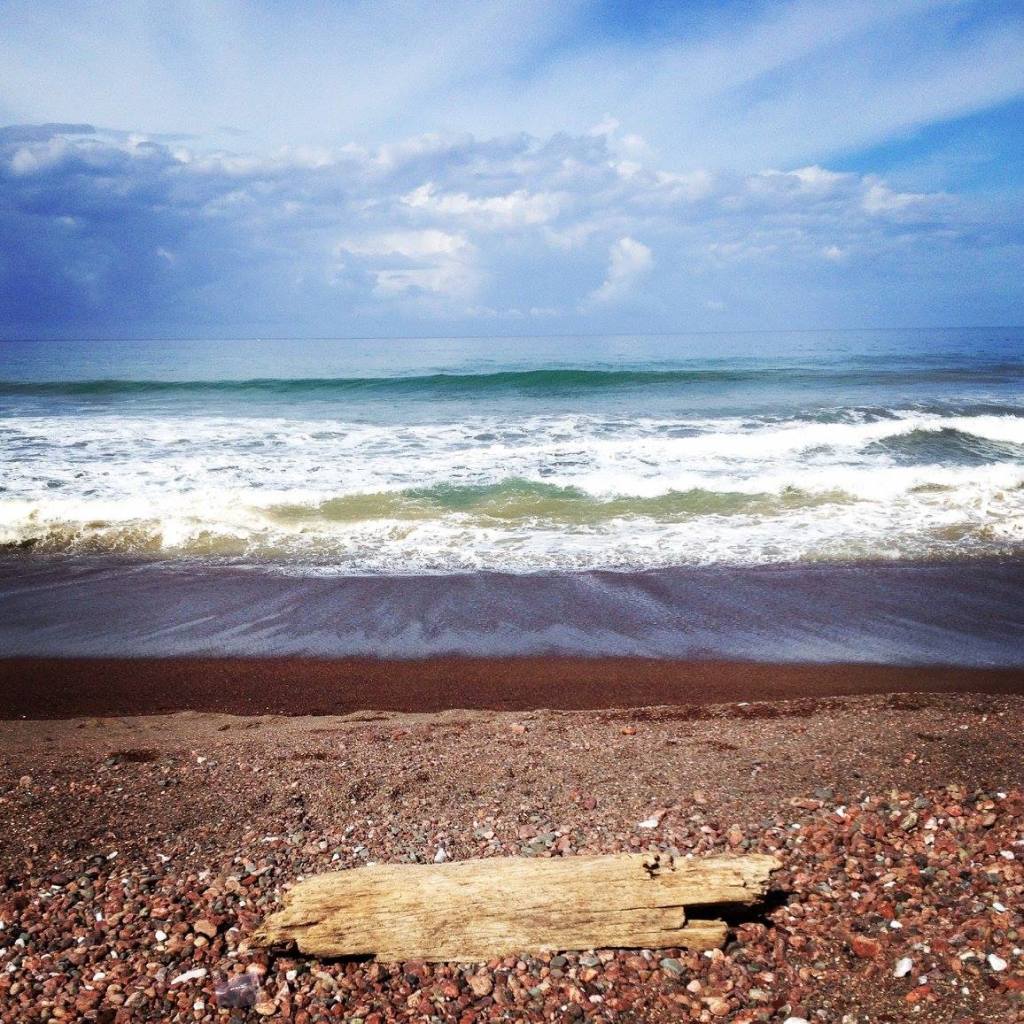
And the country was ridiculously beautiful.
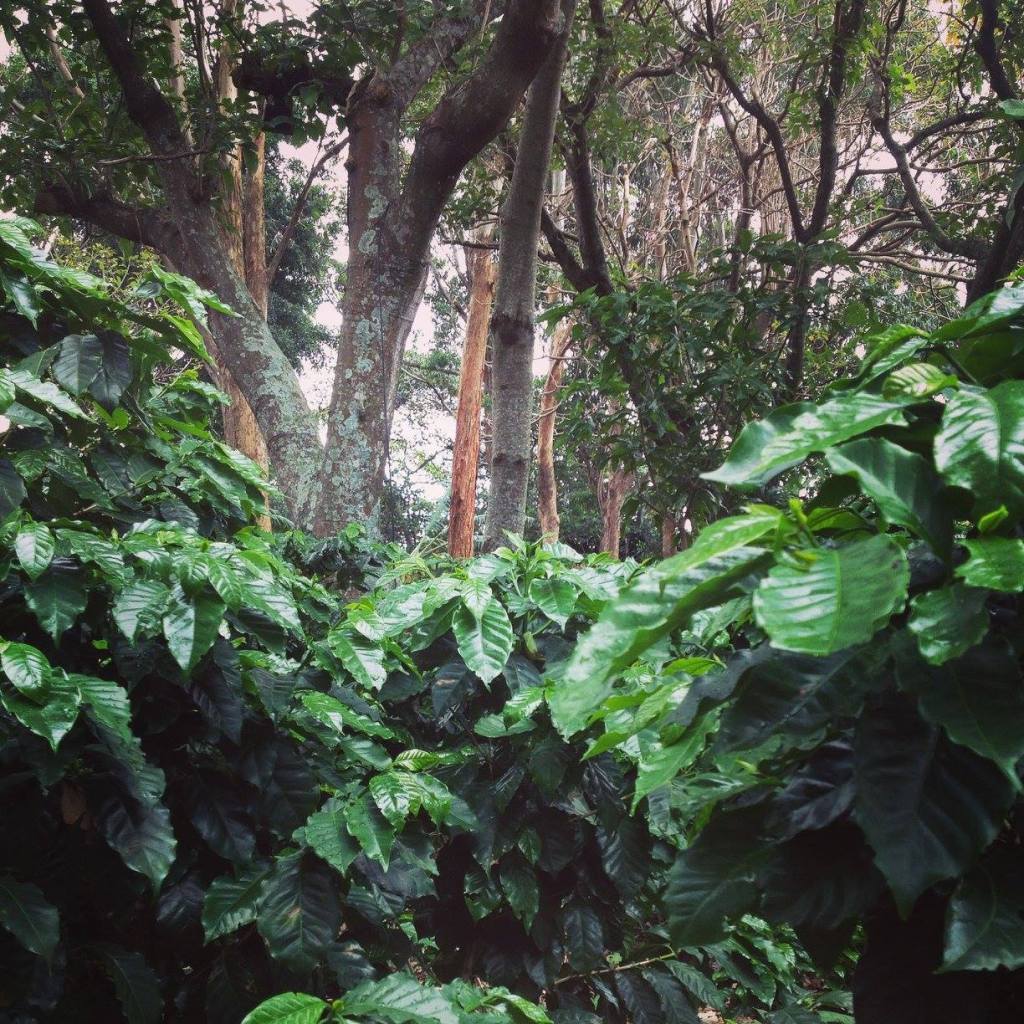
Costa Rica is where I learned to love coffee after thirty-two years of despising it. (Apparently, I just don’t like crappy coffee.)
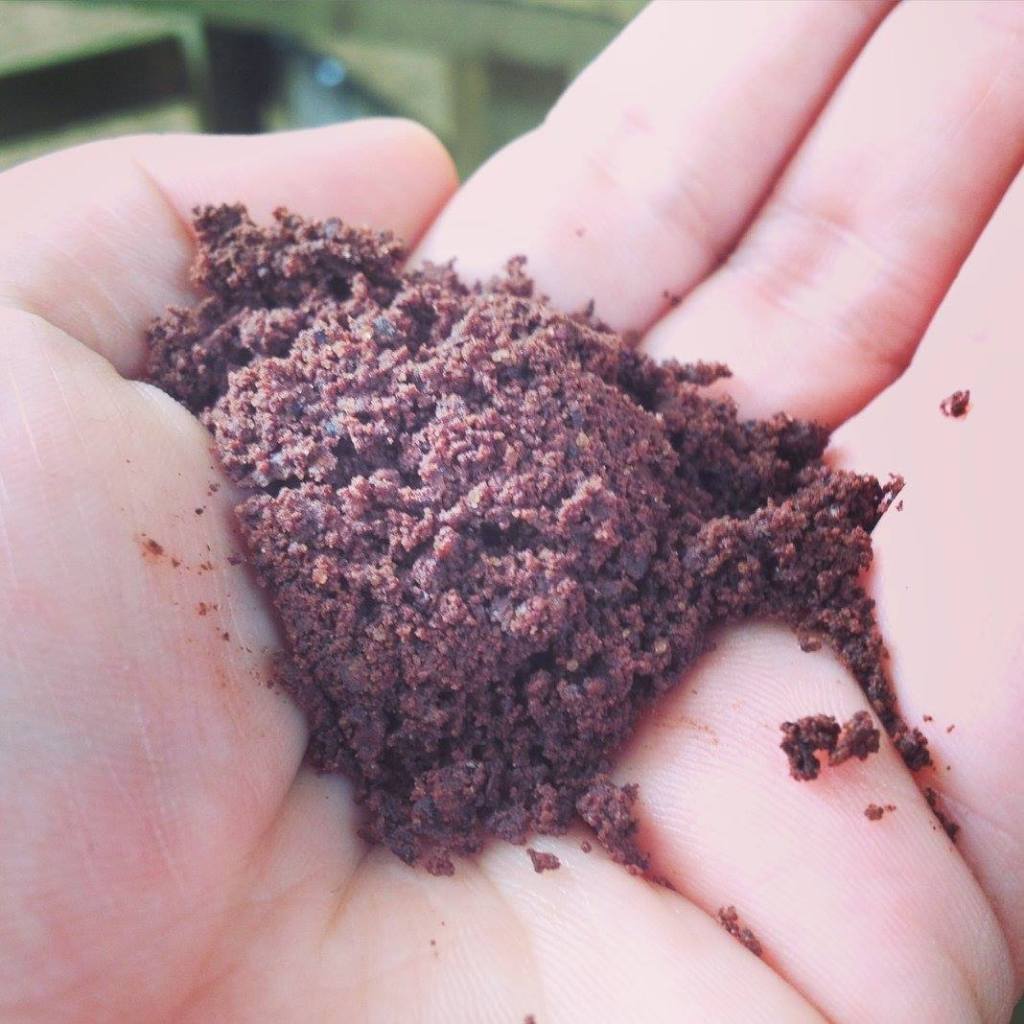
Costa Rica is where I had the most delicious handful of chocolate that I ever had in my entire life.
And Costa Rica is where I held a hummingbird for the first time.
As a kid, I believed the myth that these birds never stopped moving unless they were sleeping. But then I saw one land on the hand of a young gentleman nearby – and I had to give it try. Sure enough, this little birdie took the opportunity to rest its wings while eating – which was also the moment I learned about the hummingbirds’ incredibly long little tongues.
One of the students saw me do this and came over to the feeder wanting to give it a try. She held her hand up, as still as could be, and when one of the hummingbirds landed on her, she exclaimed, “I’m a Disney Princess!”
Recently, a friend of mine shared this video on Facebook, which got me reminiscing. These are such interesting little creatures – and these shots of them are spectacular. I recommend checking out this video from National Geographic Magazine:








 Ami Maxine