Then she blinked again, harder this time, certain that her eyes were playing a trick on her. But there he sat.
The man, seated behind a worn, dark walnut writer’s desk with thin, hand-carved legs, wore a chocolate brown dress jacket with a high collar and small puffs on top of his shoulders – the likes of which Lucy had never seen outside of a history book or museum. A line of golden buttons started beneath each shoulder and veered inward, meeting high on his waist and giving the illusion of broad shoulders and slim hips. Though when the man stood up, the illusion proved unnecessary. His light brown, high-waisted trousers, dotted and smeared with black ink from the fountain pen he held, accentuated his long legs. His eye-catching, out-of-place clothing hadn’t stopped Lucy in her tracks – but rather how she could clearly see the patterned wallpaper directly behind him.
She blinked once more, attempting to clear her eyes of whatever distorted her vision. Surely the man before her was not actually translucent. Surely this was some sort of trick of light.
He lifted the paper he had been writing on and carried it closer to the window to allow the sunlight to fall directly on it.
Through it?
He squinted at his work before giving a quick nod and returning to his seat.
Lucy reached her fingers up to her own hair, the curl and the auburn color with copper highlights almost a perfect match to the man’s.
Something felt familiar about him, which prompted her to take a step to her right, to stand within the frame of the door despite her heart racing as she did, begging her to flee. Something told her she didn’t need to be afraid of him, something more than their resemblance, but she couldn’t place it. She opened her mouth to speak.
“Lucy? Where’d you wander off to?”
Lucy peered over her shoulder at the sound of her boss’s voice, blood rushing to her cheeks, embarrassed that the man certainly heard and caught her intruding. When she turned back, however, the man had vanished, nothing in the sunlight but the dust hanging in the air.
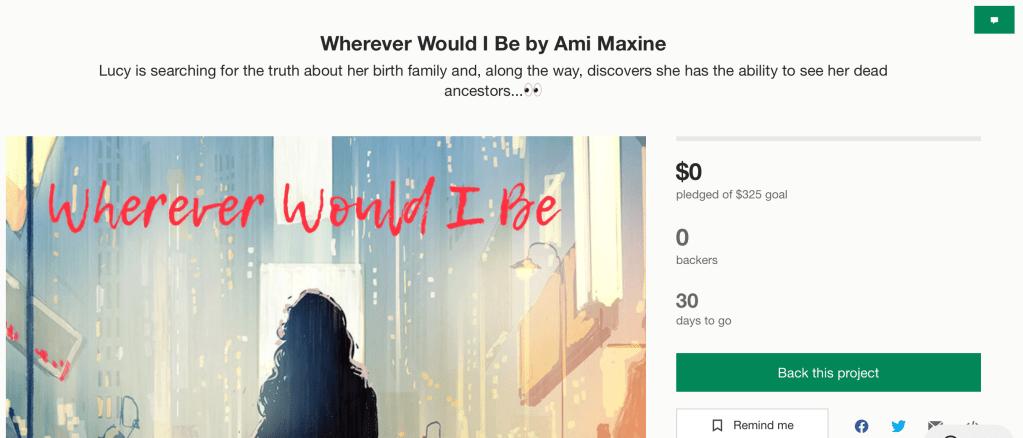
I’m not playing when I say that I went into this assuming that I’d have to “back” myself in order to make up the different to get to the initial minimum goal – so perhaps you can imagine my (genuine) shock when the project reach the minimum goal one minute shy of four hours from the launch… We still have twenty-nine and a half days to go.
Most of the backers are folks I know – and I appreciate each and every one of you who have pledged. It means so much that my friends want to be a part of this journey. (It also terrifies me to think about any of you actually reading the book. Hello, imposter syndrome, my old friend).
A couple of the pledges are from folks I don’t know, and it probably sounds strange, but it feels validating. Someone wants a copy of this story – and not only because they know me. (Not saying my friends don’t want to read the story, too…)
Legitimately just trying to wrap my head around this. Six hours in, and sitting at 124% backed. ❤
Today is the day! My Kickstarter is live. Part of the process of creating the campaign is the “story” and rewards – I thought I’d share them here:
WHEREVER WOULD I BE
Hi. I’m Ami Maxine, a writer of quiet stories. I love to explore the way in which people form and maintain all kinds of relationships, which translates into a love of consuming and writing character-driven stories.
Wherever Would I Be (new adult) is my second novel. I’m opting to self-publish partly for the experience, partly for the control over the project. My debut novel is being published with Scarsdale Publishing, and while I wait for edits, I’ve turned my attention to Lucy.
This is a story about family and identity – about a young woman who loves the family she has, and who at the same time can’t help but wonder about the family she lost. Her life takes an unexpected turn when she stumbles upon an imprint (like a ghost – but not) of what turns out to be her long-ago dead ancestor. She makes the choice to follow this thread, and she is sent down a path that will lead her to everything she has ever wanted to know about her birth family – and some things she didn’t.
WHY YOU SHOULD BACK THISPROJECT
Well, if this sounds like a book you might like to read, then the answer is you will get the book a month before it launches. If you know me, and you were going to buy it anyway, again, you’ll get it early – but you’ll also get the warm fuzzies for helping me fund the most perfect cover this book could ever have. 🙂 Plus, if you opt to add them on, you can receive some Lucy swag that won’t be available anywhere else.
THE COVER
I’ve been following Pascal Campion on Instagram ever since my writing buddy, Jack, first brought him to my attention in 2015. I love his style – the way he creates layers and uses light (which is, coincidentally, a theme in this story). And one day, he posted an image that made me think – that’s Lucy! After spending a long time assuming I’d never in a million years be able to use said image as a cover (including attempts of trying to contact Campion through Instagram), my writing group convinced me to try and find an alternate route of contact…and here we are. I encourage you to check out his work.
THE REWARDS
WWIB Digital – $10USD
For this level, you’ll receive an eBook version of Wherever Would I Be (formats available: TBD (pdf, ePub, or Kindle-friendly .mobi)).
*Add ons include ‘name a character in my next book’ ($25) – see below for more information
WWIB Signed Paperback – $20USD
For this level, you’ll receive a personalized/signed paperback copy of Wherever Would I Be shipped through USPS (to U.S. only, currently – if you are elsewhere and interested in this level, please contact me for shipping cost – but just a heads up, prices start at thirty bucks just to ship to my neighbors to the north – hi, Canada!).
You can also opt to add a second signed copy for an additional $15. Get one for you – and one for a friend.
*U.S. shipping adds $5USD
*Add ons include set of three bookmarks ($5), WWIB Journal ($10), second signed copy of WWIB ($15), Name a character in my next book ($25) – see below for more information
WWIB Bookclub eBook Bundle – $50USD
For this level, you’ll receive six codes for the eBook version of Wherever Would I Be (formats available: TBD (pdf, ePub, or Kindle-friendly .mobi)).
*Add ons include ‘name a character in my next book’ ($25) – see below for more information
ADD ONS
WWIB Bookmarks – $5USD
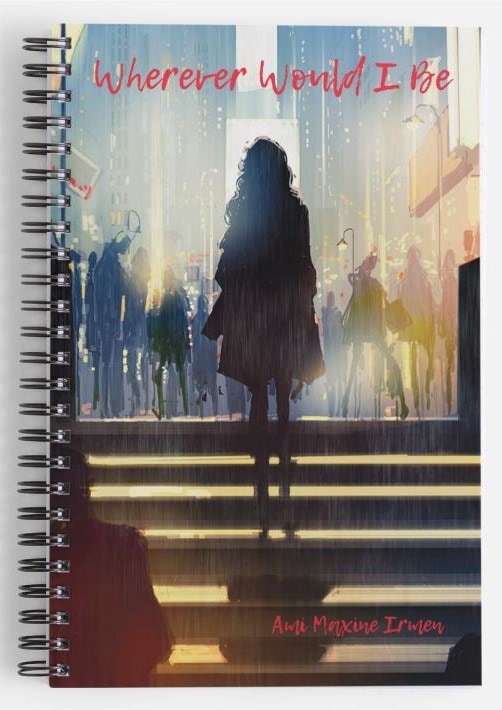
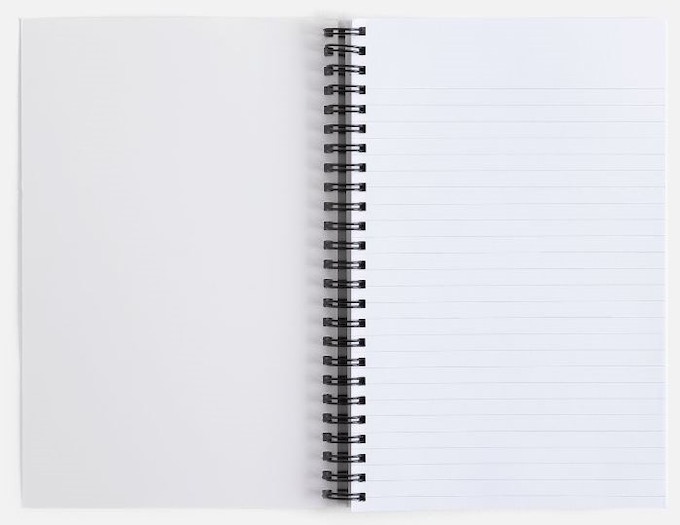
Limited Edition WWIB Journal – $10USD
Limited edition WWIB journal exclusive to this Kickstarter campaign (blank inside, 5.5×8.5, Metal spiral bound, 80 lined pages). (Unless we reach the second stretch goal, only ten of these will be available.)
Journal Cover
Inside of Journal
Onefor a Friend – $15USD
You can also opt to add a second signed copy of WWIB for an additional $15. Get one for you – and one for a friend.
Have a Character Named After You in my Next Book – $25USD
I’m currently working on a murder mystery novel (in the research stage). Add this on to your donation, and I will name one of the characters after you (and I will consult with you about it).
STRETCH GOALS
$500 – Set of Three Bookmarks
My goal for this project is to cover half of the fee to license the cover art. If we keep going and reach this goal, bookmarks all around! (If you included bookmarks as an add-on, you’ll get an extra set. Digital purchases within the U.S. will receive a set via USPS; digital purchases outside of the U.S. will receive a printable PDF.)
$750 – Capwill be removed from number of journals available
$1000 – 👀 Revealed if we reach $750
About Ami Maxine
I’m Ami Maxine. I’ve spent my entire life moving back and forth across the WI/IL border, though I currently reside in Green Bay, WI. I writes stories under the genres of Women’s Fiction, low Science Fiction/Fantasy, and Murder Mystery. I am on a quest to find the best chocolate, the best chai, and the best whiskey. You can find me here:
Risks and challenges
Generally speaking, this should be a low-risk project. The book is finished. The only risks at this point would involve supply chain.
When I made the decision to pursue using Pascal Campion’s image for my book cover, a friend floated the idea of doing a Kickstarter to help raise some of the funds for the licensing fee. I wasn’t sure how that would work (and I also didn’t know just how many folks go this route – there are so many cool projects on there!), but I sat with the idea – and instead came up with a pre-order of sorts. Specifically, a pre-order that would give early access to the book and perhaps some Lucy swag.
Which leads me to announce that I am indeed going to take a chance with Kickstarter and see what might come of it. My goal is set to raise enough (via royalties) for half of the licensing fee (though I have some stretch goals, too). The Kickstarter launches in two weeks and will run for thirty days. My goal is to launch the book in June 2023, so those that “pre-order” through this endeavor will receive the book in May 2023.
Some of the add ons include bookmarks and a journal that are exclusive to this campaign, as well as a chance to have a character named after you in my next WIP (a murder mystery). I’m a bit nervous about this – but I am remaining hopeful. I feel like this could be a really fun experience.
While it’s two weeks until the project launches, you can view it by clicking the image below:
Often, writers get to dive down fun rabbit holes of research where they get to explore the world via their keyboards or bookshelves. In some cases, though, the internet fails, and we can’t find what we’re looking for, no matter how many rabbit holes we check. When that happens, we get to take field trips (if we’re able to).
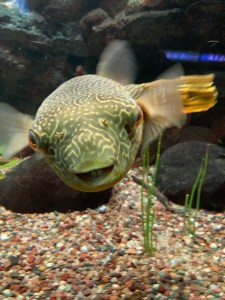
For me, I changed some rules of magic in my story, and it required me to go back and change some scenes that occur at the Shedd Aquarium in Chicago, IL (USA). I hadn’t been here in such a long time (and I do struggle with the concept of captive animals), but it was (of course) neat getting to see some of these critters up close.
I mean, how cute is this little guy muggin’ for my camera?
In addition, it does give us the chance to see things that aren’t native to our own homes.
For this visit, I needed to see areas of the facility where there would be direct sunlight, which I couldn’t really tell from pictures (aside from the bank of windows in the auditorium). I did take the time (because $$) to walk the entire facility and enjoy the experience. Overall, I had a lovely time, and I’m already thinking about other writing field trips I might be able to take… 🙂
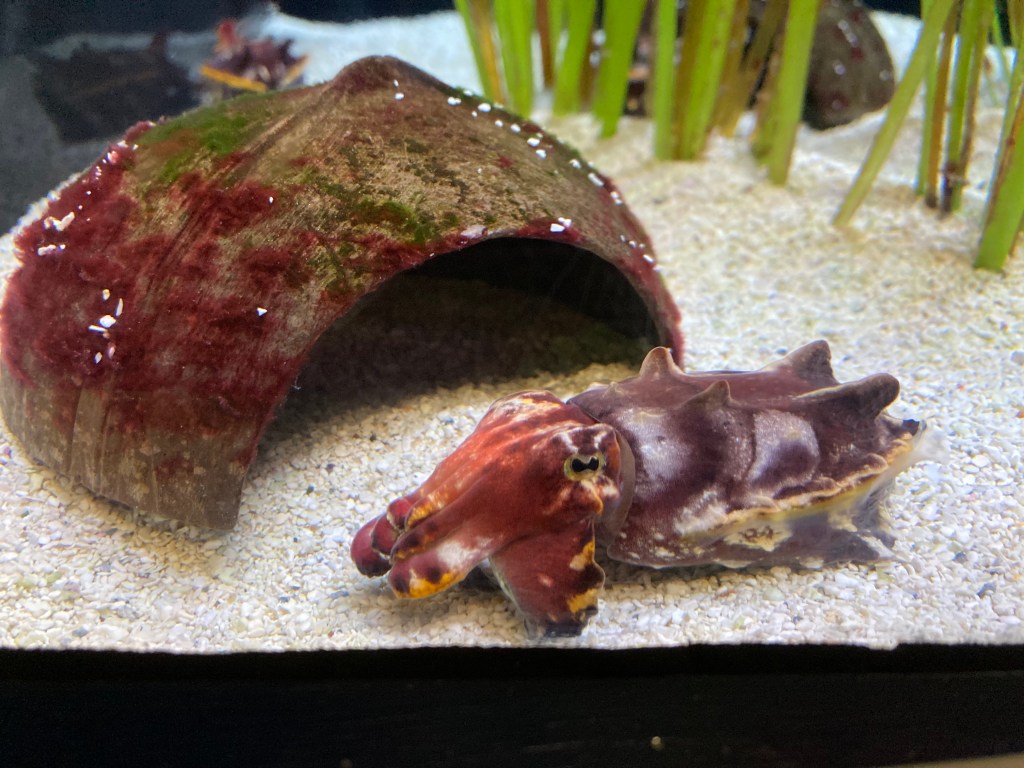
Look at this little one!! 😍 (Flamboyant Cuttlefish)
I can still vividly remember the day I sat down and started, officially, writing my first novel – I was on winter break, and I spilled out 8K words onto that digital page in one day. It was unlike any other writing experience I had ever had. I don’t know why, but this one felt different – I’d started novels before, but I’d not yet completed one. (In fact, I actually started my third novel before I wrote either the first or second one.)
Now, as I sit here with three completed manuscripts, one in progress, and one in research mode – it’s hard to remember life before I was a writer of books. Officially. I can’t help but think back to these first two stories – and what different experiences they were to write.
I know I refer to my first book as Alice’s story, but it is actually a dual narrator story – so Alice and Stanley’s stories. This one took me two years to finish writing the first completed draft. Part of this was because I didn’t know what I was doing. I hadn’t yet figured out my writing process for work of this length. But also, life got in the way a lot. My commute ate up nine hours a week. Grading ate up a rather large piece of the time pie, too. And so on and so forth. So it was two years before I got to type THE END on my first novel. I could have cried typing those words. I did it – I finally did it! I wrote a book. I was officially a writer of books. Or, you know, a writer of ‘book’, singular.
It was through this first story that I really figured out how to write a book – not just literally, but what process worked best for me. The second book was where I perfected my process for myself. The second book (and the third, actually) was written during the pandemic when I was working remotely. It’s amazing how much faster one can write a book when they aren’t driving nine hours a week. (Also amazing how much more money one has to spend on books when one isn’t filling the gas tank twice a week…)
Another significant difference between the two was how quickly I was willing to turn the manuscript over for feedback. I wasn’t quite finished when I first handed a chunk of my first story over to my writing buddy for feedback – but the section he read had been revised and edited more times than I can remember. The entire manuscript had been completed and revised and edited and polished before I even considered handing it to anyone else. With the second, I handed over a full manuscript to my entire group of beta readers that I had read through only once before. It felt a little like one of those jokes people make about parents with two kids – how the first is treated like they are made of porcelain, and then there are barely any pictures of the second child (me, I’m a second child) because it’s not like they’d never seen a child’s first steps before (I’m stretching the truth for effect – there are plenty of pics of me as a child). In this instance, though, to be fully honest, I was looking for feedback to help me fill out the story – but I think it’s telling that I was willing to hand over something that was so unfinished. (And it’s telling of how much I trusted these people. And myself.)
Alice will always be my first book – my debut. Thought at this point, it looks like Lucy might be out in the world first. Because even in publication, they are completely different experiences. Alice is with a publisher – Lucy will be self-published. And everything else? Well, those stories are on hold at the moment. This writer tried to juggle too many manuscripts all at once. Lesson learned. 🙂 (Hoping to be back in the query trenches with number three soon, though!)
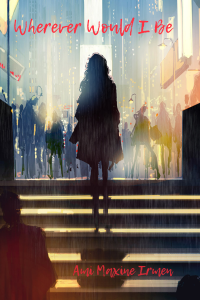
Back in July, I wrote a post about a book cover design rabbit hole I fell down in Canva. I mentioned an image by artist Pascal Campion that I really loved – one that I wished I could have as the cover of my book because it fit – the two figures (in the case of the story, sister and brother) and the fireflies. I couldn’t stop thinking about it. A few months after stumbling across this image, I found a second image of his that I also really loved – this one with a silhouette of a young girl backlit by a big city. I couldn’t help but think – that’s Lucy standing there!
Full disclosure, prior to this Canva rabbit hole, I had reached out a couple times (the last time was in April 2022) via Instagram to see if he was even open to the idea of an image of his being used as a book cover. No answer. I left it at that for a bit because I figured he’d seen the messages and just didn’t want to respond. Which is fair. I’m sure he gets plenty of questions like that in his inbox.
In June, I was encouraged by my writing group to find another route to contact him – perhaps he just didn’t look at his Instagram messages. I don’t even remember how I found that alternative route – but I did. I wrote, and I did get a response from his associate that both images were available for licensing along with the price. Ok – he absolutely deserves the price mentioned, but my initial response was – there’s no way I can pull that off. (Well, I could – it was more whether or not I “should”.)
Thus my canva rabbit hole.
But nothing I came up with left me feeling the way those two images did. I had to find a way. (More on that in an upcoming post.) Then…I had to make a decision. I played around with both images to see what a cover might look like, and ultimately, I decided on the second image. (The deciding factor was that the first felt a bit too young for the story. I still love it so very much, though. So so much.)
Today, I’m really excited to reveal the cover of my second novel with artwork by Pascal Campion:
I was the kid who knew our bookmobile driver’s name. I befriend him, and each week, we’d talk about stories. He’d bring me books I’d requested, as well as a few he thought I might like.
When we moved, I remember being disappointed in the size of our new library (we moved from a city of, at the time, around 75,000 people to a town of 187 – and no, that’s not a typo, though the population has recently hit 350). I was happy to learn, after befriending our librarian, of course, that the county libraries were all connected, and any book they didn’t have in our town, they could possibly borrow from another location. We’d go every week, my mother, my sister, and I, and we’d search the library and hang out and talk about stories with our librarian friend.
The trend of befriending librarians has continued into adulthood. I’m fortunate enough to teach at a college, which has it’s own library whose reach extends not just across the state, but the country (I see you and I thank you WorldCat). We have access to all kinds of digital databases. And we have what every library must – friendly librarians (who are, quite honestly, magical beings – I’ve inquired about some pretty out there resources, and I have yet to stump them). [Side note: They also helped me write what is still to this day the nerdiest poem title I’ve ever written – which is a Library of Congress number for a book (which doesn’t exist in real life) that I used as a metaphor within the poem.]
I make good use of my own library card at work, not just as a teacher of English, but as an avid reader. Of course, due dates become an obstacle over breaks because I live so far away from campus (like in the state next door far away) – and sometimes glitches happen. (I accidentally kept a loaned book way past its due date because the system let me “renew” it when, in reality, I wasn’t allowed to…oops…) So I opted earlier this month to get a card at my local library so that any due dates without the ability to renew would mean a short drive rather than a panic for how to get this book back across state lines.
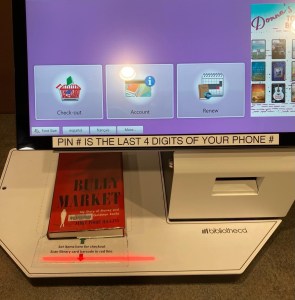
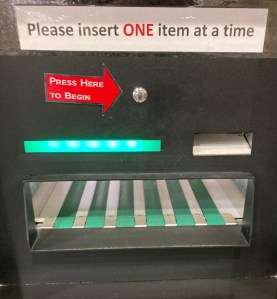
While I’ve been to several of my county’s library locations through UntitledTown, I’d not ever paid attention to the their check out/in process… (and the last time I lived in this city and utilized their services, it was done by hand). So imagine my surprise when I learned that you can complete the full spectrum of the book rental process without ever having to exchange one word with a single librarian. I can place a hold for a book online (and track them on their website – I get emails when they are available, as opposed to the arrival of a bookmobile at the end of our block or a phone call from our small town librarian). These books are lined up on a shelf with a receipt sticking out the top announcing the first three letters of my last name. I take the book, walk it over to this computer, set it where it tells me to, and then scan my library card. Voila! Who needs human contact?
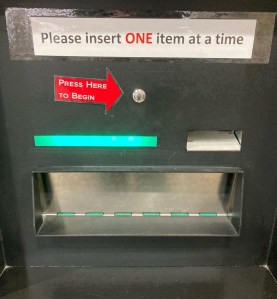
When it’s time to return it, there is this contraption. Press the button, and the little door opens to reveal a conveyor belt that sucks the book into an unknown room.
Maybe you all have been doing these things so long that you’re like, uh huh – what’s your point?
My point is – I miss the experience. I miss flipping through the card catalog. I miss saying hi to my bookmobile-driving friend. I miss getting calls that my books were ready. I miss the friendship created and maintained over a love of stories. Libraries are sacred places, and this just feels so…colorless. The magic still exists contained between the covers of a book – but it’s just not the same.
It feels like only a couple months ago when I sat down and decided that my goal for 2022 would be to a read a short story every single day. In all honesty, when I made that decision, I wasn’t fully sure I could last the whole year. Surely, I’d lose steam. Or I’d lose interest. Or I’d forget a day somewhere (and to be fair, I came close a couple times – laying in bed at night ready to go to sleep and the realization would strike, so I’d have to get up again and read through it). But here we are. It’s Dec 30, and tomorrow, I will sit down to read the final story of my challenge. I made it! *phew*
Somewhere along the way, I got curious about word count. I don’t honestly know why. I went back and started collecting the word counts for the stories to see what a grand total might be at the end of the year. Then I decided I would also (try to) collect word counts of books I read. And then – for some really unknown reason *shrugs* – I was curious about the word count of student work I’d read all year. And so I tracked.
So, after reading the story tomorrow (I’ve set an alarm to be sure I don’t forget – because I would be the person who makes it 364 days, and then misses the last one), my word count totals for the year are as follows:
Short Stories (365): 1,282,390
Books (42): 3,298,125*
Student work (Spring/Fall/Summer Semesters): 873,325
For a grand total of 5,454,140 words. I have nothing to compare this to. I have no idea if this is a lot or a little. But wow – that feels like a big number.
The shortest short story was “Proud” by Marc Littman at 100 words. (Also happened to be story #100!) (Read April 10)
The longest short story was “On Destiny” by Lee Chang-dong at 13,593 words. (Read January 21)
My favorite story from this year was “Paper Menagerie” by Ken Liu. (Assuming tomorrow’s story doesn’t knock it out of my top spot, of course – but this has been holding out as #1 since January 14.)
The shortest book I read was Write Characters Your Readers Won’t Forget by Stant Litore at (an estimated) 5,830 words. (Finished on July 20)
The longest book I read was actually a textbook (Criminal Investigation at an estimated 142,835 words), which feels like cheating – so I’m going with the next longest book, which was The Omnivore’s Dilemma by Michael Pollan at (an estimated) 134,550 words. (Finished on March 30)
*I did my best to gather word counts for books that I could find online. If I couldn’t find one (which was often the case), I took pics of a couple pages, counted the words (using copy/paste into a word doc – thank you for that feature, iPhone!) to get an average, and then multiplied that by the page count (taking out blank pages between chapters, or pages that only had a couple lines on them, or when the first page of the book didn’t start with one, etc.). In other words, this was not an exact number, but hopefully it’s close.









 Ami Maxine