Have you ever had a writer friend who talked about how sometimes it felt like they weren’t writing the story – their characters were? I know. It sounds absurd.
But sometimes – it really does feel that way.
Last week, I had rounded 80K on the first draft of my murder mystery novel, and I was getting to the point where my characters were on hot on the trail of the serial killer. I had a scene in mind where I thought they would get them – but before I started writing it, I realized it wouldn’t fit to have them there. The scene instead unfolded in a way that made more sense – and the heroes would get another chance.
Enter that next chance – what was going to be the final showdown. Only, this time, the serial killer wasn’t there by their own choice. How? I don’t know.
On a happy and somewhat related note, I did finally complete the first (very rough) draft of the novel and overshot my goal:
Even knowing how much work is ahead of me, typing those two little words felt REALLY good.
Twenty-two years ago (plus a couple months), I saw the national tour of Aida at the Weidner Center, which was located on my college’s campus. I took full advantage of the fact that my city’s performing arts center was walking distance and offered student rush tickets. I loved it so much that I went back again the next night for another performance and bought the soundtrack (the original cast recording). (I also happened to be friends with someone who worked at the Weidner who kindly nabbed one of the floor-to-ceiling vinyl posters that had hung around the center; and yes, I still have it – it’s hanging in my office. ¯\_(ツ)_/¯)
I listened to that soundtrack…I don’t even know how many times. But every time (still when I listen to it) I was utterly struck by the voice of Heather Headley, who originated the title role on Broadway (she also originated the role of Nala on The Lion King). (If you’re not a musical theater fan, you might recognize her from one of her acting roles – she was a recurring guest star on both Chicago Med and She’s Gotta Have It, not to mention currently playing Helen on Netflix’s Sweet Magnolias). There are folks who can sing (hit all the right notes at the right time for the right length), and then there are people who can SING (who can hit the notes – but can also add color and texture, who can nimbly move from note to note, who understands these things and can use them to craft more than a simple song, rather a whole experience). Heather Headley is the ladder, even when recorded. I quickly added her to my music bucket list (before I even really knew I had such a thing) – I just knew I HAD TO hear her perform in person.
I just didn’t expect it to take twenty-two years.
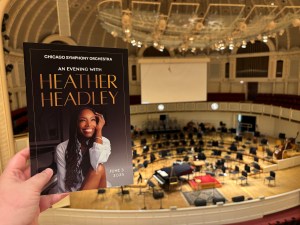
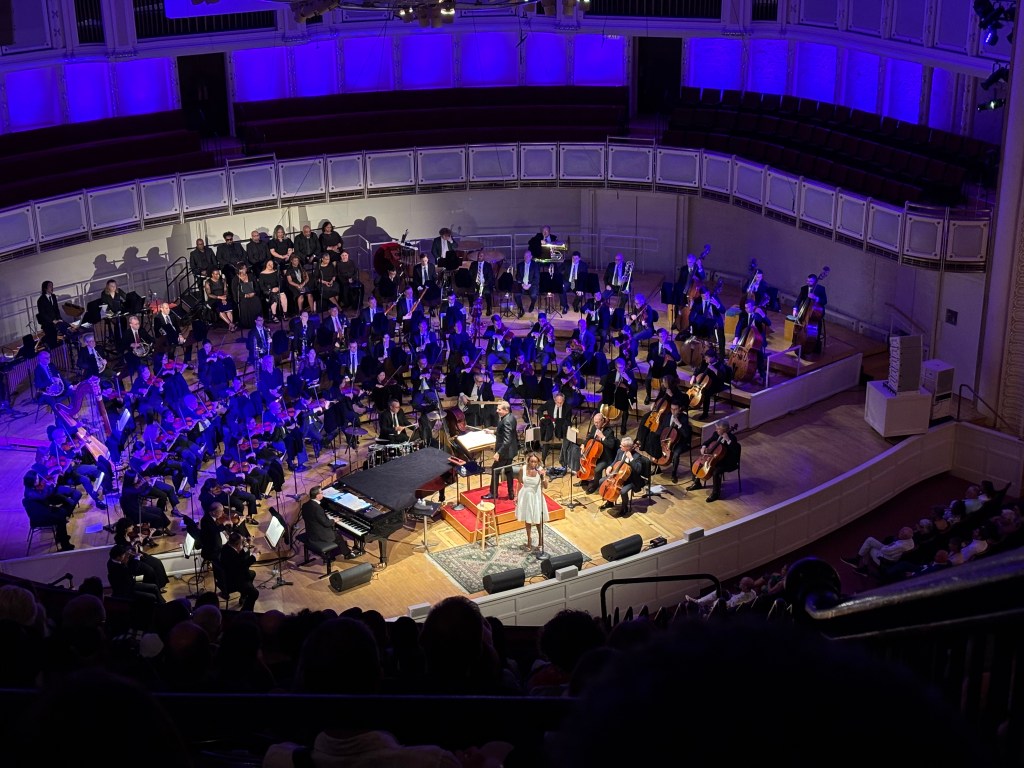
But – finally – I had the chance when she announced that she’d be singing with the Chicago Symphony Orchestra. (I know she’s sung with them before, but this was the first time the stars aligned in my favor.) Expectations were high, but no pressure, Heather!
Y’all – when I say she not only exceed but shattered my expectations…
The first song she sang was “Over the Rainbow,” which she followed up with two from Aida, and cue tears. Twenty-two years, folks. More than half my life.
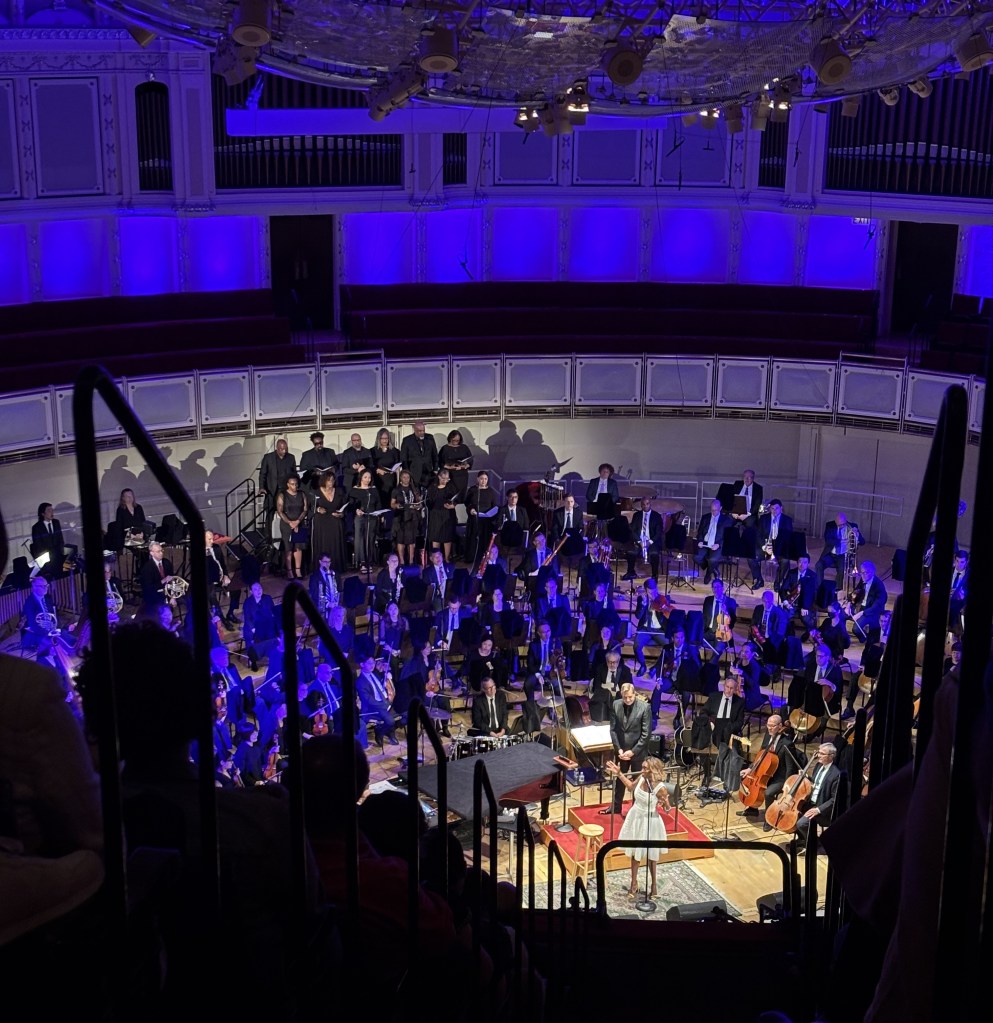
The entire night was utter magic – every single song, whether I knew them or not didn’t matter. (She was also joined for two songs by Curtis Bannister, who is currently at the Goodman in The Color Purple.) But the best part, always the best part, were the stories she told between songs. I love the little bits musicians reveal about themselves and their work during the in-betweens. And – she was funny. An utter delight.
And yes – she was backed by some of the most incredible musicians in the country in an incredibly well-built concert hall (which she demonstrated when she spoke and sang a bit unaccompanied by either the symphony or the microphone). I can understand why this venue was a bucket list one for her.
I’ll admit, this post is mostly for my own nostalgia. But a couple weeks ago (by the time this posts, more like a month), I was listening to a podcast where one of the hosts, who is also from the Chicagoland area, mentioned Woodfield Mall – which is located in Schaumburg, IL, and is the mall of my childhood. Now, this was not just any old mall. This place was one of a kind. (I know, I know – “I bet you say that to all the malls.”)
In the podcast, the host mentions that this mall was the largest under one roof (in the U.S.), and that was what I was told as a kid, too. Whether that was actually true or not at the time it was built (it opened in 1971), I can’t say for sure – but it’s definitely not anymore if it ever was. But the comment made me curious, and I may have done a deep dive – and learned even more about this place I spent so many hours as a kid. (Like, it’s currently the sixteenth largest mall under one roof in the U.S. at 2.15 million square feet. Mall of America in Minneapolis, MN, is currently the largest at 5.6 million square feet.)
There is very little I remember about the shops in this mall (though I do recall there being a Fannie Mae Chocolate shop) – it’s everything else that sticks out to me.
For one, there were fountains (and a waterfall) – which, as a kid, we of course wanted to play in. And throw coins into them. Which, people did throw in coins (and many other things they shouldn’t have), and on this mall rabbit hole, I learned that every six weeks weeks or so, the coins would be removed, dried, and packed into milk crates – which would then be picked up and cleaned (a process that took three or four days, necessary because the coins became corroded from the chlorine, and the bank wouldn’t accept them this way) and then donated. From 1993 to 2004, those coins amounted to a $100,000 donation to the United Way.
But the BEST feature of this mall? The aquarium tunnels and how when you took the glass elevator down to that level, you could see the fish through the elevator walls. My sister and I still talk about that experience, even though I honestly couldn’t tell you the last time we witnessed it – the aquariums are long gone by this time. (The waterfall and fountains are gone by now, as well.)
In my deep dive, though, I learned about the music – which I’m not sure I remember, but through the magic of the internet, I was able to find. Before the mall opened, the developers commissioned a musician by the name of Suzanne Ciani to compose music (supposedly, according to an interview she did, there had been a recent law that required new shopping centers to provide artistic enhancements to their spaces) that would play in the tunnels with the aquariums. Using a synthesizer, she composed music that mimicked the sounds of fish swimming, which would play on a loop. You can listen to it here:
Just incase the embedded video doesn’t work, you can go straight to the video here: Suzanna Ciani – Fish Music
It’s been a long time since I’ve wandered through this mall, and I’m not sure if I want to see it – I imagine it looks completely different (it went through a big renovation about twenty years ago). Some memories perhaps need to stay in childhood – but also, I doubt the new version could ever live up that 1970s vibe (which by my childhood was already over a decade old).
Description: Binti, of the Himba people, is the first of her kind to be offered a chance to attend Oomza University – which will require her traveling to another planet to study among strangers who don’t respect her or her customs. But Binti is up for the task, wanting to learn. Even if it means crossing paths with the Medusa, an alien race that is at war with the University.
Why I recommend this book: First, a SciFi book that is not European in origin/mythology/folklore/etc. – sign me up. I was excited to jump into a SciFi/Fantasy world set from Africa. Also, as a note, though I am writing this review of only Binti, I recommend the entire trilogy, including Home and The Night Masquerade. Okorafor does in seventy-four pages what most writers can’t do in hundreds. She has built an entirely new world, new magic system, wars even – not to mention an enriching and satisfying character arc for our main character.
Okorafor writes beautifully, laying out the system in a way that is easily understood, even in its complexity. The story itself, including our main character Binti, is utterly captivating – I read it in one sitting not because it was short, but because I couldn’t put it down. I then immediately requested the other two from the library (and gobbled those up, too). If you’ve never tried a non-European-based SciFi/Fantasy story, give this a try. It’s only seventy-four pages. What do you have to lose?
“They say that when faced with a fight you cannot win, you can never predict what you will do next. But I’d always known I’d fight until I was killed.” ~ Nnedi Okorafor, Binti
Not gonna lie, I’m not a huge fan of the summer months. I don’t like hot, humid weather. I’m allergic to everything that blooms. And I have to douse myself in a gallon of sun block any time I’ll be outside. You’re probably thinking I’m joking, but let’s just say this comic by the talented Sarah Andersen made me feel seen:
Artist: Sarah Andersen, Jun 18, 2016, embedded from Instagram (Click to see original post)
But there’s one thing that happens every summer that I look forward to (well, two if you include the drive-in theater opening up): I love a Farmers’ Markets. Specifically the Wednesday market on Broadway where I live. (Though I’ll hit up any market – I do not discriminate.)
I started attending this particular one a little over twenty years ago when I’d visit my friends who had a joint booth (they were just starting out as artists and selling their stuff – and they had a prime spot upwind of the kettle corn booth🤤). The market has changed a lot since then, but it’s still my favorite GB summer event.
Our market brings together (mostly) local produce (our blueberries come from Michigan 🤷🏻♀️), as well as artists, artisans, and music. I tend to go downtown first thing in the morning and write until the market starts up, walk the booths, and then find a spot to sit and read while listening to some live music. And I get to do this every single week. ❤
Well, except that one week when I had just sat down and opened my book – and tornado sirens went off. But hey, at least I had already bought my kettle corn. 👀😂 (And the tornado didn’t show up.) We’ve had two markets so far this summer, and it’s rained at both of them. The weather has become a bad over the years – Oh, it’s raining? Must be time for the Wednesday Market.
Do you have markets in your community? If so, what’s your favorite find there?
On a day near the end of March, I was driving, and an idea came to me (I have a long commute, so this is not unusual). “They” say (there was a study that I read that I can’t find – but I’m still looking – so thus the air quotes around ‘they’) that we do our best creative work not when we are “at work” or “at rest” – but somewhere in the middle. In other words, sometimes, we can’t force ideas when we are sitting in the chair trying to create; but also that we aren’t necessarily going to find them if we just stop doing anything at all.
Instead, we need to be somewhere in the middle. This is why we tend to come up with THE BEST ideas when we are in the shower or doing the dishes or, yes, driving. Back in the day, I used to pull over on the side the shoulder of the highway, turn my flashers on, and grab the notepad that had taken up permanent residence on the passenger seat. Thankfully, these days, I can simply say “Hey, Siri, take a note” – and then dictate with the most over-exaggerated enunciation ever (and hope that he got it and that it will make sense when I arrive wherever I am going).
That day in March, I was driving through a storm (thankfully a rain storm and not snow), and an idea struck me. Well, a phrase struck me. “Hey, Siri…” I got to work, pulled out my phone, and checked the note. Then I scribbled down (old-school like – you know, with paper and a pen) a few more ideas. And then I found I couldn’t wait to tell my writing buddy about it (he liked the idea, which only bolstered the pushiness of it). I told him that I was going to wait for summer to write it, but the next day, at Kavarna for my weekly writing day, the idea would NOT SHUT UP. “Pay attention to ME!” it cried. So I texted my writing buddy that I don’t think I would last until summer (sorry murder mystery).
Sometimes, an idea strikes, and it just won’t let go until you get it down. Sometimes, it’s enough to create a notes doc and jot down the idea so that I won’t forget it. Others, an outline will spill forth. But this little idea? It refused to be anything less than a full draft. Thankfully, it’s for a picture book, so we’re talking less than 1K rather than a full 80K novel.
It’s just all so strange – ideas. The way one can take hold and just not let go. While another will wait patiently for its own turn (looking at you historical fiction novel). Have you had an occasion like this where you weren’t able to concentrate on anything else until that one idea made its way to the page? What are your tricks to try and info dump and hope for that idea to wait its turn? (Or are you someone who can write/thrives with multiple projects at one time?)
This summer, I finally get to be that teacher – the ones people always throw in our faces when we ever dare to ask for a raise. The ones that get the ENTIRE summer off. *gasp*
I just finished up my sixteenth year of teaching (also, how did that even happen? I just started a couple years ago, right?), and this will be only the second* time I won’t be teaching over summer. Like most teachers, I’ve always taught summer courses because I needed to – I needed the money. At first, because I didn’t make enough during the academic school year to live on without doing so. Later, because I’m a home owner, and things break. (Can we talk about how ridiculously expensive windows are to replace…?)
No, this is not a woe-is-me post – just an honest one. I said all that in the hopes that people understand the relief I feel knowing that for three whole beautiful months, I finally get to put work aside. (Well, some of it. I do have a new course to create for fall, so there will still be work.)
Teachers are supposed to love every moment of their jobs – it’s supposed to be a calling. So whenever we dare to admit it’s hard or that we need a break, we’re told, essentially, to suck it up – because we get summers off. How bad can things be?
Well, after sixteen years, I can tell you that it got bad. We are still seeing the fallout from the pandemic in our classrooms, all the while expectations of our time outside the classroom continues to rise, not to mention students who cannot put their cell phones down for a seventy-five minute class – oh, and Generative AI popping up like the worst game of whack-a-mole ever. (It also doesn’t help that according to the Bureau of Labor Statistics**, teachers on average were making, when adjusted for inflation, $9,499 less in 2022 than they did in 2000. Starting teacher salaries, according to the NEA**, last year were $4273 below 2009 levels.) A lot of folks got burned out and couldn’t take the time they needed to recharge – and many will push on to teach summer to make sure they can pay their bills.
I feel grateful that I’m at a spot (again – after teaching for sixteen years) where I can finally take a summer off. And I may have told some folks they could slap me if I took summer classes. (Because I may have stated that I wouldn’t teach for the past few summers, only to have something happen that required that I do so.)
Well, my face remains slap-free. I’m about to recharge.
… 👀
But now that it’s here, I’ll be honest – the panic has set in. I am one who thrives with routine (even if it switches up every semester), and I’m looking at three whole unscheduled months ahead of me. Likely, that sounds like paradise for some folks. For me? 👀
As a tunnel vision worker (I’d rather take a day and knock out a big project than do a little bit every day), I’m opting to assign full days. Mondays and Tuesdays will be creating that course (through mid-June if I can stay on track of my schedule – not sure yet about after that 😬), Wednesdays and Fridays will be writing days (with the added bonus of the Farmer’s Market on Wednesdays), and Thursdays will be for home care tasks (I may be scheduling week-specific deep cleans for every room in my house 🤦🏻♀️🤣). The main goal is to end the summer recharged and be ready to walk into the classroom in August.
How do you do with unscheduled chunks of time? Are you someone that thrives by tossing the planner aside, or does having that much unscheduled time also make you itchy?
*The only other time I took a summer off of teaching at my college was the summer I went to Kenya – because I literally couldn’t teach for them, even online (where I was, I didn’t have access to internet). That being said, I went to Kenya for the purpose of teaching. ¯\_(ツ)_/¯ (I did teach online while I was assistant directing the study abroad to Costa Rica because I didn’t get paid to oversee the program.🤷🏻♀️)
I’ve been hitting some milestones lately that have felt…unreal. Impossible? I’m in my sixteenth year of teaching – but I swear I’ve only been at my college for a few years. I’m also coming up on twenty years since I graduated from undergrad (the specific date is three days from now) – and given the amount of time I had spent waiting for the day to arrive that I’d get to leave home and go to college, this anniversary feels surreal.
It also made me realize that I’m coming up on another twentieth anniversary – with my favorite cafe. At the end of my final semester of college, I met someone who has became a such dear friend of mine, my Ashley. At the time, she was vegan, and there weren’t a lot of places we could meet out and about. Enter: Kavarna.
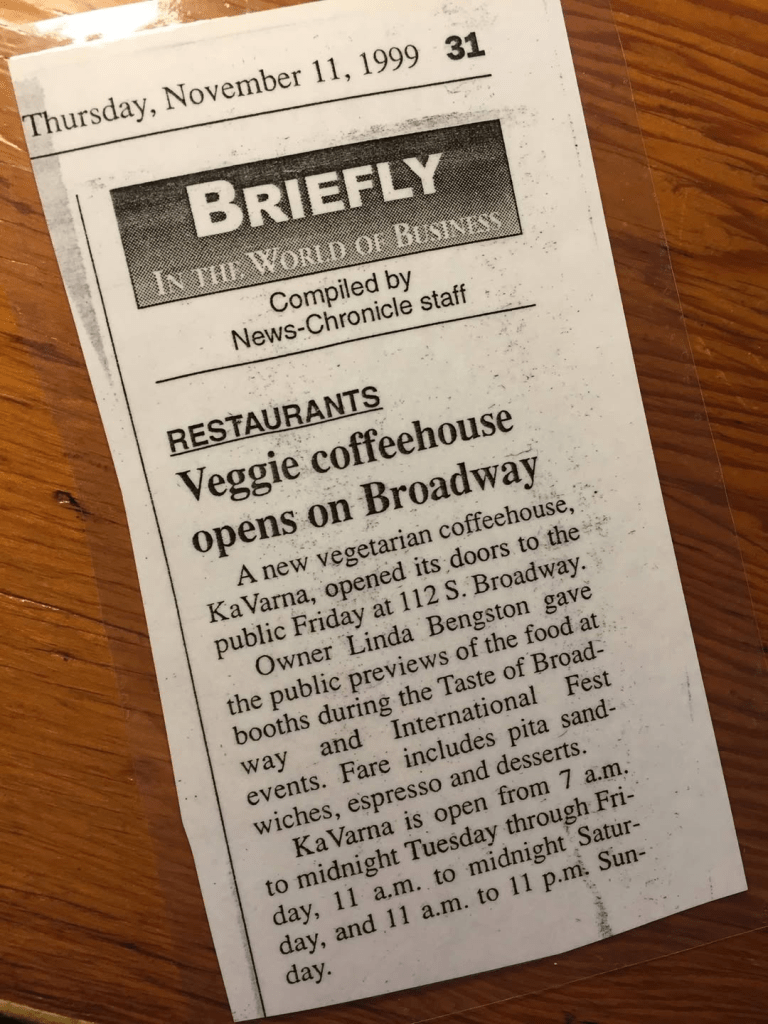
At the time, the cafe had been open at it’s original location for several years – Linda Bengston (later Galt) opened the cafe in November of 1999. As I didn’t have a car during college (and campus exists on the outskirts of the city), I didn’t really get to explore much until after I graduated, so I never had the chance to stumble upon it until Ashley first introduced me to it. (She has since introduced me to SO many amazing places, but this remains my favorite.) Back then, it was located a few bocks from where it is now, which had been a tiny spot that barely fit ten small tables but had the most beautiful tin ceiling. You had to be lucky (or really good at hovering) to nab one of those prime spots. The food was delicious, and while I didn’t yet drink coffee, Ash’s endorsement was all I needed to know it was good.
These days, it’s hard to imagine the Broadway district without this cafe, but when Linda first opened it, the cafe was one of a kind. Vegetarian/vegan options were rare on most menus – let alone having an entire establishment based around the concept. (As she notes in an interview with the GB Press Gazette, there were folks who wouldn’t come to the cafe because there was no meat on the menu. I can attest to this when my mother-in-law cracked a joke, requesting that we find somewhere with “real” food rather than return to the cafe for lunch. Linda took this in stride, and there is even a nod to this with the Rabbit Sandwich – which has “English cucumber, tomato slices, Heritage Blend mixed greens, and house dressing served on Great Harvest Oregon Herb toast.” Literally what I had for lunch today.)
On May 7, 2010, Kavarna closed up for the last time at their first location, moving a few blocks up Broadway to a much larger location (three tiers with many more tables, with room to host musicians and, later, roast their own coffee beans). The delicious food, genuine hospitality, and mosaic counter all made the trek. (Photos below from the Kavarna Facebook show what the new space looked like in 2008 before they started renovating, as well as a close up of the mosaic counter.)
When I didn’t live in Green Bay, anytime I visited the city, I had to stop and pick up some Kavarna hummus (they sell it in one pound tubs), and there are often requests for it from friends I visit who have moved away. And any time I’ve lived in the city (this is, officially, my third time living here), I would frequent the cafe like a home away from home. I’ve spent a lot of time writing here, fueling my writing with Cheesy Artichoke Wraps and tea or coffee (depending on the time of day). Good chunks of my first novel were written here. My second and third would have, too, but COVID hit.
And you want to talk about bad timing? After twenty years in business, Alex and Linda Galt decided to sell Kavarna. Kayla Viste and Mike Hastreiter took over in February of 2020. That date should probably sound familiar. These two folks probably thought their worst obstacle would be settling into this established, beloved cafe – and then a month later, they had to shutter their doors and figure out how to weather an unprecedented storm.
Thankfully, they did manage (soon offering curbside pick up, of which this writer took advantage), and once it was safe, they opened little by little. Today, much like that mosaic counter, Kavarna still stands; even with new owners (well, not really new anymore 🙂), the heart of this place remains.
One thing that I particularly enjoy about the changing of hands is the fate of it. Both Kayla and Mike had previous experience with Kavarna (as a job and as a hangout, respectively). They had come to a decision to purchase a business, and it just so happened that Karvana had become available. Something similar happened with my own family when we made our move from a Chicago suburb to a small town in Door County, where my parents became business owners themselves. Sometimes, things just work out – and in the case of Kavarna, that is the case.
As for me, I’m just happy this place is still around all these years later. No matter where I’ve lived or traveled, it remains my favorite. In fact, I’m writing these very words on one of my many Friday writing days spent at the cafe.
Wondering about that name? “Depending on how it’s used, Kavarna (Czech) translates to mean café, coffeehouse, or coffee bar. This is only a small part of what Kavarna really is.”
Description: In their first collection of poetry, Gibson covers topics like a soldier’s lingering psychological wounds, childhood bullying, the repercussions of assault, and love. They do so with “a bold and unforgettable internal voice rich with the kind of questioning that inspires action,” all with unflinching honesty. Gibson leaves it all on the page.
This collection holds twenty-six poems, mostly free verse. These are poems that Gibson also performs, so the style can sometimes be off-putting for some. That being said, Gibson’s use of language, while often straightforward (as is common in performance) is also incredibly poetic/figurative – and whether reading or listening, it’s easy to hold on.
Why I recommend this book: There are poems in this book that still give me goosebumps, even after reading them dozens of times and hearing Gibson perform them over and over. Don’t just take my word for it – whenever I include work by Gibson in my poetry class, my students always react by asking for more.
If you are someone struggling, and can’t stand the platitudes often espoused as a result that are ‘supposed to make you feel better,’ Gibson is your poet. While they come to these difficult topics with grace, tenderness, and, often, joy – they don’t do so condescendingly. They offer a different viewpoint that allows for both sorrow and joy to sit side by side.
I also recommend the rest of Gibson’s books. Often times, the first collection is the most interesting because the writer has spent the most time writing and revising it before publication. The rest can often feel hurried. That is not the case with Gibson – they just get better and better. I merely chose this one because it was Gibson’s first, and my first of theirs.
“Andrea Gibson does not just show up to pluck your heart strings, [they stick] around to tune them. If being floored is new to you, ya might wanna grab a cushion. Beware the highway in [their] grace and the crowbar in [their] verse.” ~ Buddy Wakefield, author of Stunt Water
“I thought, ‘The flowers, save the flowers…’
I never thought for a second we wouldn’t save the people” ~ Andrea Gibson, Pole Dancing to Gospel Hymns
“Because anyone who has ever sat in lotus for more than a few seconds knows it takes a hell of a lot more muscle to stay then to go.” ~ Andrea Gibson, Pole Dancing to Gospel Hymns
My favorite lines of Gibson’s (click the link for a YouTube video of their performance):
“and I know my heart is a broken freezer chest ‘cause I can never keep anything frozen. So no, I am not “always crying.” I am just thawing outside of the lines.” ~ Andrea Gibson, “Letter to a Playground Bully from Andrea (age 8)“
I remember when St@rbucks first became popular. I’ll admit, I was super judgy of folks who went there that had complicated drink orders. I didn’t even drink coffee at that point, so I had no clue what a bone dry cappuccino or a half-caff double-shot soy caramel macchiato even were. Honestly, most of the orders I’d overhear sounded like a foreign language.
How little did I know of this world? A café in town had a chai frappe on the menu, and I love a chai, so I asked – what does the frappe part mean?
Barista: It’s like a coffee frappe but with chai. Me: [blank stare] Yeah, I don’t know what that means. [laughs awkwardly at self]
That was the day I learned that frappe means a blended drink. This is a word I would end up saying a LOT in my future, usually with the word ‘mocha’ attached to it.
Back then, I just didn’t get it. Why did something you drink need to be sooo complicated?
And then, one day, I heard the following string of words spill from my mouth: grande chai tea latte with soy milk and no water. (Back in the day, St@rbucks would add water to their chai concentrate.) I remember saying it…and then it hitting me. I had a complicated drink order. I was no longer a simple water and tea bag kind gal. And once I started drinking coffee, it only got worse.
And then, I finally stopped judging myself (and others) for it. Because what’s wrong with ordering something you know you will like? (So long as you are kind to the barista when doing so.) Or something you need (a lactose sensitivity snuck up on me in college). I’ve still not ever had a cappuccino or macchiato, but thanks to the chalkboard drawn up at my fav local coffee shop (looking at you, Kavarna), I at least know what they are without having to ask. 😂
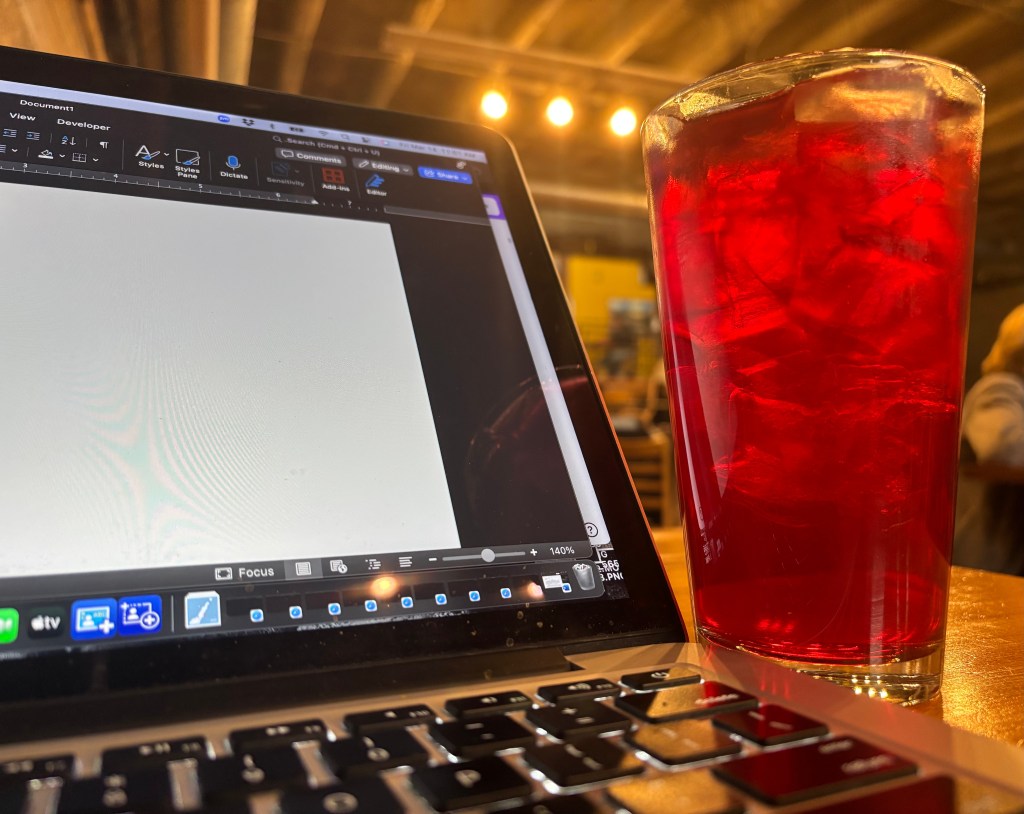
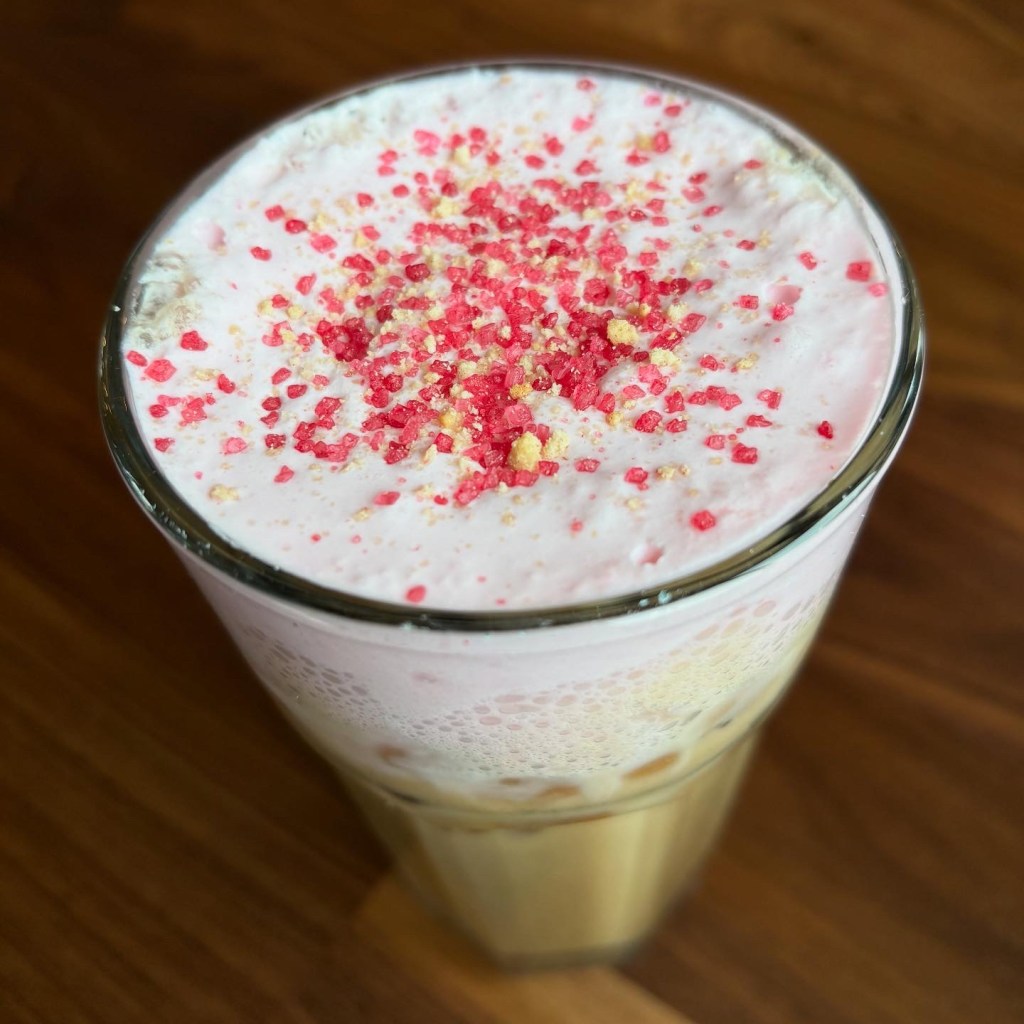
I don’t remember what this was, but there was strawberry in it.Chai Latte with Cherry Cold CreamGinger TurmericIced Raspberry Green TeaIced Cherry MochaI also don’t remember what this was – but I remember it was tasty.Rose Rooibos Latte (hot)Rose Rooibos Latte (iced)Cold Brew
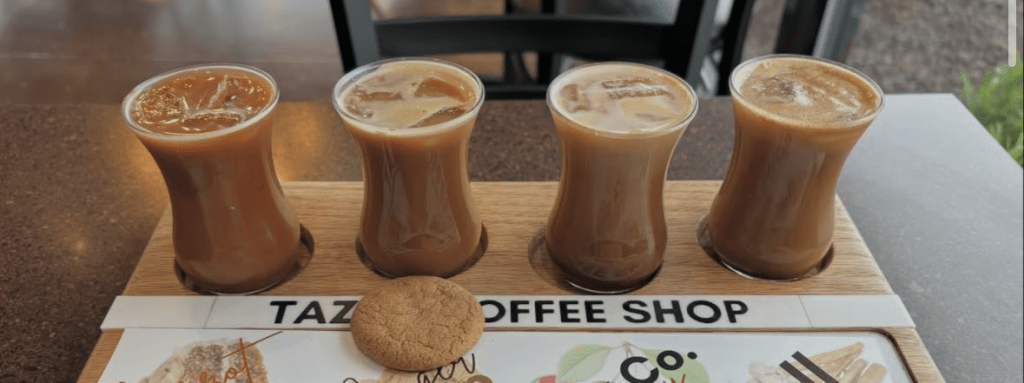
I will say that black coffee or steeped tea is still my ‘go to’ most of the time (followed by a chai latte or mocha when I want something a little extra), but I do enjoy trying new things. I really love that flights are a thing, too.
Latte FlightCoffee FlightCocoa Flight
Are you a complicated drink order-er? What is your fav?















 Ami Maxine