Forty-Seven Times

Forty -seven semesters now I have stood in front of classes for the first time (whether in person or online). (Should be forty-nine, but there was that one summer I couldn’t teach because I was in Kenya and didn’t have reliable internet, and then I didn’t teach this last summer either.) Forty-seven times I have talked about plagiarism (which now includes a subsection on AI). Forty-seven times I have explained the grading system. Forty-six times I have submitted final grades.

When I first started working at my college, I thought I’d only be an adjunct there a couple years before we’d have to move for my partner’s job. But neither of those things went as planned. And somehow, I just started my seventeenth year. Assuming I can retire when I’m eligible at thirty years in (insurance will likely be the deciding factor), then I am just over halfway.

And, honestly, it feels like a blink.

Things have changed. The students are different, with different needs and different issues. Not to mention different skills. I have been part of three re-designs of the developmental English program (because legislators keep changing their minds). I witnessed the world shutting down and had to move solely online (something I thought I would enjoy – but turned out to hate…all the worst parts of of the job without any of the fun parts). I’m continuing to witness the fall out of that. I’ve served on committees and developed programs and created trainings. I’ve had more professional development than I can recall. I’ve taught at least 184 courses (minimum five each fall/spring and two in summer – I know this is low, but it’s a close-enough guess) classes. I’ve taught at least 3,680 students (average 20 students per class). (Part of me wants to figure out the actual data. If I do, I will come back and edit. ¯\_(ツ)_/¯ )

And when I look at it that way, I suddenly can’t help but think – I’m only halfway?

Time does not play fairly. It stretches and constricts in ways I can’t always follow. All I know is that I just introduced myself for my forty-seventh semester.

And for the first time, I wasn’t nervous?

You read that right – sixteen years, three semesters a year (minus two summers), and I was still nervous on the first day of class.

But this semester, my forty-seventh semester, not a single butterfly in sight. I’m not sure yet what it means.

Visiting Lucy’s Locations

In 2018, I went to Scotland (for the first time…I can say that now 👀😁), and it was somehow more magical than I anticipated it would be. So much so that it inspired a magic realism story – my book Wherever Would I Be. In the book, Lucy visits several of the places I did (like Dunvegan Castle, my friend’s ancestral castle/clan, which became Lucy’s). However, once I got Lucy into the country in her story, I realized I needed some more places for her to go. Enter the street view function on a well-known map system and photographs on websites, and I strung together a trip that sounded utterly delightful for Lucy, her bestie, and her brother.

I wrote the first draft of the manuscript in 2020, worked on revisions and edits and thanked my beta readers, and in 2023, Lucy went out into the world. Cut to summer of 2025, and my writing bestie and I decided to take a trip to Scotland. I was finally going back. And on this trip, we included on our itinerary some of these locations that I only got to see digitally and decided it would be fun to take Lucy along for the ride.

On our first full day, we trekked over to the Fairy Pools. This was something I had hoped to see on the first trip, but we hadn’t made it work. So no surprise that Lucy went. (They arrive on page 215 of the paperback.) The sun shone brightly (I may have burnt a bit 👀) as we hiked to the pools, and there were indeed a lot of other folks meandering around. Definitely a must if you’re the type that doesn’t mind a bit of a walk, some steep grades, and beautiful views.

In the story, Lucy’s aunt, who she goes to Scotland to meet, works at a pottery shop in Edinbane – one I had found but not yet visited. We made a stop, and while I didn’t make a new family connection like Lucy did, I did find a mug that begged to come home with me. (Lucy steps foot in this shop on page 225.)

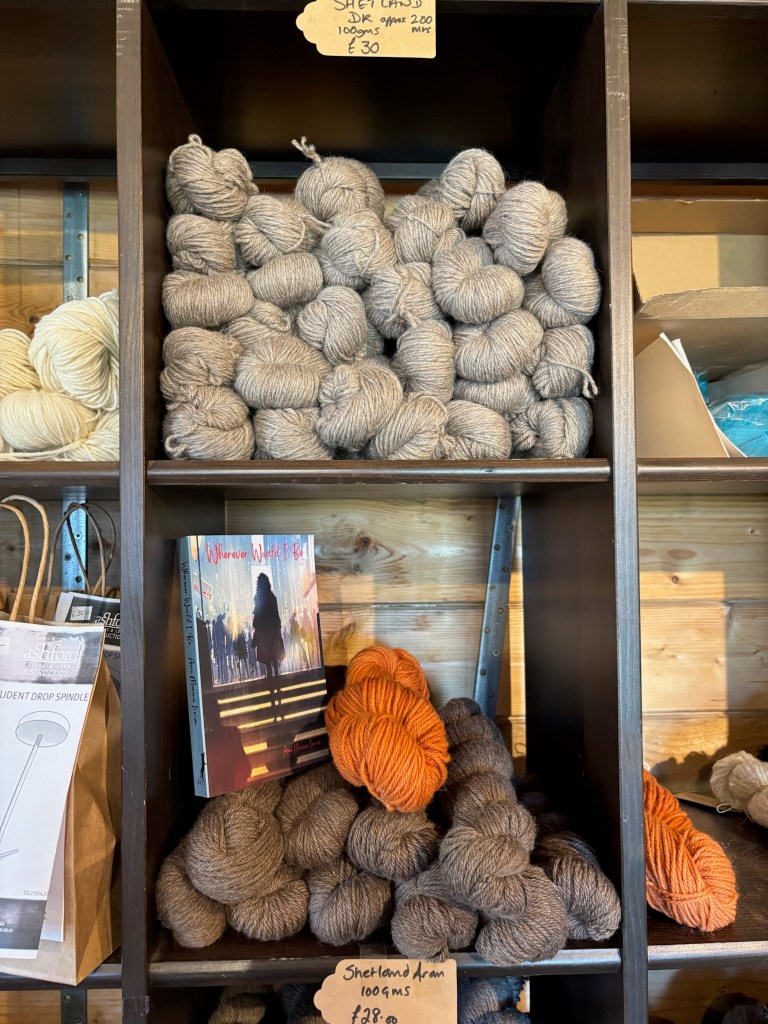
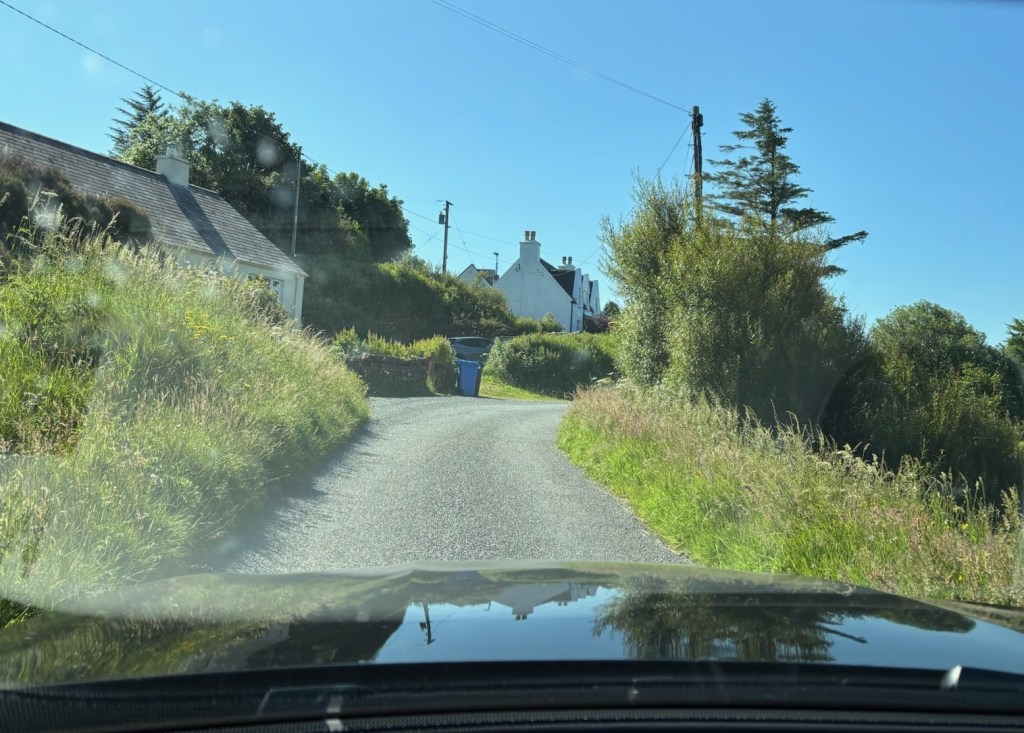
A few pages later (227), Lucy et al. check out a fun little yarn shop. In our reality, we had the navigation code…which sent us down the tiniest road I had seen yet – a single-lane residential road that was literally the width of our car. Thankfully, my travel buddy had an eSim and used his phone’s GPS, and we found it. The shop tender was friendly and chatty (not in a bad way), and I may have found some yarn to bring home, too. (The wool comes from the sheep in a field nearby.)

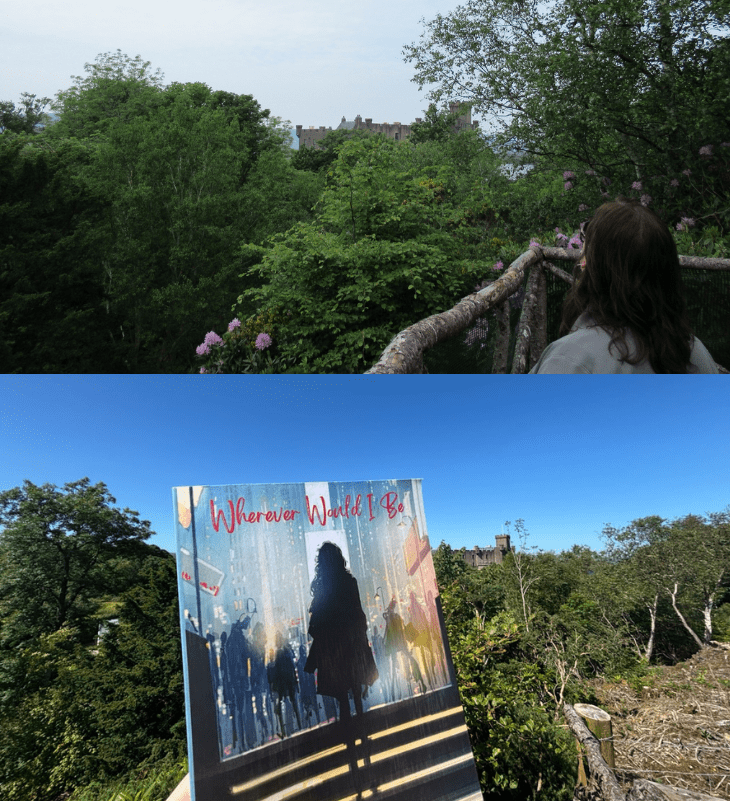
In real life, the first time I went to Dunvegan Castle, I got to witness my bestie seeing her ancestral home for the first time. This scene played out much the same way for Lucy (page 207) – right down to the spot where she first caught sight of the castle (though on this trek for me, they had done some tree trimming, and we were able to see the castle almost immediately passing through the gates).

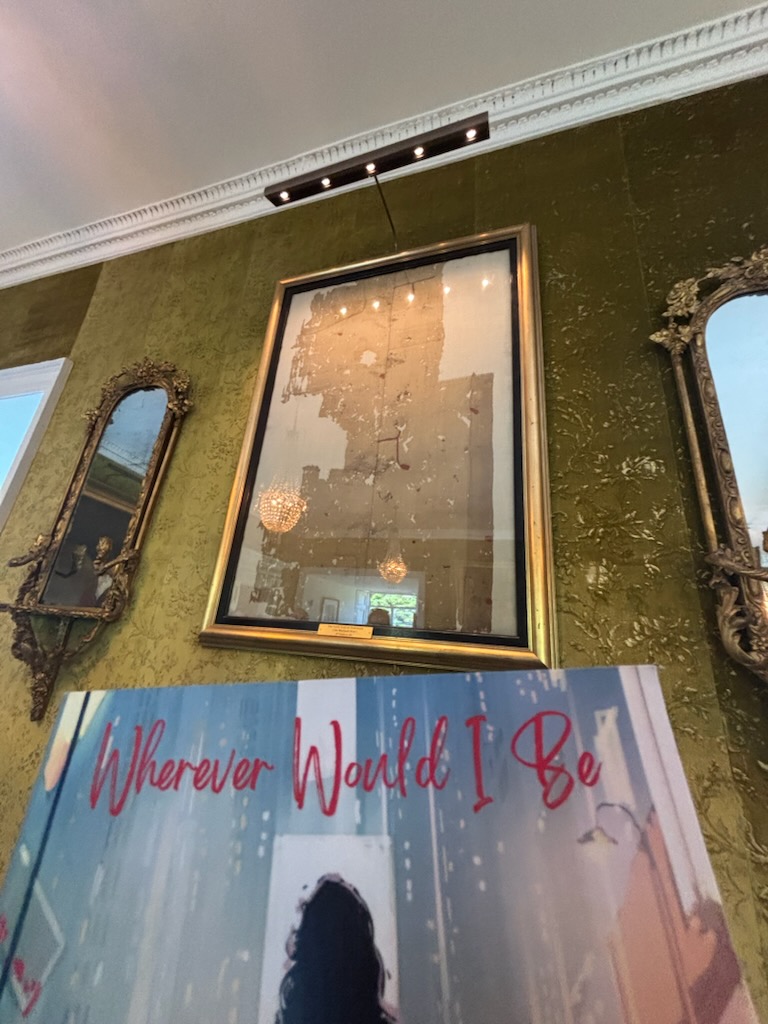
Within this castle, is the Dunvegan Fairy Flag. Little did I know when I stood before it (that first time) that it would become a central piece to Lucy’s story. The flag, now housed in a different room of the castle, still looks rather worse for the wear – but the story persists. And, according to Lucy’s ancestry, so does the magic (page 210).

While on the grounds of Dunvegan, Lucy spots several imprints, including two in the walled garden – a young woman and her child, who is fascinated by this sun dial – which was incredibly hard to describe on the page (no idea why I did this to myself ¯\_(ツ)_/¯ page 213). I went so far as to send the description to my writing bestie, asked what he thought it looked like (he did a sketch), then I sent him the image. to varify

Scotland really is magical, and I left a piece of myself there when I left the first time. I found it again on this trip, but it, unsurprisingly, opted to stay put once more. I can hardly blame it. Scotland is not an easy place to leave.

Andrea Gibson

I’ve been trying to come up with something to say about the death of Andrea Gibson for almost a month, and words continue to fail me. It’s strange, mourning the death of someone you didn’t know very well – but felt like you did. The amount of time I physically spent with Andrea added up to less than a day; the amount of time I spent reading and listening to their work is incalculable.

About fifteen years ago, a friend told me about this poet that they enjoyed – said, she felt about Andrea Gibson the way we felt about Ellis (the singer). Let’s just say that’s a successful endorsement. And so, I heard Gibson read their poetry for the first time – and I never looked back. Over the years, I read everything they published, saw them perform I don’t even know how many times, and have taught (and will continue to teach) some of their poems when I have the opportunity to teach poetry (the students always end up asking for more of their poems).

And then in 2019, I had the chance to work closely with them at UntitledTown (a book and author festival my city ran until the pandemic put an end to that). Gibson would be reading their work at an establishment in the Broadway district – which, rewind twenty-six years, was the first queer space I had ever entered. At the time, most of the establishment was an 18+ dance club; there was a 21+ bar connected to it. Helpful when most other queer spaces (at the time, a handful of bars around the city) were all 21+ (the drinking age in my state).

Photo of the most adorable sound check ever. Squash looking up lovingly at their favorite human.

I told you that story to tell you this one – during their performance, Gibson recited their poem Orlando, which is about the massacre at the queer Florida dance club. Before reading this poem, Gibson told a story about how at the age of twenty-one, they sat outside of their first ever gay bar, scared to go in because they were worried of being seen…or shot. They did eventually make it in. I’ve heard this poem read several times. But hearing it read here, in the old West, the first queer space I ever stepped foot into – well, it’s difficult to put into words the ways this broke me open.

They also recited their poem “Letter to My Dog Exploring the Human Condition,” during which they invited the subject, their pup Squash, onto stage with them. I was going to link to a recording of the Pulse poem, but this one is more lighthearted, and we could all use a little more lightness at times like this.

A few years ago, Andrea openly shared that they had been diagnosed with ovarian cancer. They chose to share their experience, and watching how this diagnosis made them fall even more in love with life was astonishing and inspiring. And maybe inevitable when one takes a look at their work and their life.

They did manage to enter remission for a while, but the cancer returned, and no matter what they threw at it, this time, it persisted. This is why it was not surprising when their death was announced on July 14, though its impact was still greater than I had anticipated. A gut punch for sure. Watching the outpouring of love from their friends, family, and fans, though, has allowed the experience to feel less isolating.

The strangest thing when an artist you admire passes is the acceptance that no new work will be coming. You hold in your possession everything they will ever create.

But Andrea Gibson, in their infinite wisdom, prepared for this, too. (You can read about their poem, from Meg, read the text, and watch a video of it on Andrea Gibson’s Substack: “When Death Comes to Visit.“)

Their partner/wife Megan Falley (also a poet) is continuing to write and post on Gibson’s Substack, and I encourage you to continue on with them.

You can find their books everywhere (though I do recommend using BookShop.Org if buying online; you can request your local bookshop to order them if they don’t carry them already). You can listen to their work via their YouTube channel.

A Return to Pen Players

Earlier this summer, I did something I haven’t done in a really long time – attended a play at Peninsula Players in Door County. It’s somehow been about twenty years (maybe plus a couple more?) since I was last here.

When I was a kid (young teen?), a friend of ours, Robert Thompson, told my sister and I about an opportunity to volunteer at the theater – if we ushered before and helped clean up after, we’d get to see the play for free. I went to every play every summer until I moved away for college. I always wanted to return, assumed I would, but then *blink* – it’s two decades later somehow.

This summer, though, since I’m not teaching, I had some extra free time. (Well, I have free time, which is new.) The first thing I added to my to do list was to call up Pen Players and see about ushering. (And when I did, they kindly told me that they would start taking ushering requests in a couple weeks. 😬) So I called back, and I signed up for four of the five shows (I’m skipping the horror one 👀).

The very first Peninsula Players show opened on July 25, 1935, though they didn’t open on their current location until the summer of 1937. Those early performances were presented under the stars, with a canvas top added in 1946 and a permanent roof in 1957. The shows could then go on, rain or shine – just lower the side flaps if needed. In June 2006, they opened their season with an entirely new structure. (There are a number of videos with auto-generated captions on their website where you can learn even more about their history.)

All this to say – I knew that the theater had renovated the structure and grounds. But I had no idea how different it would actually be. The first difference was simply walking up to this:

I tried finding a photo of the structure I knew, but no dice. Needless to say, it didn’t look like that. And the inside surely did not look like this:

In addition to housing more seats, those seats are also now permanent. Previously, the rows were made up of those folding, fabric director chairs. These are far more comfortable. Also, the ground itself was gravel slanting down from the rear to the stage. The new flooring, which I just learned from a friend after posting these elsewhere, is also heated, so they can take the chill off when the temps dip. (The only thing I don’t love about this is that it means there are now steps to get down to the front, so row K is the only accessible row for folks who can’t do stairs.) They also added a hearing loop, which is a great addition for accessibility.

Despite all the changes, though, when the lights dimmed, I got those same butterflies I used to (that I always do). Because some things, like the magic of a place, don’t change.

First Friday Rec: A Darker Shade of Magic

Version 1.0.0

Title: A Darker Shade of Magic
Author: V. E. Schwab
Genre: Fantasy, Fiction, Adventurous
Pages: 413
Publication Date: 24 Feb 2015
StoryGraph* Moods: Adventurous, Mysterious, Dark
How I Stumbled Upon This Book: Book Club
Other Books by this author: There are many – the others in this specific series are A Gathering of Shadows, A Conjuring of Light, and The Fragile Threads of Power.
*StoryGraph also offers content warnings.

Description: Imagine there are four versions of the world. Now imagine that you are one of the rare folks who can still travel between them. Well, you don’t have to imagine – Schwab did that for you. In this instance, there are four Londons – Red, Grey, White, and Black (though that last one is inaccessible even to Kell).

Kell is a smuggler, taking people’s money to bring things from the other worlds, which is going ok. Sort of.

Enter Delilah Bard. Who robs him. Then saves him. Then begs him to take her to another one of those worlds.

The story is filled with magic and treachery and tension.

Why I recommend this book: It’s beautifully written. The world building is superb. And the story demanded I not put the pages down. When I joined a SciFi/Fantasy book club, I hadn’t taken into account that most of this genre involves lengthy series [facepalm]. This is one of two (in as many years of attending) that I opted to continue the series. It’s not that the others were bad – just that if I read every series we started in this club, I’d never read anything else. Or Sleep. So I’ve been picky. In this case, I immediately bought the trilogy (and the fourth came out shortly after).

“I’m not going to die,” she said. “Not till I’ve seen it.”
“Seen what?”
Her smile widened. “Everything.”

“I apologize for anything I might have done. I was not myself.”
“I apologize for shooting you in the leg.” said Lila. “I was myself entirely.”
~ V.E. Schwab, A Darker Shade of Magic

The Greenhouse

I love a good café. I’ve certainly not kept that a secret. Any time I travel, I check out at least one local spot (more if I can), check out their mocha or their chai (sometimes both), check out their ambiance. I feel at home in a café, even when I’m far away from it. So when (a few years ago now?) I saw The Greenhouse café on an account I follow in Insta, I knew I had to visit. And I have several times since.

The Greenhouse is located on the grounds of The American Club, a luxury hotel and spa in Kohler, WI – but don’t worry, you don’t have to be a guest to check out the café; it is a public space. You do have to enter and walk through the lobby of the hotel, which always makes me feel woefully out of place, but the discomfort is worth it for the beautiful structure, which makes for an unusual but lovely café:

But wait – it gets even cooler! The structure originated as a solarium in Lancashire, England, and it was brought over and meticulously reassembled. The result is striking.

And when you’re sitting inside, the world seems, well, a world away. The café offers a sense of being cloaked, but all the while being bathed in sunlight. The last time I was there, a young lady was having her senior photos done (I’m assuming this was the case), and I have to say, it is a perfect spot to do so – both indoors and outside around the grounds. They even captured a couple cute shots of her sipping her latte.

They used to have a more extensive food menu (not sure if this will be coming back or not – they did mention that the Wisconsin Room somewhere on the premise had a full lunch), but the last time I was there, they only had breakfast sandwiches. (The wrap was tasty; the sandwiches all had meat, so I couldn’t try them.) The coffee beverages are good (the Sweet Cardamom latte especially). Everything is, yes, a bit pricier than you would likely pay at your local shop, but for the ambience, it’s worth it as a treat every now and then. Definitely great spot to meet a friend for a coffee (they also have ice cream and boozy milkshakes).

They do have pastries – though I will say that some taste is lost in the effort to make them look picture perfect, so great for a selfie, but don’t go in thinking the chocolate croissant will change your life. And a last little note: If you are like me and go to a café to work, make sure your devices are all fully charged – there are no plugs available.

World Mythology

In the fall, I get to teach a course I’ve been eager to teach for some time – a Humanities class called World Mythology. I’m sure you can figure out what the class will be about based on the title. 🙂 I spent what free time I could find during the end of Spring semester and then many full days once school ended creating content for the class. Our semester is sixteen weeks, and each will focus on a different area around the world. While I did opt to touch on some familiar mythologies, I wanted mostly to dive into mythologies that would be unfamiliar to my students (and to me).

This meant not using a textbook (which I also avoid as much as I can in my courses because of the added costs to students), and by the end, I had a nineteen page works and images cited (which will mean lots of links to check at the start of each semester to make sure they work 🤞🏻🤞🏻). But I think it’s worth it (even if it takes extra time ensuring I’m not breaking copyright). I had a lot of fun digging into mythologies from all over the world – and if my students enjoy them even half as much as I did, then I’ll call it a win.

I thought I’d share a couple of my favorite finds. I’d be curious if you were familiar with any of these.

The first comes from South Africa – the Tokoloshe (pronounced toe-co-lowsh), a trickster figure. While their appearance has evolved across stories and through time (ranging from human-like to primate-like), one thing remains consistent: their diminutive size (about hip-high to an adult human). They are mischievous (and sometimes dangerous), wreaking havoc – but also exist to invoke benevolence by scaring children (to make them act appropriately – perhaps you can think of such figures from your own childhood) or protecting against malevolent spirits. To learn more, check out this video:

The next comes from Slavic mythology – Baba Yaga, though variations of the name exist in several Slavic languages. In these languages, ‘baba’ means grandmother or old woman. ‘Yaga’ has a less-well-known etymology, though related terms bring about meanings of horror, anger, witch, and evil. In mythology, she was one of a trio of sisters of the same name (though in some iterations, she is solo) and had two contrasting roles. In some, she was repulsive and ferocious-looking and would fry then eat children; in others, she was a nice old woman who helped the hero. (That’s a coin flip I would never want to encounter.)

Perhaps, like me, the first time you heard this name uttered, it was in a John Wick film. The title character is said to be the one you sent in to deal with the baba yaga (though in this film, its incorrectly translated to mean ‘boogeyman’).

To learn more about this figure (and to learn her incredibly odd mode of transportation), check out this video:

In Fijian mythology, each island had a god who protected it. One such god is Rokobakaniceva, a giant octopus who protects the Naceva passage in Kadavu (an island south of Fiji’s largest island). If you know anything about the octopus, you know how intelligent and cunning they are, traits that this particular god was imbued with. She is best known for her legendary battle with Dakuwaqa, the shark god – a tale of chaos versus order. Even today, her influence continues – both as a cautionary tale for children and in ceremonies related to the sea, reinforcing the importance of respecting the water and maintaining balance in the world. To learn more about Dakuwaqa, Rokobakaniceva, and a couple other of the Fiji Island protectors, check out this video:

I’m really excited to teach this course in the fall – only time will tell if the students will enjoy it. 🤞🏻😬🤞🏻

Camping

I’ve been camping since the womb. Quite literally. My mother tent camped pregnant with me. There are a lot of photos (and a few vague memories) of my family tent camping at Peninsula State Park (which was also the campground my dad had been camping at since he was five). I’ve been told that we continued to camp there until my sister and I were old enough to realize how gross the bathrooms were (I’m going to note the facilities at the park these days are updated – not the pit toilets of yore). We started camping at a private campground a bit south of the park (which had spotless bathrooms, a pool, and a mini arcade). We had the ultimate freedom there – riding our bikes around the twenty-five acres, traipsing through the apple orchard, spending hours in the pool until our skin pruned.

My parents ended up buying a small camper and getting a seasonal spot – which meant our trailer stayed put year round, and we could come and go as we pleased during the summer. Once, we made thirteen trips from our Chicago suburb to Wisconsin’s thumb. This is the campground my family ended up owning and running for fourteen years.

So you could say camping is in my blood.

Yet, after my parents sold the campground in 2006, I didn’t camp much. (Also, excuse me while I have a moment – writing that year just now made me realize it’s been almost twenty years since they sold it. 😐) It’s not that I stopped loving camping – not by a long shot. But I had just graduated college and was on my way to graduate school. Life took off at a breakneck pace.

Enter a group of friends – a group of women who love to laugh and to explore nature. Who love a good farmer’s market and a day spent thrifting. And camping.

We now kick off each summer with a trek to that very park I frequented as a kid (with their new facilities; I realize I keep harping on this – but what I left out above was the time a snake was found in one of those pit toilets… 😬). We share in making meals, playing games, and, yes, laughing. This year’s trek we dealt with a thunderstorm the first night and rain most the second day – but that didn’t put a damper on us (we were also a little thankful since the state had been under a ban burn, but now we could have a campfire; well, once it stopped raining we could).

There is something about sitting in nature that is comforting. The sounds of birds chirping. The pines rustling in the wind. The pissed off squirrel dropping (I’m not exaggerating) twenty-ish pine cones onto one of our cars – over and over and over – BAM! He legit seemed to be aiming. 😂 The crackle of the campfire and the taste of dinner cooked over its flames. (Not so comforting was the camper next door yelling at their dog at 6:30 in the morning. First, it’s 6:30. Second, if you trained your dog, you woudn’t need to yell. Certainly not so loudly.)

It’s a perfect way for me to end the school year (I usually turn in grades the week before) – to walk away from work and just be. For an entire weekend.

First Friday Rec: Educated

Title: Educated
Author: Tara Westover
Genre: nonfiction, memoir, reflective
Pages: 368
Publication Date: Feb 8, 2022
StoryGraph* Moods: emotional, reflective, inspiring
How I Stumbled Upon This Book: The cover caught my attention while wondering through a bookshop.
Other Books by this author: none as of this writing
*StoryGraph also offers content warnings.

Description: Imagine being seventeen and never having stepped foot into a classroom. Or a doctor’s office. That was Tara Westover’s life. Her parents were survivalists living in the mountains of Idaho, and Tara went to bed every night with her “head-for-the-hills” bag at ready. When her brother turned violent against her, there was no one to protect her.

Tara, in secret, began to educate herself – learning enough to gain entrance to Brigham Young University. Her quest for knowledge took her literally and metaphorically all over the world. She ended up earning a PhD from Trinity College, Cambridge, and in 2019, she was the Rosenthal Writer in Residence at Harvard. A far cry from home. Perhaps too far. “You can’t go home again” is a well-known saying for a reason.

Why I recommend this book: Westover’s memoir is a testament to how an education can truly change someone’s life. I think it’s best said by Vogue (yeah, not who I expected ever to quote, either): “Despite the singularity of [Westover’s] childhood, the questions her book poses are universal: How much of ourselves should we give to those we love? And how much must we betray them to grow up?”

At its heart, Educated is a coming of age story – unlike any I’ve ever read before. But also, from the view of an educator, one I think everyone can gain something from.

“We are all of us more complicated than the roles we are assigned in the stories other people tell.”

“An education is not so much about making a living as making a person.”

~ Tara Westover, Educated

Rogue Characters: Murder Mystery Edition

Have you ever had a writer friend who talked about how sometimes it felt like they weren’t writing the story – their characters were? I know. It sounds absurd.

But sometimes – it really does feel that way.

Last week, I had rounded 80K on the first draft of my murder mystery novel, and I was getting to the point where my characters were on hot on the trail of the serial killer. I had a scene in mind where I thought they would get them – but before I started writing it, I realized it wouldn’t fit to have them there. The scene instead unfolded in a way that made more sense – and the heroes would get another chance.

Enter that next chance – what was going to be the final showdown. Only, this time, the serial killer wasn’t there by their own choice. How? I don’t know.

On a happy and somewhat related note, I did finally complete the first (very rough) draft of the novel and overshot my goal:

Even knowing how much work is ahead of me, typing those two little words felt REALLY good.