I spent so many hours in my youth amongst the aisles of the children’s books in the Arlington Heights Memorial Library, selecting that week’s stack of books that would accompany me home. We also had a bookmobile that would stop at the other end of our block (do those even exist anymore…?), and I’d traipse down to it with my arms full, returning with my new choices. It’s no surprise that even now I have a deep love for libraries (and the magicians that work within them).
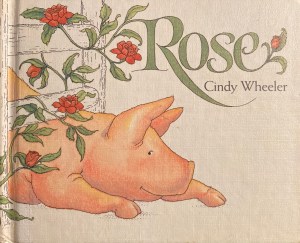
This morning, I was perusing my own shelves when I stumbled across Rose (though as a kid, I always called her Rosie), a book that I checked out so many times that my mother ended up buying it for me. I couldn’t help but pick it up and flip through it. It’s pages are well worn, sometimes ripped (*sobs*), and one in particular is adorned with pen markings that may or may not have been mine (though given my aversion to writing in books, I’d wager a guess it was not me). The check out card and pocket are still there, too.
Do you, reader out there in cyber space, have such a book on your own shelf?
I’m sure I’ve written somewhere about the joy of slow mornings that I’ve been experiencing the last couple years. How I actually eat breakfast. Every day. How I drink coffee every morning now, too. (Though that was still generally done while working.) I didn’t used to take time in the morning for such things – I’ve always been a “hit the snooze until I absolutely MUST get up and then just gogogo” type of person. But, it turns out, I don’t need to be that sort of person. (I still sometimes, usually, almost always eat lunch at my desk… I should work on that next…)
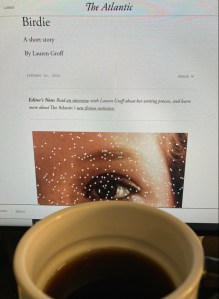
Another new addition to my mornings is the #365Stories challenge I’ve set for myself this year – to read #AStoryADay. This has become my coffee time, and I can tell you – my morning coffee has never tasted so good.
My goal was to encounter stories I might not have otherwise – to read things that I know nothing about – to be surprised. And so far, it’s been such a lovely experience. I have my breakfast. Then I roll up to my desk with my coffee and click on to the next story.
(Truth be told, I’ve wanted to do the 52 book challenge that so many of my friends post about on Facebook and such every year – but I also know that once the semester gets rolling, there are some weeks where a book is just not feasible. This feels much more manageable, for sure. But still – *fingers crossed*.)
There will be a post at the start of every month with the list of stories I plan to read (with links – you can find January’s here). There will also be links posted every day via twitter (@Ami_Maxine). Please feel free to read along! (I also have five more months to schedule – so please let me know if you have any stories you think I should read!)
I went back and forth when picking stories for this month. I was trying to decide whether I’d allow myself to reread any stories – or if they had to be 365 brand new stories. I finally decided that I wanted this to be all brand experiences for me. If I opt to reread anything, it will be in addition to the new story for that day. The goal of all of this, after all, is to be exposed to stories I might not have otherwise come across – to experience new (to me) writers (though I’ll also do “not new to me writers but new to me stories of theirs” if they show up on such a list).
The stories listed below came from a couple top ten lists I stumbled over – the first ten are from the top ten out of the 304 stories Pravesh Bhardwaj read in 2021. The others come from the 2020, 2019, and 2018 top ten lists that are linked at the bottom of the page.
Traditionally, I’m not one for making resolutions. I’m not big on “starting fresh” just because I swap the calendar that hangs in my kitchen. According to several articles I’ve read, studies show that only 8% of people keep their New Years Resolutions all year long. (I should note these articles didn’t provide citations for said studies – so take this with a grain of salt.) A whopping 80% have given up on them before February even shows up. Given my time working at the YMCA during high school, I can anecdotally support this given how January was always our busiest month of every year I worked there.
So I’m leery to call this a resolution. But I’d like to attempt to read a short story every day this coming year. I say attempt because if I’ve learned nothing else these last two years, I’ve learned to expect the unexpected, and I don’t want to feel as though I’ve failed if I miss a day or a week. (So perhaps I’ll amend this as I’d like to read 300 stories this coming year. Gotta love a little wiggle room.) I’m also going to have a mix of new stories along with rereading stories I’d like to revisit for various reasons.
I’m surely not the first person to attempt this. And I won’t be the last. So I’m curious – any of you out there that might be reading this – what’s your favorite story? What should absolutely be on my list this year?
My plan is to give a monthly update rather than post every single day. So fingers crossed that I make it at least into February. 😉
In March of 2013, I found myself, thankfully, in Boston, Massachusetts for AWP. I say “thankfully” because Chicago was getting hit with a snow storm the day I was supposed to leave, and I was fairly certain my flight would be cancelled. But I got out in time – and then the storm caught up with me in Boston, bringing along its frigid winds that made wandering about the city a bit of a challenge.
For folks who aren’t familiar, AWP (The Association of Writers and Writing Programs) holds an annual conference and book fair, moving cities each year. The conference is an overwhelming experience of too many people, too many sessions, and a giant book fair of publishers and literary journal and college writing programs. As an introvert, it’s an exhausting experience. As a writer and reader, though, it’s a place to encounter some of our favorite writers – and discover a love for some new ones.
At this point, I’ve gone to six or seven of these conference – my first to New York, a couple closer to home (Chicago and Minneapolis), and over to the west coast (Seattle and Portland). Boston was somewhere in the middle of my list, but it’s the one that sticks out most readily to me – because I got to meet Alice Hoffman.
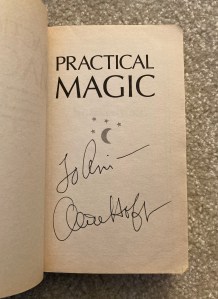
After listening to her keynote talk, I headed out into the throngs to wait for a chance to speak a few words with her while she signed my very worn copy of her book Practical Magic – whose covers were being held on thanks to wrapping the entire novel in contact paper. While she signed this (and a couple new copies I was using for gifts), I managed to croak out that I reread this book every single year.
“Are you one of the ones that started when you were twelve?” she asked me.
“Thirteen.” As a young writer, I loved the poetic language and magical story. My dream was to write my own story like this someday, to set it next to Hoffmans on my own bookshelf.
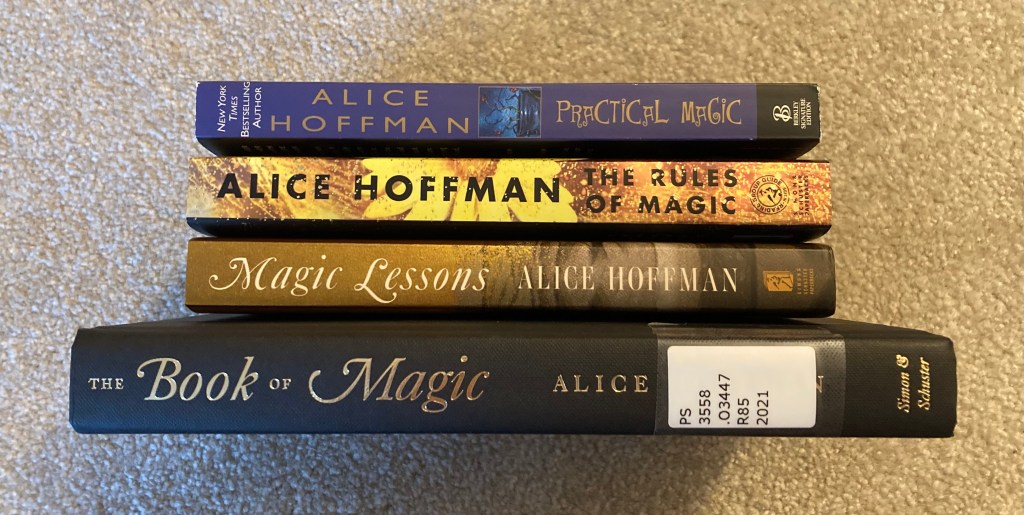
Cut to 2018 – me walking through Barnes & Noble, wandering the shelves. I catch something out of the corner of my eye, stop, take a step backward, and turn – The Rules of Magic, a prequel to Practical Magic. Needless to say, I bought a copy, took it home, and then stayed up until three in the morning reading it. I may have also geeked out a bit when I tweeted about the experience, and Hoffman responded to me – and then teased that Maria Owens probably has a story to tell.
Maria did indeed have her own story to tell – Magic Lessons, which came out in 2020. And this was followed closely by a fourth installment – The Book of Magic.
One of my goals (read: pleasures) planned for this winter break is to read the entire series start to finish – beginning with that well-worn first copy. I can’t wait to dive back into this world I’ve loved for so long – and see where this new installment takes us.
To say that this semester has been the hardest of my career feels woefully inadequate. Yes, it was worse than Spring 2021 when we had to shift mid-semester to fully remote teaching. Honestly, that semester seems like a breeze in comparison. And I’m sure you’d think that after that plus an entire other academic year of remote teaching under out belts that this semester would have been a breeze.
But you would be wrong.
I went into this year completely burned out. After the chaos of Spring 2021. After spending Summer 2021 teaching and prepping for Fall being all online. After an entire year of dragging students across the finish line. After another summer of doing the same (I also somehow ended up with nine credits for summer session – when six would be considered “full time”). I went into this Fall semester barely holding it together.
Thanks to my friends in and out of academia, I still managed to give my students everything and then some. (It really does help when you’ve got good folks in your corner that can prop you up when you’re too tired to stand on your own.) But we can only do so much if the students don’t show up. This semester, I had more students in one section fail than I normally have across all sections in a semester – because they simply didn’t show up. They didn’t respond to emails offering second chances. Or they did respond but then never followed up with the work. Or they just stopped signing into the course altogether.
Because they are burned out, too. Because it’s been almost two years, and we’re still in it. Many students are still forced to take online courses even if they aren’t wired in a way that they can be successful in them. We’ve offered a bit more face-to-face this semester, but even that wasn’t enough. I just keep thinking – it didn’t have to be like this.
But here we still are.
I submitted final grades yesterday, but unlike the usual relief that comes with this act, I just feel tired and sad. It doesn’t feel real, honestly. I can only hope that students (and my friends/colleagues) can get some rest over this break. I can only hope that next semester will be better than this one.
Two weeks until the end of the hardest semester of my thirteen year teaching career. Yep, even harder than that semester when we had to shift suddenly to fully remote teaching in Spring 2020. This semester has sort of been like those scenes in films with the trick lens where someone is sprinting down a hallway – but the door at the end never gets any closer. (Wasn’t Thanksgiving just a couple days ago? But also, why isn’t it New Years yet?)
These last two weeks will be filled with grading a final round of papers and exams of the students who have somehow managed to hang on fifteen weeks so far (by an instructor, me, who is shocked that she is still managing to hang on after fifteen weeks). Unlike every other of the thirty-five Fall, Spring, and Summer semesters I have taught, the bulk of my energy this semester has been spent tracking down students and their work – begging them to just turn something in – giving third, fourth, and fifth ‘second chances’ in the hopes that they would take the feedback in this time and make the needed changes in order for me to accept their papers – and when they don’t, requiring that they meet with me via Zoom to talk about it (they sure love that).
These students are not lazy. They are not unskilled writers. They are just tired. Burned out after a year and a half of this pandemic. And no, I’m not blowing this out of proportion (as I’ve been told by some non-academic folks in my life). This semester has been different from all the ones that came before it.
During a (previously considered) “normal” semester, I might have two, maybe three, students who neglected to turn in a paper. I’d send off a couple emails, receive an apology, and we’d all move on. This semester, for the second round of papers in my Composition I course (of which I have two sections), twenty-two students neglected to turn in their papers. Despite my best effort*, I was not able to recover all of them. (*Though, to be fair, I didn’t show up on their doorstep.)
Over the course of a semester, it’s also not uncommon for a student or two to drop or disappear around midterm. This year? I lost thirteen between the three sections of comp I/II that I have. I’ve lost a total of seven out of my humanities class, and even a couple from my creative writing course – a first in all my years of teaching.
I worry for these students. I worry for the ones who are still here and somehow managing to do A-level work despite everything else going on in their lives and in the world. I worry for my colleagues, who were all running on empty before this Fall semester even began. We’ve given everything – and it’s just not enough anymore. I worry for the new teachers who spent years studying and fantasizing about what it would be like to finally stand up in front of a classroom – only to find themselves in the absolute chaos of remote teaching – or in-person teaching where the bulk of the time is spent reminding students to pull their masks up and sit still – or, even worse, the combination of teaching remote and in-person at the same exact time. So many of these bright new talents are fleeing the profession after only a year. And I don’t blame them.
I wish I had a solution to end with. But I’ve got nothing left. I hate that every Wednesday in my writing group I state my goal to simply “survive” the following week – but that’s my reality. I need time to walk away – to shut the door on my home office for a bit and not worry about all these students who keep disappearing and colleagues who are fleeing.
But until then, I’ve got papers to grade. Hopefully.
There is little more that I love than learning new things. I haven’t always enjoyed sitting in a classroom learning, but after about four years out of grad school, I found I did miss that, too. So in 2012, I began taking classes to earn a couple of graduate certificates over at Northern IL University. The courses were unlike anything I had taken in quite some time, including a theory course – which was a struggle for this concrete individual.
This theory class, though, took me down a path of learning I never could have anticipated – all the way to Kenya. During the course, our professor brought in folks to speak about projects they were involved with (this was a feminist theory course, so the projects were all feminist in nature). One night, the two people who joined our class were Teresa Wasonga and Andrew Otieno. Originally from Kenya, they had moved to the States in an effort to give their boys a better life.
The project they were in class to share with us was the Jane Adeny Memorial School for Girls (JAMS) – a school they had founded in Kenya. Girls in Kenya face many hurdles to education (not having school fees; needing to work to help pay for needs at home; if something happens at home, the girls are the ones held back; not having access to clean water or feminine hygiene products during menstruation; in the case of one primary school nearby, the girls were sent during school to fetch water for the teachers to drink; and many more obstacles). Teresa had a dream to open up a boarding school for girls where at least half of the students would be there on scholarship – a school good enough for the richest and open to the poorest – where these girls could get an education that would quite literally change the trajectory of their lives.
[This is taken up the hill from the school – the visible red roofs are the school’s buildings.]
The project caught my attention and settled right smack dab in the middle of my heart – I wanted to get involved. I’m pretty sure I talked about nothing else for weeks after. When the course ended, the class met at a local restaurant for dinner and to celebrate finishing the semester. One of the other women in the course was telling me about a fundraising idea she had to raise money for scholarships for the school in Kenya. I confided in her an idea that I had – to teach memoir, create a collection, and use the proceeds for scholarships. I hadn’t shared the idea with the professor because I assumed she would think it was a silly idea – so when this woman turned to our prof and said, “You have to hear this,” I’m fairly sure my cheeks burned bright red.
But she loved the idea. So much so that I was in her office that next Monday speaking with the school’s founders about it – who also loved it. We even figured out an internship for the next semester where I would create this curriculum. A year later, I spent three weeks at the school teaching that curriculum, collecting the memoirs with the girls’ permission (they all wrote a short memoir, but only those that wanted to participate would end up in the book – all but one student granted us permission), and learning so much.
I will have to write another time about my experience at the school because that deserves its own attention. I will say this, though – I have never witnessed such hard working students in my entire life. To say these girls were inspirational is incredibly inadequate.
This last Monday, I met with Teresa. I was able to return to her the handwritten memoirs (which have been typed and edited). We spent a couple hours double checking the spelling of every name – it took a couple hours because as we went through them, Teresa filled me in on where the girls were now (the young woman, I should say by now) and gave me even more background on just how far many of them have come. These women are living proof of the difference an education can make.
We are now at the point of typesetting and creating a cover, which means we are getting so much closer to being able to hold this published collection in our hands. I can’t wait to see it.
For the first three decades of my life, I couldn’t stand coffee. I didn’t like the taste. Couldn’t stand the smell. I have memories of my sister and me tagging along to the bowling alley where our mother participated in league. (She once bowled a perfect game. They gave her a mug and all related bragging rights.) It was the ’80s, so we were mostly left to our devices – we played with the other bowlers’ kids, pushed our quarters through the slots of arcade games (which back then still only cost a quarter to play), and hid from our parents as we drank cups of coffee thickened with way too much sugar and powdered creamer. (My goal was always to mask the flavor of the coffee – I would have been better just sucking on a sugar cube.)
My sister and mother both loved coffee, whereas I sided with my father, who preferred to roll out of bed and crack open a Diet Pepsi. Of course, I wasn’t allowed soda in the morning as a kid. (Also like my father, I liked the taste of pickled herring and preferred salsa so spicy that it would make me sweat.)
I’d tried coffee several times throughout my adult life. Every now and then, I’d ask my sister for a sip (I always remembered too late that she put fake sweetener in hers, and every time it tasted…awful). A previous partner loved coffee, and I tried to grow accustomed to the smell as it brewed. Nothing clicked, though. I couldn’t understand what people saw in this bitter drink. If you have to dump sugar and cream (or any number of liquid flavors) into it just to make it possible to choke down, then what was the point? I’d rather just drink something that tasted good from the start. (This would have been either chai or Diet Coke.)
I was fortunate enough to be able to spend time in Kenya and Colombia in 2014, two places known for many things – including their coffee. In Kenya, access to their coffee was not easily come by, though – more money can be made in exporting their beans, so locals drank cheap stuff, if they could even afford that. (I was not able to even find coffee to bring back as souvenirs.) In Colombia, my friend I was visiting offered to take me to a coffee tour, but I declined because I figured I’d not get anything out of it. (Here, too, it was difficult to find bags of beans – I ended up buying the souvenir bags at the airport on my way home.)
Cut to Costa Rica where I was assistant directing a study abroad trip with thirty-seven students and two other directors. We would be there for an entire month, and I made a deal with myself. I would take this month and really try to understand why people like coffee – but if I left after that month and didn’t like, then I would stop trying. Some things just aren’t meant to be, after all.
I shared this bit of info with my co-director, Ken. Or as the students called him, the silent ninja. Like me, Ken is an introvert – and he is the main reason I was able to survive this month. (But that’s for another post.) I told him – this is it. If it doesn’t happen in Costa Rica, it’s not happening ever. Ken got a twinkle in his eye and said – I’ve got something for you to try.
The next day, Ken showed up with a coffee in a box from Cafe Britt. This, Ken told me, is a mocha.
Coffee and chocolate?? All these years, and no one thought to mention to me that they’d added chocolate to coffee?? Chocolate is a gateway for me, friends. So, of course, I loved the mocha. I loved the way the chocolate played with (and mellowed out) the flavors of the coffee. And I may have sought out more of these little boxes the next time I returned to the grocery store.
Later in the trip, we actually took the students to Café Britt for a tour, and we all got a huge education about the plant, about the bean, about roasting, and even the proper way to taste. Their shop had a station where you could try each of their coffees – and this was the spot where I officially realized I do like coffee, and more specifically, that I liked the dark roast best. I’m not sure what happened – if it was just the first cup of GOOD coffee that I’ve ever had, if my taste buds had changed with age (later this same summer, I would also learn that I don’t actually hate beer – just crappy beer), or if it was because I was in Costa Rica. Whatever the reason, I don’t even care. The love affair between me and coffee that I had pined for had finally begun.
It’s been six years since that trip, and now I can’t remember how I ever made it through a rough day without that little bean. (Well, I do remember – it was Diet Coke. I just can’t believe how much of that stuff I used to drink…) While my taste for coffee has expanded (where have you been all my life, mocha frappe? Or dirty chai? Or cold brew?), I find I still can’t get down with the cheap stuff. (My tongue is apparently a fancy b$%&h when it comes to coffee. And beer. And chocolate…) Get me a good bean, well-roasted, and I will dream about curling up in a warm mug full of it. (Unlike eight-year-old me, you can keep that sugar and cream to yourself – good coffee doesn’t need anything added to make it taste good. For me, at least – you flood your coffee with whatever you need to!)
Even after six years of loving coffee, I’m so used to passing over coffee flavored things that it’s often a shock to realize I can try things flavored this way. Coffee gelato? Yes, please. Coffee in chocolate? Duh. And just the other day, I tried coffee flavored Greek yogurt. *drool* (Me from seven years ago wouldn’t even recognize herself today!)
I now have a coffee pot in my office and a press at home. I know all the local coffee shops along the route between my home and work (and when they open). I have even been known to stop at a gas station. (Well, specific gas stations – not all gas station coffee is created equal.) And I finally understand what Ellis meant in her love song to coffee – a song I had sung along to for almost a decade without truly understanding it. I understand it now.