Below is the foreword from Voice of Jane Adeny Memorial School for Girls:
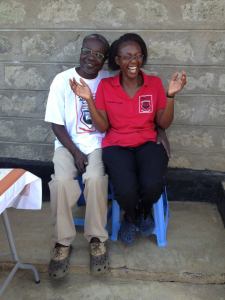
Set into a lush green hillside of Muhoroni, Kenya (near Fort Ternan), is the Jane Adeny Memorial School for Girls (JAMS), founded by Teresa Wasonga and Andrew Otieno. The school is named for Teresa’s mother who identified the ten acres on which the compound sits. After breaking ground in 2009, the school opened its doors in 2011 to twelve Form One (i.e., freshman) students. As these students moved up, new classes were added behind them, and in 2014, the year of the school’s first graduation, there were eighty students spanning the four forms. In 2019, the school reached capacity enrollment with 165 students.
To say that Teresa and Andrew have changed the lives of these young women who have attended JAMS is an understatement. Of the first six classes who graduated from JAMS, 100% of them have sat for and passed their Kenyan Certificate of Secondary Education (KCSE) exam, and 70% of them have achieved scores high enough to qualify them to move on to higher education, either vocational college or university. (This is double the national average, which is approximately 35%.1)
In Kenya, primary school (first through eighth grade) is compulsory and in 2003 became tuition-free. Secondary school, though, is not required, and fees kept a number of students from being able to continue. In 2008, a policy was created, but never implemented, to make secondary school tuition-free. While the government provides subsidies for teacher salaries (though only for those they specifically employ) and teaching materials (22,244 Kenyan shillings, which is just under 200 USD), parents are still responsible for boarding equipment and stores, transportation, and a portion of maintenance and improvement fees, activity fees, electricity fees, and administration and personnel salaries. Depending on the category of the school, this cost can amount to 40,535-53,554 Kenyan Shillings (about 350-470 USD; while this may not sound like a lot, remember that the current average yearly salary in Kenya is 140,000 shillings, which is about 1,230 USD)2. This doesn’t even include extra fees schools themselves may also add for things like building new classrooms, new dormitories, or other equipment.
Providing subsidies allowed the country’s enrollment to grow a bit, increasing from 43% to 67%. As a result, enrollment in higher education then nearly doubled between 2012 and 2014. For reference, recent gross enrollment for tertiary education was 11.5% – 13.2% for males and 9.7% for females. It is important to note that funding for public higher education institutions was then cut in 2015, putting a larger burden on students who qualified to attend and creating another financial barrier to education.3
In addition, we need to add to the list of barriers occasions that may keep a student home (which disproportionately affect female students), such as wage-earning jobs, help needed within the family home, and lack of access to clean water and hygiene products during menstruation. Even after all of this, girls who are able to make it into the classroom still face significant barriers from teacher credentials and attitude. (In a study done by Cynthia B. Lloyd et al., they found that “[w]ith each 10 percent increment in the number of teachers who say that studying math is ‘important’ for girls, the chance of girls dropping out decreases by 47 percent.”4) Another anecdote that I learned while visiting the school was about a primary experience where the girls in the class were sent during class to fetch water from the nearby river for their teachers to drink, thereby missing out on instruction. The boys were never sent.
The work being done at Jane Adeny Memorial School for Girls is combating all of these barriers that are set up between girls and their education. One way they are doing this is through fundraising for the purpose of scholarships. $800 covers a full year of tuition, room and board, school supplies, uniforms, and books for a student – bringing to life Teresa’s goal of a “school good enough for the richest and open to the poorest” (quote attributed to Horace Mann).
This book you are holding is one such fundraising endeavor. During the summer of 2014, JAMS students participated in a “Memoir Writing for Empowerment” curriculum where they told the stories they wished to tell in their own voices. Students were given the option to publish within this collection, and they were excited knowing that their work would go on to help other girls who wished to study at JAMS.
Why memoir? Well, “[t]he world’s earliest archives or libraries were the memories of women. Patiently transmitted from mouth to ear, body to body, hand to hand. The speech is seen, heard, smelled, tasted, and touched…Every woman partakes in the chain of guardianship and of transmission.”5 In pre-Colonial Africa, this rang true. More so, these stories were “peopled with heroines” where women have “been identified as founders of dynasties and civilizations” and who sometimes “transformed and re-created an existing body of oral traditions in order to incorporate women-centered perspectives.”5 Once colonized, there was a shift from the oral tradition to writing, and those with the skills not just to write, but write in the languages of the colonizers were the ones that got to tell the stories. Unsurprisingly, this system “created a hierarchy privileging men by virtually erasing any meaningful female presence.”6 As Tuzyline Jita Allen notes, “women, originators of the text, [we]re reduced to a footnote.”5 Through her work, Allen found, interestingly, that often times women silenced themselves. She proposes that this might have been due to wanting to avoid criticism or censure, and that just as Virginia Woolf ‘rightfully’ renamed Anon as Woman, in printed work it is likely that the initialed first name of South African writers were in fact women. “In a chaotic mix of race, gender, ethnic, class and language conflicts, the creative women in South Africa seem to have smuggled [their] art into the public arena by hiding behind the mask of the initial.”5
It wasn’t until 1966 that Africa saw its first published novel written by an African woman – Efuru by Flora Nwapa. By this time, Obioma Nnaemeka states that “a uniquely male literary tradition was already in place,” and “one of the consequences of this situation was that, thematically and stylistically, African women writers and particularly those of the first generation showed close affinities with their male counterparts.”6 These African women writers, Nnaemeka continues, were hyperaware of their readers and critics, which were usually male, and worked to “deploy different strategies to (re)present the specificity of their postionality.”6 In other words, these women were well aware of the history that preceded them, the culture they were existing in, the importance of their craft, and the importance of their voice. One such writer, Dr. Margaret Ogola, states, “I always say that I have worked a lot and saved many lives, but it is the power of the pen that has brought me to where I am. Women have a story to be told, and they have an angle from which only women can tell that story.”7
We are thrilled to finally share the words inside this collection with you. We thank you for your donation to the Jane Adeny Memorial School for Girls Scholarship Fund. Some notes – first, please know that in order to preserve each writer’s individual voice, minimal editing was done to these stories; also, these are written in British English, which has some spelling differences compared to American English.
These stories give insight into a time before these girls came to JAMS. We’ve added post-JAMS updates for the students we have contact with, though for more substantial updates on what some of these students have accomplished after graduation, be sure to check out the afterward.
NOTES
- “History – Friends of Jane Adeny Memorial School.” Friends of JAMS, 2021, https://jamskenya.org/about-us/history. Accessed 8 May 2021.
- “2023-2023 School Fees for National Schools, Extra County Schools, County and All Boarding Schools.” Education News Hub, https://educationnewshub.co.ke/2022-2023-school-fees-for-national-schools-extra-county-schools-county-and-all-boarding-schools/. Accessed 10 Mar 2022.
- “Education in Kenya.” World Education News + Reviews, 2 June 2015, https://wenr.wes.org/2015/06/education-kenya. Accessed 8 May 2021.
- Lloyd, Cynthia B., Barbara S. Mensch, and Wesley H. Clark. “The Effects of Primary School Quality on School Dropout among Kenyan Girls and Boys.” Comparative Education Review, vol. 44, no. 2, 2000, pp. 113-147.
- Allen, Tuzyline Jita. “Doing Archival Research in South Africa for Women Writing Africa.” Women’s Studies Quarterly, vol. 25, no. 3/4, 1997, pp. 245-248.
- Nnaemeka, Obioma. “From Orality to Writing: African Women Writers and the (Re)Inscription of Womanhood.” Research in African Literatures, vol. 25, no. 4, 1994, pp. 137-157.
- Kuria, Mike. Talking Gender: Conversations with Kenyan Women Writers. Nairobi, Kenya: PJ – Kenya. 2003.
All proceeds from Voices of Jane Adeny Memorial School will go directly to the Friends of JAMS scholarship fund. The Kindle version is priced at $9.99; the paperback is priced at $15. If you are interested in helping further, please consider also donating directly to the Friends of Jams scholarship fund.
| Your Donation | Provides: |
| $50 | A year of school supplies for one student (calculator, writing materials, notebooks) |
| $100 | Full set of school uniforms for a student |
| $250 | Solar battery to power a campus building |
| $500 | Textbooks for a student for 4 years |
| $800 | Full Sponsorship for 1 year for one student (tuition, room & board, school supplies, uniforms, books) |