80K for Lucy

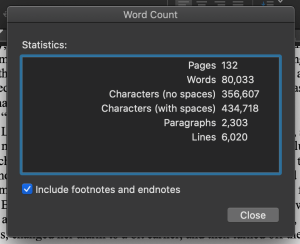
My first draft for Lucy’s story was about 60K, and I was panicked. I love the idea of this story, and I was heartbroken that I felt I had reached the end but missed the genre’s minimum by 20K. I knew, of course, that I had rushed things and that there were subplots that needed to be added, so I went through another round, and little by little, word by word, I reached 76K.

I was spent, though, and I was afraid to do anything else with the story because I didn’t want just to add word count – it had to be substance and story. So, I sent her off to three beta readers – and one has already returned her to me. (Thanks, Cody!)

I had intended to do a line edit when I went through each of the readers’ feedback, but it’s finals week, and there is an avalanche of papers coming in, so yesterday I simply sat and read through his feedback. He had some great points of places that felt rushed (partly in my effort just to get the story down – but also partly because I wasn’t sure a reader would care about those particular moments) and noted where he’d like more “showing”.

And little by little, the word count crept up – and she hit 80K. It was a relief – more so because it wasn’t just me aiming for the word count – it was adding in needed details and story. So thank you to Cody for getting me and Lucy over that hurdle.

Now to figure out a title while I wait for the others. 🙂

Sounds Like Me

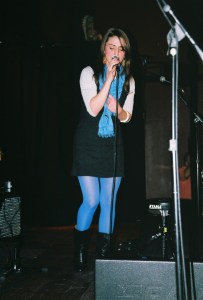
Sara B, St Paul, MN, 2007

The first time I heard Sara B perform, it was at an in-store signing/meet & greet at a Borders in MN. My significant other at the time had been a fan of Sara’s music ever since seeing her playing a song in the background of a movie called Girl Play. They had looked her up (a much more difficult thing to do in those days) and found a copy of her first album, Careful Confessions. At the time, I was in graduate school in Mankato, MN, and my SO was in town for a visit. It was October of my second year, and I knew of but hadn’t yet heard any of Sara’s music. This day was a birthday present for my SO. Including me driving up to and around St. Paul in a time before GPS. For me at least. After the mini performance, we got to meet with Sara B and chatted with her and took pictures and got signatures, and we found ourselves outside and my SO was flying high and said – I’m good. We can go home now.

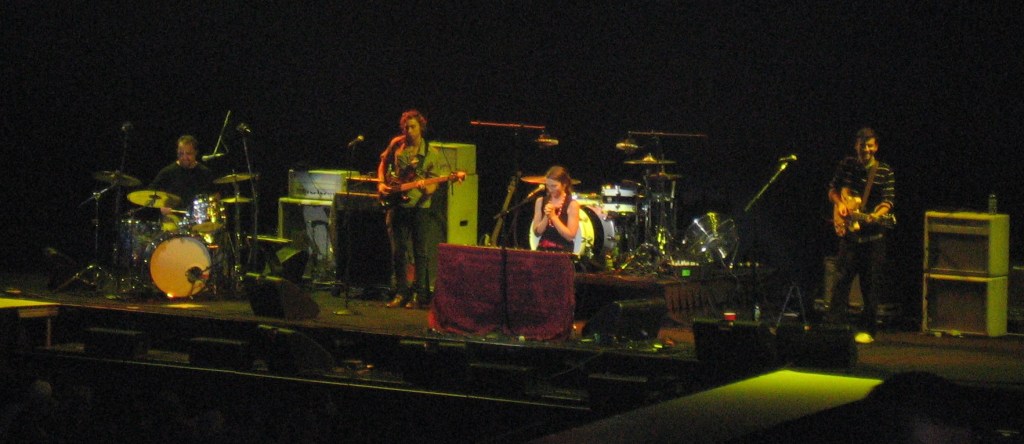
Which would have been fine – other than we had tickets for a concert that night, Oct 1, 2007, at the Xcel Center. Had I known about the signing prior to shelling out the money (which when combined with the gas money it took to get there and back, was a lot for me at the time), I wouldn’t have bought the tickets. But I had bought them – and we were going. And we were going for the sole purpose of seeing the opener for the opener of the headliner – Sara B. Again. This was time number two – Sara and her piano up on stage playing to a half empty arena singing her heart out.

Sara B w/her band, St. Paul, MN, 2007
Sara B, Madison, WI, 2008

The third time I saw Sara perform was at a small bar in Madison, WI, called the High Noon Saloon. This is also the night that, while we waited after the show for Sara to come out and do signatures, my SO leaned over and asked me to marry them. I said yes. And because of this, when Sara B finally did come out, and I walked up to her, my hands were shaking quite noticeably. She asked what was up – and when I told her what had just happened, she smiled brightly and hugged me. This is an anecdote we told for years to come as a part of the proposal story since upon my return to my SO’s side, they replied, “So, what was that hug all about?”

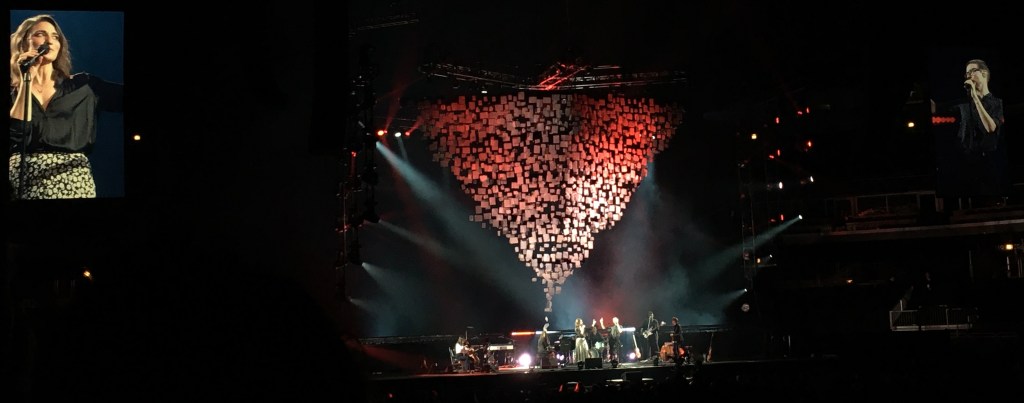
The fourth time I saw Sara B was a little over a year ago at the United Center in Chicago as she supported her album Amidst the Chaos. At this point, I was divorced several years and wanted a memory of this great singer in action that wasn’t tied to my now ex. It was yet another stellar night of music and storytelling.

Sara B, Chicago, IL, 2019
Sara B, Book Tour, 2015

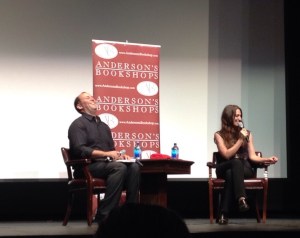
There was one other encounter in between the third and fourth, though not a concert. Two days before my sister’s birthday in 2015, I sat in a small auditorium listening to Sara B, on her book tour, call herself a “salty angry woman” and give writers the advice to “make yourself sit the fuck down and write.” (The notes I took from this event five years ago are still in my phone.) I bought two copies of her book that night, and even though we were instructed by the folks running the event that she wouldn’t be personalizing them beyond our name (thankfully written down on a post-it so that it would be spelled correctly…if I had a nickel for every book I own inscribed to Amy…), I whisper-asked if she would add a Happy Birthday to my sister’s copy that I was buying to gift to her in a couple days – and she smiled that smile and said sure.

The thing I hate to admit is that even though I did start reading the book when I first got it, I maybe got ten pages in and then stopped. I have no idea why. But when I was telling a friend of mine about all the heavy books I had been reading lately (of the last four, two were historical fiction about Shoah/Holocaust, one about biases, and one a memoir about female incarceration and starting a movement to aid women recently released from prison), he suggested that maybe the next book I read be something light. When I scanned my bookshelf, I saw this title sitting there still waiting to be read.

It was exactly what I needed in this moment in so many ways – the break down of her songs were interesting, her honesty and openness were welcoming, and her vulnerability was much needed at this moment in my life.

Beta Readers for Lucy

I went into the post office today. Normally, that’s not a sentence that is worth writing down – but considering I can count on one hand the number of times I’ve been inside any such establishment since *checks watch* March, this was a big deal. I donned a mask. I went inside. I tried my best to not clench my jaw.

So what brought me inside? Lucy. Three copies of my WIP printed and stuffed into manilla envelopes, addresses already written on the fronts in an effort to minimize the time spent indoors with other people. (I also had return envelopes that I needed to have weighed and stamps affixed to, and after I folded them and stuffed them inside with my manuscript, and despite the large piece of plexiglass between us, I still stepped back and turned to the side before I lowered my masked and licked the envelope shut. Life is strange.)

This is the roughest draft of anything I have ever shared with anyone. Even when I sent Jack pieces of Alice, I had already revised and edited them several times. I think part of the process is growing a thicker skin – being less afraid to be vulnerable by handing work over. The other part is I need eyes on it. The word count is still bit short – but I don’t want to add fluff for the sake of hitting 80K. I want to know what people want from Lucy. And then I want to add it. So, she is on her way. And she gets to travel farther than I do this year – to Illinois, to Oregon, and to Washington state.

And now I wait. I can’t wait to hear their thoughts.

COVID and Reading, Part Two

I hit another reading slump after my frenzy back in August. Part of this might have been because on top of everything else, the Fall semester began. It would be several months before I would read anything other than student papers – but once again, I suddenly became ravenous for it.

I opted to switch between fiction and non-fiction – all of these have bee on my bookshelf patiently waiting to be picked up. I can’t wait for the day I can wander around a bookstore. Until then, I have plenty of lonely books waiting for me here.

The Alice Network by Kate Quinn — Back before COVID, my friend Jack and I would meet up when he was in town and wander around bookstores and drink tea and eat chocolatey goodness. Three of these books came from the last time we did this. I do love historical fiction, and Quinn did a great job of putting me into the shoes of a spy in 1915 in enemy-occupied France and into the shoes of a young woman, pregnant and unmarried, in search of her missing cousin in 1947. There’s even a charming Scotsman – so how was I to resist? I will definitely be rereading this sometime.

Biased: Uncovering the Hidden Prejudice That Shapes What We See, Think, and Do by Jennifer Eberhardt, Ph.D. — This book should be required reading for everyone. Everyone. Eberhardt does an incredible job of explaining bias and bringing the receipts. I’ve done a lot of reading and work in the realm of bias, and still, I was blown away. This was a book I found through Eberhardt’s Armchair Expert interview – if you don’t have time to commit to the full book (though you should find the time), then at the very least give her episode a listen.

The Tattooist of Auschwitz by Heather Morris — Ok, so this book, it’s noted, started out as a movie script that Morris wrote after interviewing Lale Sokolov, a Slovakian Jew who was imprisoned in Auschwitz in 1942. During his time there, he became the tattooist of the camp, having to permanently scar those imprisoned with him with the telltale numbers on their arms. It was through this position that he met Gita, a woman he would fall in love with. Lale also risks his life, along with the help of some of the women he befriends, by smuggling jewels and money to workers who come and go – trading these for food and other supplies. The story itself is an account of Shoah/Holocaust that I have never experienced before – but I do have to note that the novel still reads very much like a script, which makes sense since that was its first iteration. It’s a lot of telling when I ached for showing.

Becoming Ms. Burton by Susan Burton & Cari Lynn — This was another Armchair Expert interview find, an interview with Susan Burton. Burton tells the story of her journey through sexual abuse at a young age and her subsequent battle with addiction and incarceration – and how one small thing changed the trajectory of her life – something that she has replicated with over 1200 incarcerated women. I gobbled this book up in one day – the entire thing. I couldn’t put it down. It’s heartbreaking and devastating and so full of hope. This is another MUST READ – a true testament to the difference one person can set into motion.

The Librarian of Auschwitz by Antono Iturbe (translated by Lilit Ĺ˝ekulin Thwaites) — This book was a thing of beauty. Devastating, as it is also about Shoah/Holocaust – but beautifully written. It’s based on a true story about the family camp set up at Auschwitz and the brave people who created a school right under the Nazi’s noses – risking their own lives to educate the children kept there. Within the school are eight smuggled books – anyone caught with these will be punished by death. Even so, Dita takes on the role of the librarian, taking care of the books, having to fix their covers and sew their pages back into place – risking her life to make sure the children have access to these books and the knowledge and stories contained within their pages. And this book – I lived and died within its pages.

The following excerpt comes from Iturbe’s afterward in the edition that I have:

~ Antonio Iturbe, translated by Lilit Žekulin Thwaites

Reaching the End…Again

Ok. NOW I have a full draft of Lucy’s story, and it’s sitting at just over 76k. I have more of that “accomplished” feeling that I had with Alice, which feels rather lovely to feel once more.

It’s a story of family, focused specifically on Lucy and her journey to discovering where it is she comes from. In it, she travels to Scotland, which was terribly fun to write because it meant reminiscing about my own road trip there, with all it’s “driving on the wrong side of the road” and breathtaking views. There are a couple places in this book that I didn’t visit on the first trip – I guess that means I have an excuse to return. 🙂

Reaching The End

I remember typing The End when I finished writing up All Falling Things. It felt like such an accomplishment – having written my first novel. A complete draft. I was exhilarated.

Well, I just reached the end of Lucy. And I feel anything but exhilarated. While I have the story arc completely written down, there is much work left to do. This has been such a different experience of writing – and I’ll admit I rushed to write the section I really wanted to write. And now I must go back and fill in the meat of it. In other words, I’ve got the main plot down – time to subplot-it-up. 20k words of subplot, in fact, to reach the genre’s minimum range. Perhaps that is why I don’t feel quite so exhilarated. I reached The End, but she’s not even close to being done.

Sometimes the Internet is a Wonderful Thing

In this time of COVID, especially, the internet can prove to be quite useful when it comes to research done from the comfort of one’s home. Like, did YOU know that the Chicago Public Library Digital Collections includes over 160,000 pictures and records given to them from the Chicago Park District? I didn’t. But now I do – and this is the project that Lucy works on during the (still untitled) book. Her Friday evenings are spent in the archive room, scanning in photo after photo, adding it to their digital collection.

To see the 1938 photo of Douglas Park that Lucy references in the story, click here.

I know I’m not the only one who gets joy from such things. 🙂

Things I’ve Learned on the Path to Publication

If there is anything that I’ve learned on this journey, it’s that there is no one set path to publication – though it can sure feel like there is a path and everyone is just keeping it hush hush. But there really is no chronological “to do” list that will guarantee publication – even if you have written the best book that has ever been written. It’s an isolating path, and it can seem overwhelming because so much of it is out of our control. I am in now way an expert – just sharing what I’ve learned along the way.

Beta Readers. Once you have a manuscript completed, and you’ve gone through and revised/edited it, the first step is to find beta readers (several – and try to make it an odd number so that if there is a disagreement on anything, it can’t be split down the middle) – specifically find people that you can trust to be completely honest with you. Having a love fest is not going to help you. You need people that can and will point out confusing passages and plot holes and things that just don’t work. This can be where having a writing group would come in handy – although your readers don’t have to be other writers. When you get your manuscript back, do your best to be honest with yourself as you go through and consider their feedback and your revisions.

Documents to Prepare. While your beta readers are reading, there are some documents you will want to put together. The first is the query letter. There are a lot of resources out there that can walk you through how to write such a letter, but the essentials are as follows: address the agent by name (obviously leave blank for now – but you should not be sending form letters with “to whom it may concern”), start with the hook and comps (titles of published books that would fall along the lines of your own), follow with a brief summary of your novel, mention why you chose to query them specifically, and end with a brief bio (mention platforms and previous publications/experiences only if they are meaningful). I emphasize brief – try to stick to one page/less than three hundred words.

Next, write up a synopsis of your novel. Again, be brief – one or two pages. If you are tipping over a thousand words, you are telling too much. Stick to the main characters and plot points – this is not a time for minor characters or subplots. On the flip side, this is not just a simple laying out of the plot – it needs voice, it needs character of its own. This is a chance to show off your own voice. Write it in third person. (NOTE: A lot of writers find it really helpful to write a two page synopsis before they even begin writing their novels.) Again, there are a lot of great resources out there for writing such a document.

Revise these documents. Have people read them over. Revise again. Edit like your life depends on it – because your book’s life depends on it.

Once you’ve done all that, attempt to write a Twitter pitch – it doesn’t have to go on Twitter, the point is just the brevity. If you had to sum up your novel in 280 characters, how would you do this? (Bonus if you can leave enough characters for a couple hashtags, such as those used for social media pitch fests.)

Editors. Before you send your manuscript to an agent, you may want to consider getting an editor. This step requires funds, though, and not all writers can afford this. An editor is not a requirement to submit to agents, but an editor can make sure your manuscript is truly ready. This is another place to be really honest with yourself about what you have written. Do you need a content editor? Do you need a copyright/line editor? Can you afford to do this? Your eventual publisher will assign an editor at their cost once you have a contract, but if your manuscript is riddled with plot holes and typos, it likely won’t grab the attention of an agent/reach a publisher. I often tell my writing students that an essay riddled with typos tells the reader that the writer doesn’t care about their work – so why should the reader? The same applies here. You don’t need to be an English major to be a writer, but if you don’t have a handle on grammar/mechanics, it’s best to get some help.

Searching for an Agent. Agents are the gatekeepers to larger publishing houses. There are a number of publishers that won’t accept unsolicited/unagented work. As I’ve mentioned in a previous post, there are a lot of places out there that will provide searchable lists to help you locate agents that are interested in the genre you are writing in. Two such lists are AgentQuery.com and Manuscript Wish List (MSWL also has an editor search). The key here is only submitting to people with interest in your genre and who are currently open to submissions. It doesn’t matter how good your book is – if you don’t meet their requirements, they will not even open your query. (The same goes for works outside their stipulated word count range.)

Also, make sure you only submit what they ask you to submit. The majority of agents will ask you for a query letter. Some might ask for a synopsis. Others might ask for a specific number of pages (I’ve seen requests for the first five, ten, twenty, or fifty pages). There may be other things they request. Biggest note: only send your manuscript when you are asked to do so.

If all goes well, you’ll get a request for a manuscript and then an offer to work together. The agent will then work to get you a contract with a publisher.

I would advise tracking which agents you have submitted to (you can submit to multiple agents at once) and when you sent them. Some agents will send letters (via email, generally) letting you know they aren’t interested. Others won’t respond – they will just note that if you don’t hear from them in, for example, six to eight weeks, that means they aren’t interested. (I had submitted to seventeen agents. I only officially heard back from six of them.)

Alternate Routes. If after a time, you find that you are not getting the bites you hoped for, or even alongside sending agent queries, there are other ways to get your manuscript noticed. One is contests – smaller publishers may offer contests that allow them access to manuscripts. The winner of the contest is usually published. (There are also usually reading fees associated with these contests; sometimes, there is a monetary reward for the winner in addition to what they will eventually get in royalties.) You can find these by searching for publishers that publish in your genre and see what they list on their websites. Another is a pitch fest on social media. For example, there is #PitMad and #DVPit on Twitter. (#RevPit is a contest to win a free edit of your manuscript.) Like contests, pitch fests can be tailored to specific genres, author identity, etc.

Small publishing houses are also (sometimes) open to unsolicited manuscripts. Get to know books that are in the same genre/line as your own – see who is publishing them, who their agents and editors are – then see if any of them are open to queries.

Contracts. My first piece of advice if someone does offer you a contract is to take a deep breath. Take five. Sleep on it if you can. This was an exciting experience for me – and it was a bit strange because they emailed me to let me know they wanted to offer me a contract and was I interested. I said sure since it couldn’t hurt to look – and looking didn’t obligate me to anything. When they send you the actual contract, read over it – but take a few more breaths. I was not given a date I had to decide by (I even asked if there was one, and they said there wasn’t). If the publisher is rushing you – that might be a red flag. You should have the time to explore legal representation (which is again going to cost money).

A piece of advice offered to me that I took was to apply to the Authors Guild – this was given to me about a week after I was sent the original contract. I wish I had known right away – so I’m telling you, whoever is reading this. Please note, this is ONE option – you do NOT have to do this. There is a fee associated with membership – but when you have a published book or a contract offer, you can apply for a membership level that includes free legal assistance in a couple of ways – including reviews of contracts. This will allow someone who does this for a living to catch any red flags that might exist within the contract.

Another piece of advice I offer you is this – ask the publisher if your contract is open to negotiation or if it is the finalized offer (i.e. take it or leave it). While you want to make sure you have someone look over the contract, you should know what they should be looking for – are they only looking for red flags, or are they looking to offer advice on what you should negotiate for? This will affect the time you then take to consider the offer – either you are looking for a straight yes/no, or you are considering the points the legal advice offers and deciding what you will then turn around and ask the publisher. Understand negotiations are a discussion – they may say no; they may come back with a counter-offer. Just don’t waste the time coming up with that initial response if their offer is already finalized in their eyes.

The biggest piece of advice I can give you is this – you have a right to walk away, and if you feel at all uncomfortable with an agent or a contract offer, walk away. I know this sounds bonkers considering this is the goal – but you wrote the book, and you deserve to feel comfortable with how it will be handled moving forward. Don’t sign everything away just because you want to see your book in print.

The next piece of advice – ask questions. Even if you feel like you have asked too many questions. Get your questions answered before you sign anything.

Last bit of advice – read rules/stipulations carefully. Some agents will note not to send to other agents at the same agency until you have heard back from them. Some contests will stipulate things like unpublished authors only or stipulate things like an author’s sex or race/ethnicity. Don’t submit to things that you don’t qualify for.

I Signed It

It has been twenty-four days since the email wanting to offer me a contract to publish All Falling Things arrived in my email inbox.

It’s been one day since I signed this contract. It’s official – my manuscript is one giant step closer to being published.

After many emails back and forth with the editor-in-chief, after asking questions through an author support page on Facebook, after learning about and then applying to the Authors Guild, after many conversations with a few of my friends, after several FaceTime sessions with Jack, after twenty-three days of debating and consulting – I signed it. Jack and I were FaceTiming when I initialed each page and then signed (electronically – which felt anticlimactic). And after all that, I felt – numb. It’s still sinking in, I think, but All Fallings Things is officially “forthcoming”.

24 days can be converted to these units:

  • 2,073,600 seconds 
  • 34,560 minutes 
  • 576 hours 
  • 24 days 
  • 3 weeks and 3 days
  • 6.56% of 2020

What’s in a Name?

This post contains spoilers for All Falling Things.

Though most of the characters in this book are connected by name only to AIW (mostly the secondary characters), there are a couple who are based more around characteristics. Because of this, I had a little more room to play with their names. I really like finding names that are significant to the character in some way.

Take Kya Asho, the woman that becomes Alice’s bestie. Kya means “diamond”; Asho means “pure of heart.” She embodies both these things (diamond by way of her sparkly personality – it also alludes to a stressful backstory, which we don’t get to in this book).

Then there is Lucas Shiri. Now, if you don’t want a major spoiler…stop reading right now.

Lucas means “light”. Shiri means “song of my soul.” In the original ending of this book, one of Alice’s goals was going to be to explore her relationship with Lucas. It was in my head from the start that she and Lucas were soul mates (if such a thing exists). Sorry to those that were #TeamStanley – he was never meant to be her forever. Lucas is. BUT – I didn’t want this story to be about “finding a man.” Love is wonderful – but it’s not what Alice came all the way to Chicago to seek. The story instead ends with her finding herself. (Also, at the end of the book, she is intrigued by Lucas, but their romance has not yet bloomed. Alice was telling the truth when she told Stanley there was nothing between them.)

And then there’s Cat. Again, it was never my intent for Cat and Stanley to end up together. (Don’t worry – their loves are out there.) For one, it felt too easy. It also felt more like Stanley would have been using Alice, and he really wasn’t. He did truly love her (and she did truly love him). But Cat – poor fierce fabulous Cat. Her last name, Scordato, means “forgotten” and “left behind” in Italian. Cat is on her own journey – and she will find her happy ending. But a romance with and marriage to Stanley is not part of it. She is finally on her own path, too, by the end of the book.

Then there is the title, the name of the book – All Falling Things. This is reference to the idea that all of the people within its pages are searching, are on their own journeys. For some it’s falling in love (Kya and Simone). For others it’s falling out of love (Cat). For others yet, it’s both (Alice and Stanley). For most of them, it’s tripping and falling over their own feet (metaphorically, of course) as they try to find their places in life. Even Cat, who seems so sure of everything, is seeking her place.