Growing up in a suburb of Chicago, I, of course, learned about the Great Chicago Fire. It’s a fire that many across the country learn about. After all, in just three days, 2,100 acres burned, leaving over 100,000 people homeless and taking the lives of over three hundred people. Historians still debate the impact of the fire, some believing that without it, the city would probably have simply been a ‘much smaller metropolis and not the second largest city in the United States.’ (In the two decades that followed, the city’s population more than tripled – to one million.)
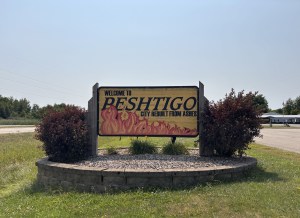
Then I moved to Wisconsin – and I learned about that other fire, the one most people outside of the state have never heard of.
On the very same night as the Great Chicago Fire, another fire took hold two hundred and fifty miles north – in the town of Peshtigo (PESH-tih-go – the fact that I feel compelled to include a pronunciation should be telling to how few people I’ve met who have heard of it – well, that and how it was mispronounced as pesh-TEA-go in a film staring Michelle Pfeiffer).
This fire is believed to have been started by railroad workers clearing land for tracks, starting a brushfire – that became an inferno. (Not as glamorous a story as Mrs. O’Leary’s cow*.) It had been unusually dry that summer, and the fire moved so fast that some survivors said it was like a tornado (in fact, it is referred to as a firestorm).
In its wake (which included jumping over the bay, a distance of about fifteen miles), the fire consumed 1.3 million acres and destroyed seventeen towns, taking a couple thousand lives with it. The reason it’s called the Peshtigo Fire when so many other towns were involved was because this is where the first started, the entire town was consumed in an hour, and eight hundred lives were lost here alone. (The image below shows the difference in scale of the two fires – that red blip on the right is the Chicago fire’s burnt district. NOTE: This is not a contest of which was worst – this is simply a way to help folks better understand the true scope of this particular fire.)
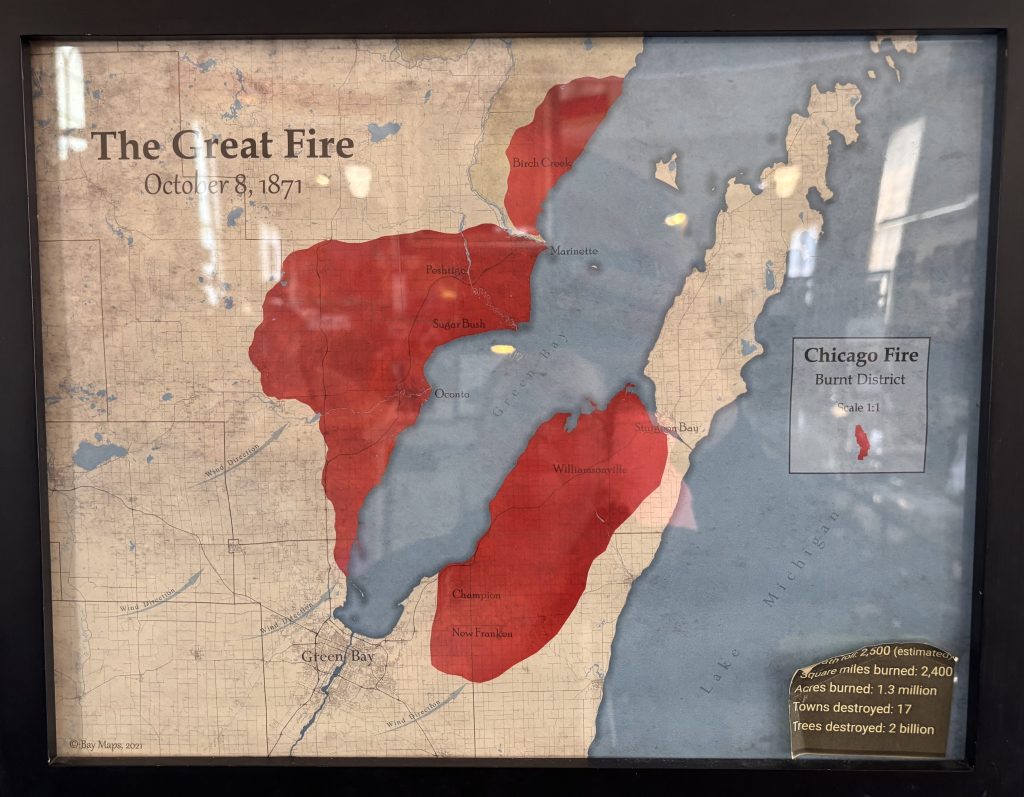
So, if the Peshtigo fire was so destructive, why is it that most have never heard of it when they have heard of Chicago’s? Some believed it was because a city’s fire made better news than a series of small towns. But it may actually have been that Peshtigo’s only telegraph line had been destroyed in the blaze, and news of the fire didn’t make it out until much later. (Remember, this was the late 1800s.) By the time news of the fire spread, it was old news. (I also acknowledge that many other fires occurred around the Midwest around the same time that I also didn’t learn about in school.)
You may also be asking why on earth I’m telling you all this.
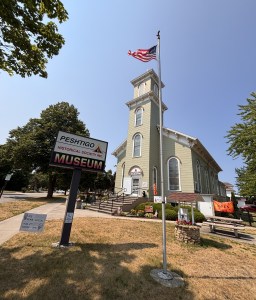
Well, recently, I took a spontaneous road trip, and on the way home, I stopped by the Peshtigo Museum**, which includes artifacts and information about the fire – something I’ve wanted to see in person for some time. I’d never been to Peshtigo before.
In grad school, I had written a poem*** about the fire based on a detail that remained with me – that people who could escaped to the river in the hopes of hiding from the fire. The fire was so intense, it continually flamed out over the river, and the air was so hot that people had to constantly splash their faces with water, some covering their faces with drenched clothing so that the air wouldn’t scald their lungs. And they had to do this all night. Some managed to survive this way. (I made the date the name of the poem, but I had to add ‘Peshtigo, WI’ to it because my classmates, of course, thought I had written about the Chicago fire.)
Well, I finally got to see the river I had written about in person.

Outside the museum and plaques around town, there is not sign of the fire that ravaged this area over a hundred and fifty years before – but staring at that river, I could still feel the history of it.
Had you heard of the Peshtigo Fire before reading this?
Some tidbits for ya:
*Mrs. O’Leary’s cow has since been exonerated – apparently a journalist had made up the story in an effort to create some drama (because a city decimated by fire wasn’t dramatic enough?). Even after said journalist admitted to this, the story carried on. Probably (at least partly) because we don’t know what started it.
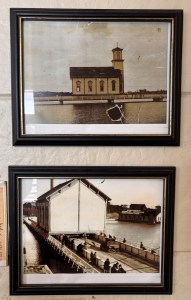
**The Peshtigo Museum resides in an old church, which sits on the site of the original Catholic church that was lost in the fire. The church that had been rebuilt on the same spot was struck by lightning and burned again. The current church had actually been one that had been rebuilt on the other side of the river (see images to the left – or above depending on the size of your screen), and when the second church burned, a plan was made to move this other existing structure. It took three days to move it across the river – and then, once placed, they realized that they had set it down backwards, and they spent another half day turning it around.
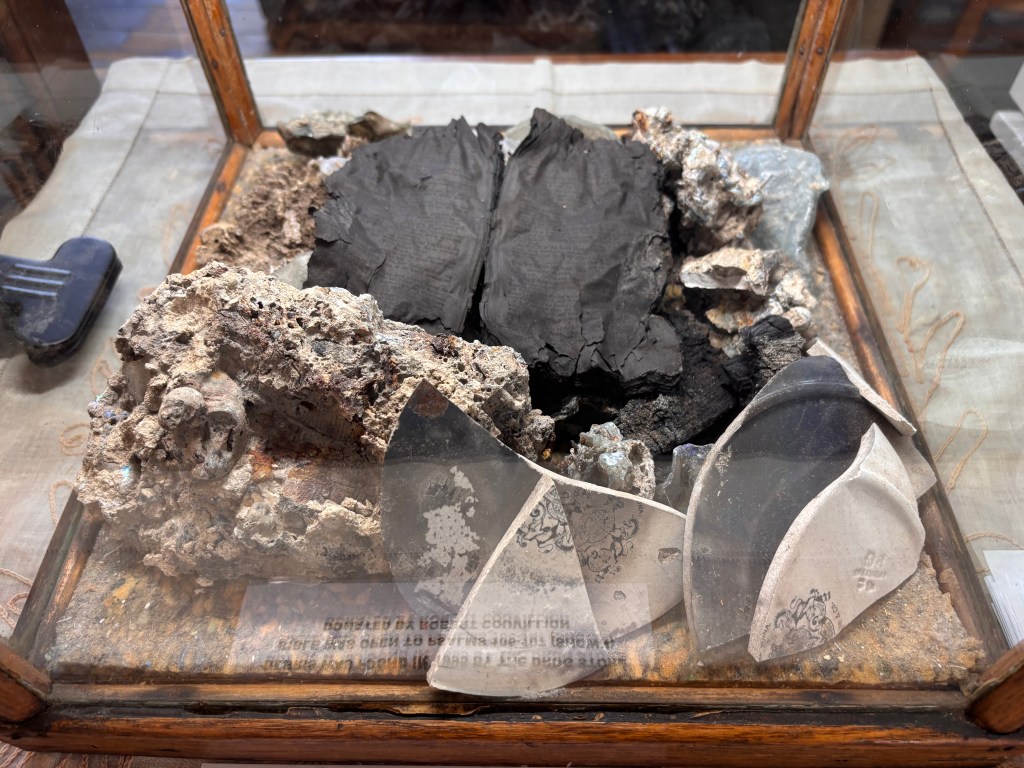
The image below shows some artifacts that were found on the site, including a bible that had been found sitting opened, severely charred. If you zoom in on it, though, you can still read the print.
***My poem found a home at a creative nonfiction journal, and then a few years later, I read it at an event for UntitledTown. After I was done with my reading, my former undergrad professor/advisor, who has done extensive research on the fire in support of a novel she’s writing, informed me that like many people, animals also sought the river to escape the first. Herds of cattle, for instance, who inadvertently drowned many of those people. In my own research, I did find an account of one thirteen-year-old German immigrant girl who managed to survive by holding the horn of one of those cows all night.

