I generally only post on Fridays, but today was a good day – and in a time where those can feel rare, I thought I’d break my schedule for these moments.
The first big moment came this morning when I sat down to read my story – today marks day 90 of my #365Stories #AStoryADay challenge. 90 Days. 90 Stories. 504,647 words. This has been such a fun challenge for so many reasons – but my favorite is just the experience of these stories that I wouldn’t have otherwise come in contact with. (My favorite story thus far is “Paper Menagerie” by Ken Liu – I highly recommend checking it out.) Nine more months full of new adventures await!
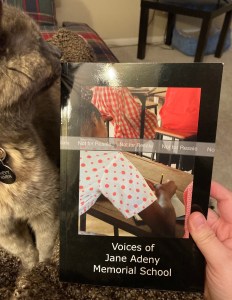
The other big moment came when I arrived home and checked my mail – and found the printed proof of the Kenya project, Voices of Jane Adeny Memorial School, waiting for me! This project started a decade ago when I was taking some classes for fun at the nearby university. I never expected this academic endeavor would have landed me in Kenya. I never could have anticipated the bumps in the road to getting this put together and published. But here we are – a GIANT step closer. My weekend will, amongst work-related things, be spent reading over this and trying to find any issues with formatting and any remaining typos (with the understanding and humility to realize there will likely remain a typo or two no matter how many times I read through this). Just feeling so many feelings now that I’m finally holding this.
I’ve offered to collect prompts for my writing group’s poetry challenge for the month of April, which in the U.S. is National Poetry Month (among a lot of other things). Thanks to the internet for allowing me to scour and collect the following list:
Write a poem that is about something abstract – perhaps an ideal like “beauty” or “justice,” but which discusses or describes that abstraction in the form of concrete nouns.
Write an ode praising something society has told you that you need to be ashamed of.
Turn on the radio to a station of music you don’t traditionally listen to. Don’t turn it off until you’ve finished a poem.
Write a poem on how to do something mundane most people take for granted, such as how to tie your shoes, how to turn on a lamp, or how to pour a cup of coffee.
Write a poem with no more than twenty-five words, including the title.
Write a poem about a thunderstorm in your attic (or another form of weather indoors).
Write a poem about a person you lost contact with several years ago.
Pick up the book nearest to you. The last line of the book is the first line of your poem.
Think about something you own that is broken and write about possible ways to fix it. Duct tape? A hammer and nails? Get metaphorical/abstract/fantasy.
Write a poem about after the party – when all of your guests have gone home.
Write a poem telling someone they were wrong and why.
Write a poem where you admit you were wrong and why.
Imagine there are ladders that take you up to the clouds. What could be up there? What feelings do you have about climbing the ladders, or is there a mystery as to how they got there in the first place?
Write a poem about the magic word someone needs to access your true self.
Write a poem about doing your least favorite chore.
Write a poem about building a fire.
Write a poem about waking up.
Write a poem about the necessity of making mistakes.
Write an ode to a stranger you see on the street.
Write about feeling lost in a crowd.
Write a poem that personifies a letter that never made it to its recipient.
Write about the last picture that you took.
Write about why the keys get lost – perhaps what the keys are saving the person from down the line by delaying them.
Write a poem in which the words or meaning of a familiar phrase get up-ended. For example, if you chose the phrase “A stitch in time saves nine,” you might reverse that into something like: “a broken thread; I’m late, so many lost.”
Even before the pandemic, Cave Point was my happy place. It’s got everything – hiking, water, excellent splash opportunities. During the pandemic, it’s become a safe haven for my mental health, whether I stop by on my own or adventure with my dear friend, Jen.
Credit: Jen McDonald*
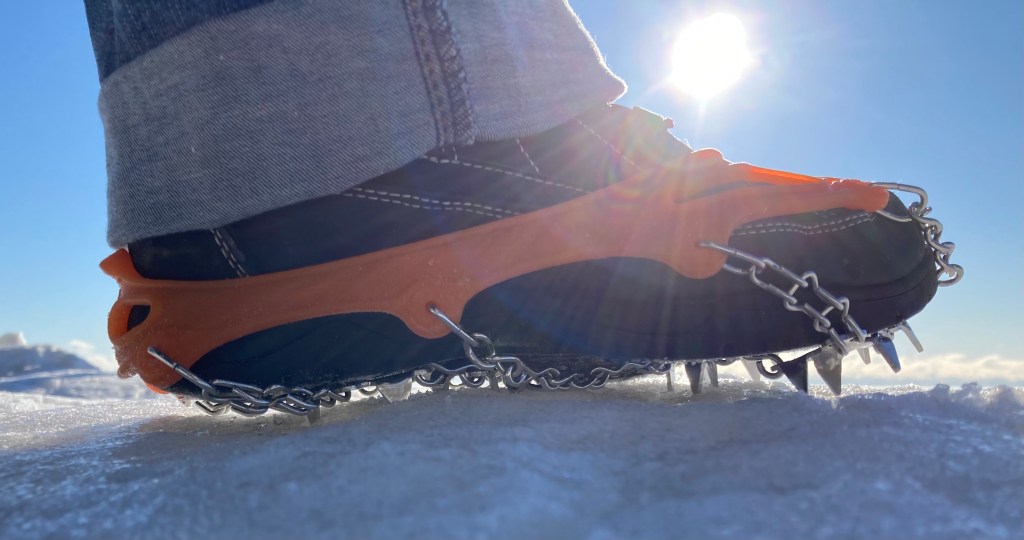
It really doesn’t matter what time of year one heads to Cave Point – it’s always beautiful. And calming. Even when there’s freezing rain or such strong wind that the splashes easily overshadow (and drench) anyone who is standing on the cliffs. Which is why safety is always the key. Especially when the cliff tops are covered in ice – this adds to the beauty, but also requires proper equipment.
Last weekend, I headed up to Cave Point with a couple friends, and the water was so calm and low that we were able to climb down (safely, of course) one of the cliffs and use our ice cleats along the limestone below – normally under water. We could not have asked for a more beautiful day. (Though don’t let the pics deceive – it was cold, like -8 wind chill cold – which is why I again say proper equipment is important.)
Credit: Jen McDonald*
Cave Point is located on Lake Michigan between the towns of Valmy and Jacksonport on the Door County Peninsula, the “thumb” of the state of Wisconsin. The cliffs are made of dolomite and limestone, part of the Niagara Escarpment that runs under the entire county, and have been carved by centuries of beatings from the lake.
In the 1930s, the Door County Board of Supervisors had the forethought to preserve nineteen acres, which is today known as Cave Point County Park. If you’re feeling up to some traipsing through the woods, there is a trail along the shore that will take you all the way to Whitefish Dunes State Park. During the summer, there are picnic benches you can sit at and eat lunch (please take all trash out with you). If you’re an experienced diver, you can access dozens of underwater caves. If you like to kayak, there is a launch about a mile north of the park.
I highly recommend finding a good spot to sit and watch the water – and wait for the perfect splash.
*Whenever we go to Cave Point, Jen and I sneak pics of one another as we explore. These two are ones she snuck of me. 🙂
Recently, I was asked “What do you wish someone had told you when you first began to write?” And honestly, it stumped me in the same way “What is your favorite book?” or “Who is your favorite author?” stumps me – in that I have far too many answers that I can’t possibly narrow it down to one. If I had a chance to sit young-me down and have a conversation about writing, I’d probably overwhelm the poor girl. So instead I sat with the question for a bit, and I finally came back with – I wish I had been allowed to take it seriously earlier.
People are often shocked to find out that I actually started college as a business major (well, people who know me are shocked, at least). It felt like a safe choice – something I knew I could do that I would be able to support myself with. But it wasn’t the thing I wanted to do. I wanted to write. But the chances of making a living on that are fairly slim (at least in my world at the time) – and I had been raised that stability was to be the number one choice in one’s career.
A couple months into my first semester of college, though, I was bored to tears. I changed my major to English, deciding to follow another childhood dream of mine – teaching (yeah, the pay is not the best – but it could hopefully put a roof over my head and keep me close to the thing I truly love – I mean, someone actually wants to pay me to talk about writing all day? Sign me up.).
College was the first time I allowed myself to be serious about my writing, which wasn’t necessarily supported by everyone in my life. This turned out to be an important boundary for me, however. So if given the chance, I would sit down young-me and tell her, “If you want to write, then write. Even if every single person around you doesn’t take it seriously, you can. You don’t need anyone else’s permission.”
I still remember the first time I saw my name in print. The experience was exhilarating. In a “right place, right time” scenario, I had learned that the county paper was looking for someone to write the weekly column of my town’s news (the previous person having just retired). I was a freshman in high school, but, as the kids say these days, I decided to shoot my shot, even though I was certain they would never hire a fifteen-year-old. But they did.
My first column appeared on December 19, 1997 – my first and last name in small print below the bold text of my town’s name. I know this because each week, my mother cut out my columns and collected them in one of those old school photo albums, the ones with the sticky pages and the clear plastic sheet you peel off and then settle back over whatever you are trying to preserve. All four albums (one for each year I wrote the column) are currently sitting on my bookshelf. This is probably the first time I’ve looked at it since I wrote it, and I’ve already found an error.
For all those inquiring minds out there – I got paid a whopping fifty cents an inch. I was lucky if my month paycheck hit double digits.
But the pay didn’t matter – I was already living a (short) life-long dream of seeing my name in print.
When I got to college and started writing short stories and poems and submitting them to places, I came upon a question that all writers will face (though some will likely never bat an eye at it) – what should my byline be? In some instances (like my college’s literary journal), I opted for my first and last name. For some other pieces, though, that I sent out into the world, I opted for a pen name. Why? Because I was afraid who might find it. Not in a – I wrote mean things about them sort of way – but in a – what if they make fun of me for taking this seriously sort of way? That feeling took a long time to stamp down. (And honestly, looking back, I realize these people would never have randomly googled my name looking for something I might have written, anyway.)
Today, I opt for my full name. Part of this is to take ownership and pride over my writing. I worked hard on it, after all. The other, the use of my middle name, is a bit deeper – it’s to honor my maternal grandmother, from whom I received the name. But also – I’ve stopped caring who takes me seriously or not. I take it seriously.
It’s a personal thing, what you decide to use as your byline. If your want to use a pen name because you’re worried about what people will think of your work – remember that no matter what, there will be people who love it and people who don’t. Here’s a great article to help you with your decision – The Pros and Cons of Using a Pen Name by Kelly Notaras.
Just don’t underestimate the exhilaration of holding your first book (or article or story or poem) and seeing your name. I still get goosebumps. 🙂
For this month, I chose (kind of) at random stories from Granta, the literary quarterly from Cambridge University, something I’d stumbled upon in my search for stories. I say ‘kind of’ because I scrolled through their list and chose any story that I came across – but skipped over the excerpts because I wanted stand-alone stories. As with the previous two months, I have no idea what these stories are about – the goal is simply to experience new writing. Feel free to read along!
Probably the most difficult thing I’ve found to track/wrap my head around is tracking multiple projects. This is new to me. In grad school, when I was writing multiple short stories all at once while working on my thesis, there still wasn’t all that much to track (mostly because there was one destination for these stories – my thesis). Currently, I’ve found myself in the position of having one book in the process of being published, two manuscripts ready to query, and two WIPs. I realize I’m fortunate to be in such a position – but sometimes, it’s just difficult to know where to put my focus. (Well, when my editor sends my book for edits, that’s obviously where my focus goes.) Part of the overwhelming feeling comes from the enormity of all of this. But like any large goal, we just need to break it down.
‘Query my manuscript’ can be broken down into a couple steps: 1) write query letter (which you will want to personalize to each agent), 2) write synopsis (several versions – I recommend 1 page, 2 page, 1000 words of or less – but be prepared that an agent may have another specification), 3) searching for possible agents, and then 4) submitting a specific number of queries each week.
Again, I use Excel to track agents I’ve submitted to (with headlines of the date I subbed, the agent’s name, agency, and email, what they request, and the URL to their agency page and/or MSWL or Agent Query page). When I submit, I fill the row in yellow. When I hear back, I change to red for rejection and green for a full request (and then to red when that’s rejected). It’s important to track the date you send your request – many won’t respond because of the volume they receive – so they may have a “if you don’t hear from me in X number of weeks, you can assume it’s a no.” Also, track the agency – some will request that you don’t sub to more than one agent at their agency at the same time. If the first rejects, though, you can sub another.
Small goals should also be feasible. A small goal is not “I’m going to sub fifty agents this week.” Maybe ten. Maybe five. Maybe fifteen. But fifty is a lot.
Checklist marked red with a red pen
My plan is to spend this week searching for possible agents to query. Starting the following week, I’ll submit ten a week, five per manuscript.
The second part of goals is accountability. For me, it’s writing them down in my planner. Like I said last week, I’m the queen of to do lists. If I can get it down on paper, then I’m not having to hold it in my head as something to do. But also, it’s super satisfying for me (someone who works well with intrinsic motivation) to check it off when it’s accomplished.
As for the WIPs – again, the process here will be a personal one. Some people are “I write an hour every single day” people while others attempt a specific word count.
REPEAT AFTER ME: You do not have to write every single day in order to be a writer. Folks who tell me, “Oh, come on, you can find fifteen minutes somewhere” clearly have no idea what it’s like to be a teacher who has some weeks that are overloaded with grading, or that some folks just can’t work in fifteen minute increments. I have a writing day – Fridays. I don’t expect to write any other day, though it is a bonus if I do discover some unexpected time to sit and write. I write this day in my planner, too. I put up boundaries (I mark this entire day as busy on my work calendar, and I have it in my syllabus email policy that I don’t check email on this day). I make it a priority. I also don’t put requirements on my writing goals (which I know, I know – goals need to be measurable!). I don’t count minutes in the seat or words on the page. For some people, these things help keep them moving, which is great. But again – if it doesn’t work for you, then don’t force it.
There are many ways to track your projects. Mine go onto my to do lists in my bullet journal. I also have a small group of writing friends that meet every week who help hold me accountable when I share these goals with them. But you can use Excel (or another such program) to track minutes/words/submissions. Use a planner or notebook. Whatever works best for you and you can easily access. I just promise – getting it down and out of your head makes it all seem much more manageable.
I’m a planner person. Leading up to the new year, I sit down and draw out weekly schedule templates in my bullet journal. Because of the nature of my job, my life gets planned four months (a semester) at a time. I am the queen of to do lists.
And I get teased mercilessly for it. ¯\_(ツ)_/¯
But this is how my brain operates. I like to know what’s coming so that I can 1) better address inquiries into my time (sorry, I have 20 papers to grade that day – or – looks like I’m free!), and 2) predict how much energy I will be expending on a given day (Introvert with a capital I over here).
So it probably surprises nobody that I’m also a planner in my writing. (I’m also a huge Excel nerd – I once took an Excel class for fun – so I am happy to find any excuse to use the program.) I’ve found templates for calendars within Excel that work really well for keeping track of my story’s timeline:
My first novel in particular is tied to specific real-life events, so to keep everything straight, I needed to get it all down on paper. (I even went so far as to look up specifics about things like weather that actually occurred on those days.) It helped so much that I’ve done the same with my current WIPs – it helps with continuity so that I don’t have rain when it’s supposed to be the middle of winter.
Again, you don’t have to use excel, but I highly recommend such tracking to keep your timeline from getting tangled up.
I remember early on in my learning about writing stories being taught Freytag’s pyramid: introduction/exposition, rising action, climax, falling action, denouement. At the time, the simple structure made sense and worked just fine with the types of short stories I was writing at the time.
As my instruction went on, as my stories became more complex, I learned about variations of this pyramid – the straight line of the rising action imitating the “spikes and dips” one would find on a titled EKG printout. No (good) story is a beeline to the climax – there are many small climaxes along the way, with resolutions of various sizes. Not to mention – subplots. (The other piece, of course, that complicates that line of rising action is the length of the story. A short story will have fewer spikes and dips than a novel.)
In grad school, I had the opportunity to take a screenwriting class, during which we talked about the three act structure – which for some reason just clicked with me. I liked the rhythm of it.
While I still teach the variations of the Freytag Pyramid when I teach Fiction (we write flash and short stories in the class), I also teach the three act structure for those students who might be interested in novels. I use a breakdown of The Wizard of Oz and reference K. M. Weiland’s Structuring Your Novel.
For myself, after I’ve filled out the questionnaires for each of my main characters and have cast them all, I sit down with this three act breakdown (exposition, inciting incident, plot point one, rising action, midpoint, second plot point pre-climax, climax, denouement) and fill in what I can about what I see for the story. I still find the corresponding Wizard of Oz plot points help to spur my own story forward.
The most important thing, though, is that despite being a planner when it comes to my writing, I don’t hold myself to what I put down in this document. The story may shift as I’m writing it. New characters might emerge. I might better realize the story I want to tell. This initial outline is just for me to get an idea of the arc and begin to thread in the subplots. This can also help with writer’s block – I don’t have to sit and wonder what comes next because I already know the scene I have to write. If become stuck at a particular plot point, I’ll try writing a different part of the story. An outline doesn’t have to be super detailed – I just find that the more detail I can get down initially, the easier the drafting stage is for me.
I’m part of a really stellar online, global writing community. I found them, actually, through a workout program, and they were such an unexpected bonus who have become super important in my writer world. We have a private Facebook group where people can ask questions and share resources, and I’ve found questions about a specific subject that keep circling around – tracking. How do we keep track of…well, everything?
I’m always happy to share what my process is like, and I make sure to note that what works for me won’t work for everyone, and to be sure to read what others have said and try things out. It can take time to get a process together that works for us as individuals. And even then, it will continue to shift and grow as we continue to work.
The conversation came up again recently, so I thought I might share here what I’ve been doing for tracking characters, plot, timelines, and multiple projects – though I’ll start here with Characters. I’m drawn to reading and writing character-driven stories, so it’s not surprising that ideas come through them. I generally get a sense of the story through learning more about them.
My first step is to conduct an interview with them. I really like K. M. Weiland’s character questionnaire:
Over the years, I’ve added a few questions (like pronouns) and edited a couple to make them better fit what I was trying to accomplish. (I also direct my students to this for their own work – as I tell them, they should want to know their characters so well that if I were to ask what brand of toothpaste their character uses, they could answer without hesitation.)
After that, I like to cast my characters. I usually have an idea of what they look like in my head, but I want something solid to refer to when writing so that I can make sure I’m consistent with their details. I use PowerPoint to track photos and other details about these characters, as well as images of any important items or settings that appear within the story (even for stories that exist in made up settings, I’ll still try to find photos that best represent what I’m seeing in my head). As a visual person, I find this to be so incredibly helpful to track.
If you don’t have access to PP (or just don’t like it), there are many other options for visual ways track your characters (items, setting, etc.). One example that a friend from my group uses is Pinterest. (I had a brief, torrid love affair with the platform about a decade ago and had to ban myself from it because there are just too many cool crafty ideas and delicious recipes to explore – and I can’t be trusted with that kind of access.)
A similar platform with less temptation that I’ve used for many things is Trello – you can create separate boards, and then within them, separate lists that have individual cards. You can include images, text, links – anything you would need to help yourself track. The bonus here, like Pinterest, is that it’s a web-based platform – so it’s essentially saved on a cloud, and you have access anywhere you have internet/data. (They also have an app for your phone.)
If you are more the type who likes making webs to track things, there’s Miro – a virtual whiteboard. I do not have personal experience with this platform – it was a recommendation I found via the writing community on Twitter.
There are, of course, a plethora of possibilities for tracking – and some will work for you, and some won’t. The point is just to try out a few things until you find the thing that clicks.


 Ami Maxine