A Poem in Your Pocket

repost from my work with UntitledTown

Did you know that in 2002 the Office of the Mayor of New York City, in partnership with the city’s Department of Cultural Affairs and Education, started Poem in Your Pocket Day? Or that in 2008, the Academy of Poets expanded the program across the country? Or that in 2016, the League of Canadian Poets extended the program north?

Wait – what is Poem in Your Pocket Day, you ask? 

It’s a day to celebrate and share poetry. On this day, pick a poem, carry it in your pocket, and share it with others – at school, at work, as you wander through the bookstore…share with anyone anywhere. (Share it on social media #pocketpoem)

I first learned about Poem in Your Pocket Day when a colleague of mine started stuffing our mailboxes with origami-folded poems a few years back. This “poems for pockets” giveaway has become a campus-wide endeavor for us. And we encourage you to do the same. Pass them out at work. Pass them out at school. Pass them out on the street or to patrons in your favorite coffee houses. Create bookmarks with your favorite lines of poetry. Add a short poem to your mail signature. Get the word out there – poetry is for everyone!

Poem in Your Pocket Day this year is April 29. See their website for more information.

National Poetry Month – Danez Smith

The first time I met Danez Smith (they/them), they asked me if I was IT. I promise that this is not something I should ever be confused for. I have mad respect for any IT person – because I know NOTHING about fixing computers. Any fixing I’ve ever managed has been total dumb luck (or via tips from my dear friend, Cody, who is my go-to for all things tech-related – for which I both thank and apologize).

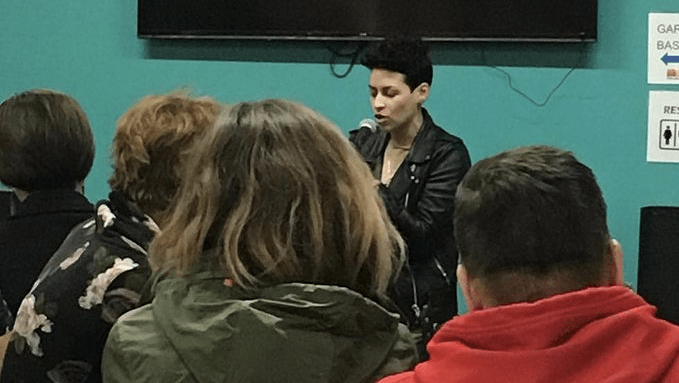
That day, I was just me being me – arriving earlier than most people. I was not IT – I was there for their craft talk on long forms of poetry for UntitledTown, Green Bay’s Book and Author Festival. But in full honesty – they could have been planning to read from the phone book, and I would have gone. I’ve been a fan of Smith’s poetry for some time, and I was happy to study at their feet.

Smith was also the keynote poet for UntitledTown that year, and we were granted a chance to spend an hour in the same space as them reciting poetry – and it was pure magic. I got literal goosebumps.

Smith has four books: Homie, Don’t Call Us Dead, [Insert] Boy, and Black Movie. There are links for all of them on Smith’s website, as well as a collection of recordings of their poetry. They also co-host the bi-weekly VS podcast with poet Franny Choi, which is presented by the Poetry Foundation. You can follow them on Instagram and Twitter.

First Interview

This morning, my first official interview as an author dropped! I was nervous heading into this, but Kathleen Foxx, the host of Badass Writers Podcast, put me at ease quickly. We had a lovely chat where I talk about writing, my debut novel, and the how the Voices of JAMS collection came to be (which, by the way, you can officially purchase by clicking here).

As for the interview – the episode is available via Apple, Spotify, Ancho, and Google Podcasts. Links are available through Kathleen Foxx’s website.

National Poetry Month – Andrea Gibson

I first heard the name Andrea Gibson about a decade ago when a friend mentioned them (Gibson’s pronouns are they/them/their). My friend said Gibson was their favorite poet and said they were coming to campus and asked if I would come along. I am so very glad I said yes.

Gibson has a way with words and being on stage that I envy – something I know is not in my own body, something that cannot be learned. I fell hard for their poetry that day, purchased their book (Pole Dancing to Gospel Hymns), and devoured it. (They’ve had several other books and CDs out since then.)

I’ve lost count at this point of the number of times I’ve seen Gibson perform – stand alone performances, joint performances, conferences, etc. My favorite performance, hands down, was the UntitledTown performance on April 27, 2019, at the Tarlton, formerly The West. Back when I was in college, The West was the first queer space I ever existed in. It was a place to dance and not worry – so to hear Gibson’s poem in this space about the first queer space they ever existed in was something else. Plus, we had the cutest ever sound check with their pupper, Squash. And when Gibson read “A Letter To My Dog, Exploring The Human Condition” directly to Squash, who sat so attentively – this was the sweetest moment of poetry I’ve ever experienced.

During the pandemic, I’ve had a couple opportunities to “sit in” on performances that Gibson has held in their home via Zoom, and I have found these performances just as engaging as in person. (Nothing will ever beat live for poetry or music or art or…, but it’s better than nothing, and my soul still always felt full afterward.)

As with the other poets I’ll be chatting about this month, there is ample opportunity to go down some poetry rabbit holes with Gibson – their own YouTube is a great place to start. You can access links to their collections (You Better Be Lightning, Lord of the Butterflies, Madness Vase, Pansy, and Pole Dancing to Gospel Hymns) on their website. You also can follow them on Instagram and Twitter.

Little Libraries

In the U.S., April 3-9, 2022, is National Library week. In honor of this, here is a repost about Little Libraries I wrote for UntitledTown.

When I was a kid, I used to beg my parents to take me to the library – probably every day. Of course, this wasn’t always possible despite their willingness to feed my book addiction. So when the city bookmobile started making a stop at the other end of our block, they were thrilled. Every week, I walked down the block with my arm full of books and exchanged it for another pile that I would haul back home. The driver and I were on a first name basis, and he would even take requests and bring books he thought I would enjoy.

These days, bookmobiles are a thing of the past (well, they still exist, but are few and far between). Life-sized libraries still exist, and the librarians who work in them are still magicians – but we can’t assume that everyone has access. 

Did you know that research shows that children who grow up without access to books are, on average, three years behind when starting school than those with access? While libraries do amazing work to help bridge this gap, they can’t reach everyone.

With this year’s UntitledTown theme of community, we couldn’t possible not talk about the man who made it his life’s work to get books into the neighborhoods (and hands) of those that didn’t have easy access to books and, in many cases, libraries. That man, from Hudson, WI, was Todd Bol. In 2009, he built a model of a one room schoolhouse, filled it with books, and placed it in his yard – providing 24/7 access to books to those in his neighborhood. People loved it so much that he made more and gave them away to this friends and family to set up in their own yards.

What started as a tribute to his mother, a teacher, quickly became an inspirational goal. Along with Rick Brooks from UW-Madison, Bol aspired to fund the creation of 2,508 Little Libraries by the end of 2013. They ended up achieving that goal a year and a half early, turning their work into a global book-sharing movement.

Though Bol passed away in October 2018 from complications of pancreatic cancer, the non-profit organization he launched remains active. In the days leading up to his death, he noted, “I really believe in a Little Free Library on every block and a book in every hand. I believe people can fix their neighborhoods, fix their communities, develop systems of sharing, learn from each other, and see that they have a better place on this planet to live.”

As of last year, a decade after Bol built and placed the first Little Library, there are over 90,000 registered Little Libraries in over 90 countries.

Though he spent the last decade of his life as the creative force behind the Little Library movement, he was also a teacher, a lifelong entrepreneur, a father, and a husband. “He was the best, most generous, goofy, and kind person,” his son Austin noted. “He taught us to be kind to others. To many he was an innovator and genuine change maker. To us, he was dad. We will miss him always.”

2015 marked the debut of The Little Free Library Book, written by Margret Aldrich, and published by Coffee House Press.

Here are a couple pictures of some of my favorite libraries:

Campground in Manitoba Canada
Honey Bee Island – border between Ontario and NY
Worcester Massachusetts Bookmobile

National Poetry Month – Rudy Francisco

Why Poetry Matters // Repost from my work with UntitledTown

When offered the chance to write about why poetry matters, I jumped at it – because poetry matters to me: as a writer, as a reader, as a teacher, as a living, breathing human being trying to make sense of the world around me and the world inside of me. So this would certainly be a fun and easy task, right?

But the moment I sat down to put together my thoughts on the topic, panic set in. Quickly. Because how does one put into words why poetry matters – and in under a thousand words, even? Well, this one, after staring down the intimidation of that blinking cursor for far too long, reached out:

“My initial reaction to that question – “why poetry matters?” – is to bristle a little bit at the premise, that poetry is in need of defending. For initiates, people who have discovered the pleasures of poetry, its value is implicit. It’s an unquestioned presence in their lives.” ~ Casey Thayer, Self-Portrait with Spurs and Sulfur (Mary Burritt Christiansen Poetry Series, 2015) and Rational Anthem (Miller Williams Poetry Prize, 2022)

“To me, poetry serves as a way to communicate those things that are buried inside that conventional prose can’t reach. It’s the electricity of words and sound and space. It’s the feeling of touching a lover’s hand for the first time, or the last. It means I can say the phrases that sound insane but mean the world to someone.” ~ Brian Baumgart, Rules for Loving Right (Sweet Publications, 2017)

“In my early twenties, I sort of woke up and looked around my life – with two young sons, and a partner who was all wrong for me – and realized I was utterly lost. I was staying up nights writing terrible rhyming poems in a brown recliner by one dim light. I had no idea then that I was trying to save my life – that I was climbing my way back to myself. For the first time in years – maybe in my entire life – I was tending my desire to ask questions and to move forward – to live.” ~ Lisa Fay Coutley, In the Carnival of Breathing (Black Lawrence Press, 2011), Errata (Southern Illinois University Press, 2015), and Tether (Black Lawrence Press, 2020)

“Poetry allows us to speak and communicate some of the most emotional parts of life in a compact way that reaches all kinds of people. It crosses the boundaries of culture, gender, race, religion, class, and belief. It gives us a glimpse into the realities of one another.” ~ Heather A Johnson

The thing is, poetry matters. It matters to those trying to figure out who they are. It matters to those trying to make sense of current events or sense of their individual pasts. It matters to those trying to find their voice, their community. It matters to the Syrian refugees (original link is broken). It matters to the South Africa’s Struggle Poets. It matters to the youth learning about language and culture. It matters to the spoken word movement that has turned poets into rock stars, poems into things that go viral, and readers into groupies who mouth the words like song lyrics – it matters because it brings people together with art in a time where the world can feel so absolutely isolating.

Today, poetry has many faces, allows any who wishes to join in. It allows freedom for those who need to let their voices romp but also structure for those who require it. Poetry connects people through shared experience and allows windows into difference. It is witness. It is history. It is adventure. It is safe space and terrifying territory all at once. Poetry can be a subtle conversation. It can be a rally cry. “Poetry,” Thayer states, “is a medicine. For some, creative expression is the only platform available to them to work out questions, especially questions of identity and selfhood. In this way, it’s therapeutic.”

So why does poetry matter?

Simply put: because we need it to.

Each week, I’ll be sharing a poet whose work I enjoy and admire. In some instances, I’ve had the privilege of hearing them read their work in public. This is not the case with Rudy Francisco (yet, anyway), but I’ve been a big fan of his poetry (as many have) for some time. Francisco has a way with words that is intoxicating. He can take a simple news article and turn it into a thing of beauty. Don’t believe me? Then listen to this and this. I’ll wait.

See what I mean? I can’t recommend Francisco enough. He is definitely someone to study. And even if you “don’t like poetry,” he’s someone to listen to.

You can find links to his books (No Gravity, No Gravity Part II, Helium, and I’ll Fly Away) on his website, as well as fall down a rabbit hole of his poetry performances on YouTube. You can follow him on Instagram and Twitter.

A Story a Day: Month Four

For this month, I wanted to read stories specifically by disabled writers. I found the stories below by searching for literary journals that accepted only stories from such authors. As with the previous three months, I have no idea what these stories are about – the goal is simply to experience new writing. Feel free to read along!

  1. Deforestation and Other Side Effects” by Tiffany Promise
  2.  “anatomy of a burning thing” by Monica Robinson
  3.  “The Year of Internal Optimism” by Laur A. Freymiller
  4.  “Snowfall Sarcophagus” by AJ Cunder
  5.  “Storytelling” by Jack Croxall
  6.  “Recycle” by Joyce W. Bergman
  7.  “Living with Peggy Sue” by Jay Merriman
  8.  “Be Still” by Chris Pellizzari
  9.  “Skinned” by Keletso Mopai
  10.  “Proud” by Marc Littman
  11.  “Blind by Fate” by Connor Sassmannshausen
  12.  “About the Decorations” by Cade Leebron
  13.  “Thirst” by Cosi Nayovitz
  14.  “A Borderline’s Survival Kit” by Elizabeth Ruth Deyro
  15.  “Molting” by Jesse Rice-Evans
  16.  “The Glitter Factory” (or, she had always suffered from someone else’s prophecy)” by Kara Dorris
  17.  “Through History, Changeling” by L.C. Elliot
  18.  “New Jersey Devil Vignettes I-V” by L.R. Bird
  19.  “Subject” by Megan Nicole R. Wildhood
  20.  “After Sodom Burned (Or, From the Prehistory of X-Ray Astronomy)” by Vittoria Lion
  21.  “Laati” by Abrona Lee Pandi Aden
  22.  “Second Story Window” by Shannon Cassidy
  23.  “Everyone Says I Miss You” Shannon O’Connor
  24.  “A First Date” by Bill Tope
  25.  “A Christmas Tale for the Disenchanted” by Mack Blickley Part 1 & Part 2
  26.  “Death of the Author” by Shahd Alshammari
  27.  “Weary Dreams” by A. C. Riffer
  28.  “The Potter’s Notch Predicament” by Ed N. White
  29.  “Toby’s Garden” by Ana Vidosavljevic
  30.  “Little Ninjas” by Suzanna Kamata

Big Day

I generally only post on Fridays, but today was a good day – and in a time where those can feel rare, I thought I’d break my schedule for these moments.

The first big moment came this morning when I sat down to read my story – today marks day 90 of my #365Stories #AStoryADay challenge. 90 Days. 90 Stories. 504,647 words. This has been such a fun challenge for so many reasons – but my favorite is just the experience of these stories that I wouldn’t have otherwise come in contact with. (My favorite story thus far is “Paper Menagerie” by Ken Liu – I highly recommend checking it out.) Nine more months full of new adventures await!

The other big moment came when I arrived home and checked my mail – and found the printed proof of the Kenya project, Voices of Jane Adeny Memorial School, waiting for me! This project started a decade ago when I was taking some classes for fun at the nearby university. I never expected this academic endeavor would have landed me in Kenya. I never could have anticipated the bumps in the road to getting this put together and published. But here we are – a GIANT step closer. My weekend will, amongst work-related things, be spent reading over this and trying to find any issues with formatting and any remaining typos (with the understanding and humility to realize there will likely remain a typo or two no matter how many times I read through this). Just feeling so many feelings now that I’m finally holding this.

2022 Poetry Challenge

I’ve offered to collect prompts for my writing group’s poetry challenge for the month of April, which in the U.S. is National Poetry Month (among a lot of other things). Thanks to the internet for allowing me to scour and collect the following list:

  1. Write a poem that engages with a strange and fascinating fact. It could be an odd piece of history or something just plain weird.
  2. Write a poem that includes images that engage all five senses.
  3. Write a poem that takes the form of a warning label . . . for yourself!
  4. Take one of the following statements of something impossible, and then write a poem in which the impossible thing happens:
    • The sun can’t rise in the west.
    • A circle can’t have corners.
    • Pigs can’t fly.
    • The clock can’t strike thirteen.
    • The stars cannot rearrange themselves in the sky.
    • A mouse can’t eat an elephant.
  5. Write a poem that humanizes your favorite villain.
  6. Write a poem of simultaneity – in which multiple things are happing at once. Emily Dickinson’s “I heard a Fly buzz – when I died”
  7. Write a poem that is about something abstract – perhaps an ideal like “beauty” or “justice,” but which discusses or describes that abstraction in the form of concrete nouns.
  8. Write an ode praising something society has told you that you need to be ashamed of.
  9. Turn on the radio to a station of music you don’t traditionally listen to. Don’t turn it off until you’ve finished a poem.
  10. Write a poem on how to do something mundane most people take for granted, such as how to tie your shoes, how to turn on a lamp, or how to pour a cup of coffee.
  11. Write a poem with no more than twenty-five words, including the title.
  12. Write a poem about a thunderstorm in your attic (or another form of weather indoors).
  13. Write a poem about a person you lost contact with several years ago.
  14. Pick up the book nearest to you. The last line of the book is the first line of your poem.
  15. Think about something you own that is broken and write about possible ways to fix it. Duct tape? A hammer and nails? Get metaphorical/abstract/fantasy.
  16. Write a poem about after the party – when all of your guests have gone home.
  17. Write a poem telling someone they were wrong and why.
  18. Write a poem where you admit you were wrong and why.
  19. Imagine there are ladders that take you up to the clouds. What could be up there? What feelings do you have about climbing the ladders, or is there a mystery as to how they got there in the first place?
  20. Write a poem about the magic word someone needs to access your true self.
  21. Write a poem about doing your least favorite chore.
  22. Write a poem about building a fire.
  23. Write a poem about waking up.
  24. Write a poem about the necessity of making mistakes.
  25. Write an ode to a stranger you see on the street.
  26. Write about feeling lost in a crowd.
  27. Write a poem that personifies a letter that never made it to its recipient.
  28. Write about the last picture that you took.
  29. Write about why the keys get lost – perhaps what the keys are saving the person from down the line by delaying them.
  30. Write a poem in which the words or meaning of a familiar phrase get up-ended. For example, if you chose the phrase “A stitch in time saves nine,” you might reverse that into something like: “a broken thread; I’m late, so many lost.”

Cave Point

Even before the pandemic, Cave Point was my happy place. It’s got everything – hiking, water, excellent splash opportunities. During the pandemic, it’s become a safe haven for my mental health, whether I stop by on my own or adventure with my dear friend, Jen.

Credit: Jen McDonald*

It really doesn’t matter what time of year one heads to Cave Point – it’s always beautiful. And calming. Even when there’s freezing rain or such strong wind that the splashes easily overshadow (and drench) anyone who is standing on the cliffs. Which is why safety is always the key. Especially when the cliff tops are covered in ice – this adds to the beauty, but also requires proper equipment.

Last weekend, I headed up to Cave Point with a couple friends, and the water was so calm and low that we were able to climb down (safely, of course) one of the cliffs and use our ice cleats along the limestone below – normally under water. We could not have asked for a more beautiful day. (Though don’t let the pics deceive – it was cold, like -8 wind chill cold – which is why I again say proper equipment is important.)

Credit: Jen McDonald*

Cave Point is located on Lake Michigan between the towns of Valmy and Jacksonport on the Door County Peninsula, the “thumb” of the state of Wisconsin. The cliffs are made of dolomite and limestone, part of the Niagara Escarpment that runs under the entire county, and have been carved by centuries of beatings from the lake.

In the 1930s, the Door County Board of Supervisors had the forethought to preserve nineteen acres, which is today known as Cave Point County Park. If you’re feeling up to some traipsing through the woods, there is a trail along the shore that will take you all the way to Whitefish Dunes State Park. During the summer, there are picnic benches you can sit at and eat lunch (please take all trash out with you). If you’re an experienced diver, you can access dozens of underwater caves. If you like to kayak, there is a launch about a mile north of the park.

I highly recommend finding a good spot to sit and watch the water – and wait for the perfect splash.

*Whenever we go to Cave Point, Jen and I sneak pics of one another as we explore. These two are ones she snuck of me. 🙂