One of my favorite lessons when teaching is when we talk about dialects and colloquialisms – where we discuss the differences in terms based on geography around the U.S. Sorta like I say tomay-toe, you say tomah-toe. But more along the lines, I say soda, you say pop. One says firefly, and the other says lightning bug. (Incidentally, where I grew up, we used these terms interchangeably. I did this activity in a global writing group I’m part of and learned that in Italy, the term they used translates into ghost light.) And just how many syllables are there in caramel, anyway? ¯\_(ツ)_/¯
In most instances, though, we can still understand what the other is saying. In most instances.
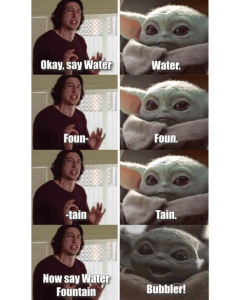
Cut to ten-year-old me walking through the halls of my new school, and someone stopped me and asked where the ‘bubbler’ was. “Um, the what, now?” I think it’s more commonly known these days that Wisconsinites are known for calling drinking fountains bubblers. Back then, this was a brand new word for me. And we had only moved 247 miles. Imagine if we had moved to one of the coasts how many new words and idioms I might have learned. Instead, my days are peppered with ‘ope’ and ‘er no’ (a phrase added to the ends of our questions to maintain that Midwest ‘nice’ where we give the listener an out to whatever question we just asked them).
In this particular lesson, I talk with my students about our audience and making sure we are writing in a way that they can understand us (they only have what is on the page, after all). If we are writing to a group of geographic peers, we don’t have to worry as much about things like this. And in some cases, wider audiences can still understand from context. But there does come a point where we may create a language barrier.
At this point, I put up a list of Scottish phrases that are not so easily understood by the average resident of the U.S. I then ask, by raise of hand, how many look up definitions of words or idioms that are unfamiliar to them while they read. Generally, very few hands go up. Most just skip over them. I point out that their own reader is likely to do the same – so it’s on us to make sure we are communicating our message as clearly as possible.
I’ve consumed enough British content (movies and books) to understand that though we speak the same language, U.S. English and British English are not wholly the same language. However, many of the differences are like those of the firefly/lightning bug – they are common enough or make sense enough to be understood (given context) even if you are hearing them for the first time. Lift is an elevator. Flat is an apartment. An unfortunate word is slang for a cigarette (which if uttered here in the states is a slur).
Recently, I’ve been consuming more and more British content. For one, they do game shows better than we do. And during these shows, there is a plethora of slang and idioms being spouted, and I have to admit that I often have my phone at ready to translate their English to my English when context fails me. Sometimes, it’s easy – they call jumping jacks ‘star jumps.’ (I think they win this one. My friend, Jack, disagrees.) But then…aubergine? It’s an eggplant. Pipped at the post? Narrowly beaten at the last possible second. (I kinda like that one.)
Then – cut to an episode of the show Taskmaster (Series 3, Episode 1 – and yes, they call them series while we call them seasons; in the states, a series means the entirety of a show’s run). At the end of each episode, there is a live task done (usually) up on the stage. In this instance, the five contestants were joined by five people of Swedish descent. Then the task was read out: “Balance your swedes on your Swede. Your Swede must remain standing at all times. Your swedes may only balance on the exterior of your Swede.”
Enter confusion. Especially when one of the contestants then held up a root vegetable. Specifically, a rutabaga.
You know I went on a deep dive. Long story short:
What we in the states know as a rutabaga is widely known as a Swedish turnip. The Brits shorten that to swede.
Ok. But then how on Earth did we land on RUTABAGA? (-‸ლ)
Well, it turns out that the Swedish word for this particular root vegetable is rotabagge. Literally translated – root bag. (I mean, what?)
It’s been a journey, folks. (˶ˆᗜˆ˵)
And the journey continued even after I had originally written this up but before it posted. 🤣 One of the cool things about being a part of a global writing community is that I’ve made (online) writerly friends from all over. One of whom is Swedish. She wrote on my post (I wrote about this on my personal Facebook page, too) that rotabagge is actually a dialect word used in the western part of Sweden (and also refers to a series of children books called “Rootabaga Stories”). The translation for Swedish turnip is actually kålrot. Language is cool.
 Ami Maxine