Every year (meaning the start of the academic year, which for my school is mid-August), we (the faculty and staff) are tasked with taking a number of trainings: Ethics, Title IX, and cybersecurity. Every year while doing that last one, I can’t help but wonder how these scams ever work. Doesn’t everyone know not to click on any links? Always to verify?
But if that were the case, these people would stop trying. We all continue to get bombarded because there are people it works on. It’s a numbers game for them – send it to a hundred, a thousand, more, and if you get one, it’s likely worth it (depending on the scheme).
TL;DR – never click on any links or open any attachments without verifying they are official; you should never have to pay for anything up front when someone offers you representation or publication. (Notes about writing scams at the end.)
If you need more than that, I’ve got some examples of what to watch out for.
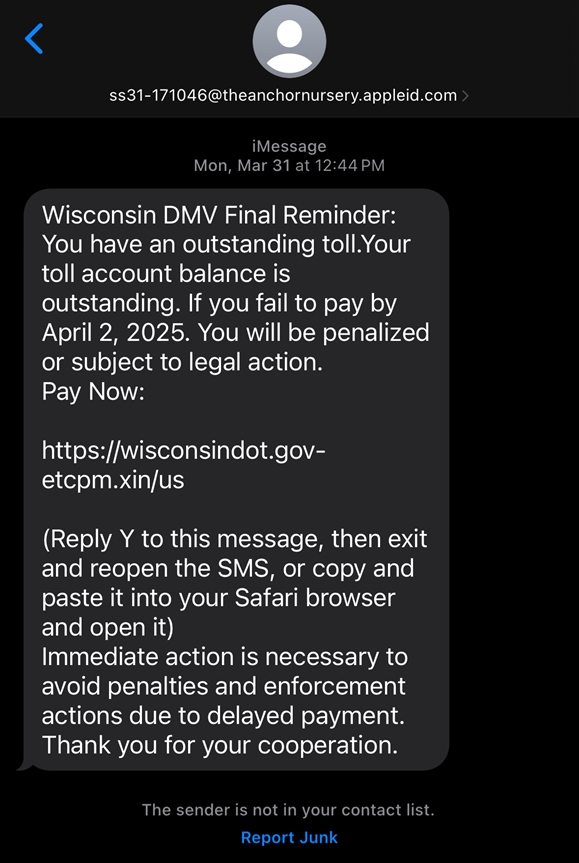
A year+ ago, I got the above text message saying that I had outstanding tolls in the state of Wisconin and that I will be “penalized and subject to legal action” if I don’t pay now. They provided a link for me to click to make this payment.
This one made me giggle because WI doesn’t have tolls. (Do your homework, scammers.)
First – you would never be notified of overdue tolls through a text. They send invoices through the mail to the address attached to your plates (so make sure your address is up to date at the DMV or you will be missing notices and incurring more fees). In addition, there are many red flags in this text that can let us know this is a scam:
- It came from an email with the domain indicating The Anchor Nursery. Definitely not anything related to the DMV. The random series of letters and numbers as the ID for the email is also a red flag.
- The Actual website for the WI DMV is https://wisconsindot.gov/.
- Anyone can buy any URL that is not already in use – they are hoping you see the first part and ignore the rest – the URL for the site in the text is the full https://wisconsindot.gov-etcpm.xin/us. (Note: The domain is everything that comes between the https:// and the next / – so in this case: wisconsindot.gov-etcpm.xin. This is what you need to look closest at – because they hope you see the ‘wisconsindot.gov’ part and think it’s legit.)
- An .xin doman can be bought by anyone, though they are aimed at the Asian market. An actual .gov cannot be bought by anyone other than an official government agency (that being said, they can slip the letters gov in there hoping to dupe you). Also, they are hoping you miss the .xin by adding the /us. Anything after the initial domain indicates a specific page on that website; it’s not a part of the actual website domain address – they are hoping using a reference to U.S. will distract you again from the .xin.
- Often, these scams will give you a sense of urgency in the hopes you panic and pay, and that you do not take the time to do your due diligence. This text came in on March 31, and I ‘have to pay’ by April 2. In reality, the timeline for being overdue and incurring fees/needing to pay is longer than this:
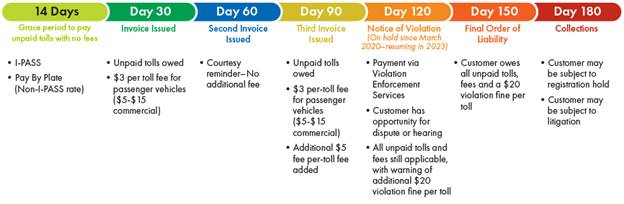
- Also, the Illinois Tollway is not part of the DMV – it’s a separate organization. It also does not contact the DMV about unpaid fines, and the DMV is not in charge of sending notices of unpaid fines. The Illinois Tollway itself can put a hold on your registration. This will, of course, then flag at the DMV. (But note that the graphic above says they “may” – not that they will. Same note about litigation.) Again, if there is an actual missed toll and fine, just make sure your address is up to date at the DMV, and you will receive the first notice, which you can pay and avoid getting anywhere near collections.
So, you get a text like this, and your state does indeed have tolls (or you live near one that does and have recently driven through one of their tolls). What do you do? For IL, you can check your account/plate by going to www.illinoistollway.com or calling 1-800-UC-IPASS (1-800-824-7277). (You can search for the official website and phone number of your own state.) But whatever you do, do not click on any links or open any attachments without doing your due diligence.
After a bit, the scammers must have realized that WI doesn’t have tolls, and they switched their tactic:

- This one at least came from a phone number and not a random email. However, it came from an international number: +63 is the code for the Philippines. (If the first set of numbers is only two digits, it’s an international code. You can google the code and see where the text is coming from.) If this were legit, it would come from a local number that you can locate on the actual agency website. (That last part is key. Lots of scammers have figured out ways to call from what looks like a local-to-you number.)
- DMV stands for Department of MOTOR Vehicles. Typos, misspellings, and other such inaccuracies are a good indication this is not from someone at the actual office. In addition, the DMV doesn’t deal with traffic ticket fees. Police and the courts do.
- North Wisconsin Car State Administrative Code 15C-16.003 does not exist. (An additional inaccuracy – North Wisconsin? Any actual codes would be for an entire state.)
- Again, the actual website for the WI DMV is https://wisconsindot.gov/
- The URL for their site is the full https://wisconsindot.gov-ye.icu/us. Same notes as above about the .icu domain. (Though this is an upgrade. While .xin is geared toward Asian markets, .icu is more global. This change was certainly intentional on their part.)
- They again gave a sense of urgency – the text came in on June 3, and I ‘have to pay’ by June 5.
- The text is about a traffic ticket – no idea why they would “transfer to a toll booth”? Traffic tickets and the tollway have nothing to do with one another.
- The one thing they do get right is that if unpaid fees go to collections, yes, it can indirectly affect your credit score. But, again, there are a lot of steps and official notifications along the way to that (and six months).
Another common scam is the cold-call job offer:
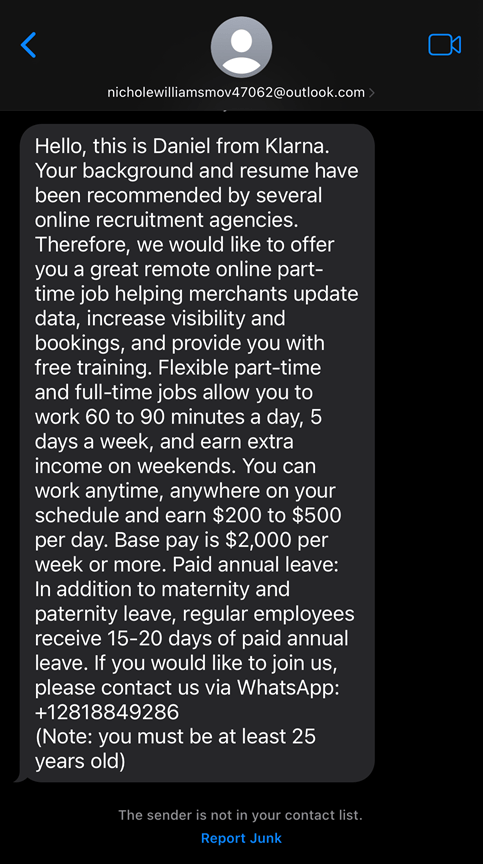
- Ok, first clue – the name given (Daniel) does not match the email it is coming from (Nichole Williams). Also, if this were legit, the email would have been something like @Klarna.com
- Next, Klarna is a real business – you can look it up. They have this warning at the top of their page even letting you know about the scam:
- In addition, no one is going to offer you a job through a text message based on some resume you didn’t send them. If you are working with a head hunting agency, you might get a cold call – but it will come through a phone number or email you can locate on the company website (and the head hunter will probably give you a heads up that it is coming). Either way, you would have to still interview before you would get an actual job offer.
- If it sounds too good to be true, it probably is. No one is paying 2K a week for 60-90 minutes a day. This is so unreal. If you are going to be hired for some job that is paying well over two hundred bucks an hour, it’s going to be a highly skilled job with a rigorous interview and onboarding process. Not a text message out of the blue.
- The number they give is through WhatsApp. BIG red flag. Any communication should come from a phone number that you can verify on their website.
- That being said, the WhatsApp number is cloaked as a number from southern Texas (likely why they are using WhatsApp in the first place). Klarna is based in Sweden. They have offices elsewhere in the world, but none on their site are listed in Texas. Took me about ten seconds to find this out.

The same goes for anything you get through email or voicemails, even letters in the mail. Protect yourself. Verify. Verify. Verify. If you weren’t expecting it, it’s probably a scam. If it seems too good to be true, it’s very much likely to be a scam.
All this to say that writers are often targets of scammers. Why? Because we have big dreams, and we want to believe that opportunity finally came knocking. And people try to exploit that. Again – if it feels too good to be true, it probably is. Some things to watch out for:
- If a publisher contacts you with a contract and asks you for money for ANY step of the process, it’s a scam. The publisher is the one taking the chance on you – they cover ALL up front costs in the hopes that they reap the reward when the book goes to market. (Same goes for requests for payment to represent you. Or requests from TV shows or podcasts asking you to pay them to be on their show. That is not how this is supposed to work.)
- On that note, there’s also a scam currently going around where a ‘celebrity’ podcast wants to interview you and asks for access to your Facebook or Insta page for a live event; it’s a scam. They don’t need access to your accounts to hold a live event with you.
- If a publisher reaches out about a self-published book and offers you a five or six figure advance – but your book is not selling millions of copies, be wary. They aren’t going to offer that kind of money without some sort of assurance that they will make it back and then some. And if your book isn’t doing those kinds of numbers already, the offer is a scam.
- Watch out for literary awards that charge reading fees. Most of them are scams. (Note – most but not all. This is where that due diligence comes in.) The most reputable ones do not charge a reading fee.
- Don’t pay for reviews. Even if it is a legit person who reads and honestly reviews your book, agents and publishers don’t take them seriously, and it may even backfire if you are looking to get representation.
- If you get a call from a studio or agency wanting to make a movie of your book – but first they ask you to pay to produce things like a ‘pitch deck’ or ‘theatrical trailer’ – it’s a scam. Again, it’s your IP. You own the copyright. They are paying YOU to use it. Any costs incurred are on them. This is why they have financial investors.
- Impersonation scams are big – so do your research. If you get an email out of the blue from a supposed agent or publisher, don’t click any of the links they provide or open any of the documents attached. First, do a search for the official website and make sure this person is a member of their staff. Even then, anyone can make a website. If it’s a publisher you’ve never heard of, check out places like Writer Beware. (They also have lists of current scams.)
- Also, if you get an offer of a contract, this is indeed a time where you MUST read the ‘terms and conditions’ and ALL the ‘fine print’ before you sign anything. It’s not fun to read – but you need to know what it is you are signing away. (In the U.S., soon as you have an offer from a publisher, you can join the Authors Guild. Your dues give you access to legal advice, and they will look over contracts and let you know about any red flags. If you are in other countries, check into local guilds to see if they perhaps offer the same service.)
 Ami Maxine