I think one of the trickiest things about self-publishing is figuring out what to charge for your book. (Well, that and trying to summarize an 80,000-word novel into a couple-hundred-word blurb. And don’t even get me started on log lines…) A few years back, I wrote up a series of posts that went over everything I had learned through the self-publishing journey. I have to imagine at this point, the Royalties post is outdated due to rising costs, but the sentiments are still there.
The first thing you’ll want to do is stop by your local book shop (ooooh noooo…) and take a look at other books in you genre. What are they charging? What seems to be average? Consider, also, the length of your book compared to theirs. The longer the book, the higher the printing costs. Also, be aware that depending on your print on demand (POD) company, they will have a minimum you can sell it for (since the price will need to, at a minimum, cover printing costs/fees – each company varies in their costs, so some research is necessary).
You will also need to check with your state’s Department of Revenue (DoR) to see if you are required to have a seller’s permit. I was recently invited to participate in an event that required one. The permit in my state (Wisconsin) is twenty bucks, which covers two years, with a renewal cost of ten bucks, which also lasts two years. I wasn’t thrilled about the added cost to the event (since they were charging forty bucks for the booth…), but I went to investigate anyhow. In talking with the person at the DoR, however, they noted that I didn’t need a permit unless I sold more than two grand a year in sales. Now – every state will have different laws, so make sure you check into whether or not you might need one and how much it will cost. Factor things like this into the price for selling your book and attending events.
So what goes into the cost of a book?
- First, does your POD charge for creating an account or to upload the file? (For example, one particular company used to charge forty-nine bucks to upload a book for print, and then they would charge the same cost every time you need to re-upload it, such as you found errors or made other changes). They have since changed this – they now do not charge for the initial upload or for any changes made within the first sixty days; then it’s twenty-five bucks per ‘revision’ (or upload). Other companies never charge for the uploading or re-uploading of files.
- The next part is the printing of the book. Many things will go into the cost: size (6×9 is most common these days, so I’ll use that in this example), number of pages (let’s go with 300), whether the interior is black and white or color (most novels are B&W), if you want to print on the inside of the cover (I did not), and how quickly you want it printed (this particular company’s lowest price point means it will be printed in up to five business days – you can pay more to get them faster, as there are two-day and a one-day options, though that will cost you $6 and $7.09 per book). For all of the choices I made above, printing the book will cost $5.45. (A second company with the same criteria came to 4.60. A third is 4.84. In other words, do your research. You can probably guess what company was the cheapest cost – but cheaper doesn’t mean better. Also, that cheap version is from a company that most local bookshops will not buy from, so keep that in mind**.) There are other decisions to make that won’t affect the cost, such as what paper you want to use and whether you want the cover to be gloss or matte.
- You will also need to take into account what it will cost to ship those books to you. At the company I’m using above, to ship one book to my area (obviously shipping will depend on where you live), it would cost another $3.49 (this is for their basic shipping, which is SLOW and has no tracking, so not the best option – if the shipment never arrives, you have no recourse; I do their standard ground because I’m shipping to a residence and it provides tracking – however, this is $9.69 for a single book – not at all great. If you can buy in bulk, the cost of shipping will, of course, go down per book. At this particular company, I found that ordering fifty copies was the most economical to ship. At fifty copies, it would cost $38.99 for standard ground, which comes down to $.78 per book. They also have two-day and next-day, but the price to ship fifty goes up to over five and over fifteen per book respectively.)
- Don’t forget the sales tax (and, yes, you should be declaring any book sales as income on your taxes each year – so make sure you develop a way to track your sales and compensation, as well as all business expenses – save every single receipt). Each state, city, county, etc., will have their own sales tax, so you will need to figure out what they are for where you live (things will get more complicated if you are selling in other areas/states. I am not a tax accountant; you’ll want to talk to yours. For the purpose of this post, I’m speaking in generalities of what I’ve learned). For example, my state has a 5% sales tax, and my county has an additional .5% – so I would need to collect a 5.5% sales tax.
- And last, the IBSN. I didn’t take this into account per individual book what this will cost, because you have it for the life of the book. But for most PODs, you will need to purchase and provide the ISBN (there is one in particular, the one small shops won’t buy from, that will provide you an ASIN, but that is not transferable. If you want to sell through anywhere else, you will still have to buy an ISBN. Also, you will need an individual ISBN for each version of the book – ebook, paperback, and hardcover – as well as any new editions that you may publish down the road.) I was given Bowker as a recommendation, and I did end up using them. Please know that ISBNs are not cheap – and it is better off if you can buy them in bulk (but, again, that is if you can afford to do so). At the time of this writing, one ISBN was $125. And remember – you need one for each version. You can buy in bulk – 10 was $295, so a significant savings. 100 is $575. There is an option to buy 1,000, but unless you are a publisher, that’s definitely on the extreme side.
Ok – let’s say that I did my research, and the typical price for my genre/page count is 15 bucks. Selling my book directly from me to a customer will get me the highest royalty:
Total – printing – shipping – sales tax = royalty
15 – 5.45 – 3.49 – .83 = 5.23 (if I bought one copy)
15 – 5.45 – .51 – .83 = 8.21 (if I bought fifty copies)
It’s understandable that not everyone can afford to buy bulk in advance – it’s also a risk because you don’t know how many you will sell. If I buy ten and sell ten, I’m ahead. If I buy fifty and sell ten, I’m at a loss. Also, make sure you consider costs involved with making that sale – including your own time. If you go to an event, you may have a booth fee and that seller’s permit fee mentioned above.
Now, five to eight bucks per book probably sounds GREAT. However, consider that most of your sales likely won’t come in this manner. Another option is that your local bookshop might carry your book (and may even hold a launch event or reading). This is great. If they buy from you, meaning they will take your book on consignment, you will print/ship the book to yourself and then hand over some copies to them; if the book sells, they will send you the royalties. Most bookshops will ask for a 40% cut. So if your book is 15 bucks, you get nine bucks, and they get six. But remember – your shipping and printing cost comes out of your cut. If you bought in bulk, and your book cost $5.45 to print and $.78 to ship (in this scenario, the shop would collect/deal with the sales tax), you will figure royalties like this:
(15*60%)-5.45-.78 = 2.77
Another option with local bookshops is that they can order directly from a POD (this is why it’s important to pay attention to which you use – there is a particular company small shops won’t buy from). In this instance, you don’t have to worry about paying for anything up front*. The shop will pay for shipping and handle sales tax; the printing cost comes out of your cut. The bookshop will take 40% of the sale. BUT – the POD will ALSO take a cut because they are acting as a distributor in this instance. In this scenario, you will have to set the ‘discount’ (i.e. the price the bookshop will pay). When using this same company, you have to set it as 53-55% (your cut is reduced to 47-45% – obviously, setting it at 53% is the best option for you). The plus is that you get the royalty when the shop makes the purchase*.
(15*47%) – 5.45 = 1.60 (there is no reason to set at 55% – don’t give the POD extra thirty cents)
So when it comes to local-to-you bookshops, it’s a better margin to get the copies yourself and work on consignment. The OTHER reason it’s better is that if the book doesn’t sell, you can get it back at no cost (aside from the travel to that shop to pick it up).
*If they buy from the POD company, and it doesn’t sell, if you have your book set up as allowing returns, you are on the hook for reimbursing the POD for that cost. You have the option to have it returned to you (you pay shipping and print costs, though you can hopefully turn around and sell it) or have it destroyed (you still pay printing costs).
This return policy may not be a huge deal if it’s only a book or two. However, this particular company pushes wide with distribution – you will be on every book-selling website that allows it. Those companies may opt to buy more copies than they actually sold to save on shipping costs for them. If those then don’t sell, and they return them, you’re on the hook. (You can read about this more in my Seventeen and Seventeen: Part Two posts.) You can opt to put ‘no’ for returns, but they warn that this might stop bookshops from ordering your book at all.
One more thing to think about if you are selling direct is what ways you will accept compensation. Obviously, cash is the easiest (assuming you have money on you at all times to make change). However, these days, folks don’t always carry cash – so you will need to consider your other options. Venmo (and others like it; I do use Venmo, but, no, this is not an ad, and I’m not getting anything for mentioning them) allows you to transfer money, and if you do it certain ways, you don’t get charged fees, which would eat into your royalties. (By certain ways, I mean things like – when you transfer from Venmo to your bank account, if you’re ok waiting a couple days for the money to show up, then you don’t get charged. They would charge a fee for an instant transfer.) Also, consider if you would you take a check (if you don’t know them personally, make sure you get a phone number in case the check were to bounce) or credit cards.
I recently learned how easy Square is to use (again, not an ad). In downloading the app, I found out that you don’t need to buy the little square to plug into your phone (they will actually send you one for free), and if you have an iPhone and the card has a chip, they can tap to pay with the Square app right on your phone (no device needed). There are fees with this, however – 2.6% + 15¢ (or .54 for a $15 book) for magstripe card transactions (i.e. swiping using the device), chip card transactions, and contactless (NFC) payments. They also charge 3.5% + 15¢ (or .675 for a $15 book) for manually entered transactions (where you have to type the number into the app). So take all of this into consideration for how often you might use the thing.
Total – printing – shipping – sales tax – Square fee = royalty
15 – 5.45 – 3.49 – .83 – ((15*2.6%) + .15) = 4.69 (or 7.40 if you can buy bulk)
15 – 5.45 – 3.49 – .83 – ((15*3.5%) + .15) = 4.56 (or 7.26 if you can buy bulk)
Square also allows you to send invoices. The fees for that are 3.3% + 30¢ (or .795 for a $15 book) per invoice when customers pay with credit or debit online.
The square app also lets you set up tax and mark which items should be taxes, and it will add it to the cost. You can opt to say tax is included on books paid for with cash, check, or Venmo, and then say it’s not included on Square because of the other fees they charge. Or you can still include it. These are all choices you’ll need to make for yourself.
There are other costs to consider – such as if you want to buy swag (either to hand out for free, like bookmarks, or to sell). Also, if you will be attending events, consider what you might have to purchase (you might want a cashbox or bag to hold you cash, to create displays, buy a tablecloth as not all events provide them). I didn’t even go over online sales, which might also include the cost of creating and running ads. You might also require costs such as paying someone to typeset the book or create the cover, not to mention editing. Self-publishing is not a cheap endeavor if done right – but it does allow for the most flexibility and control of any publishing option.
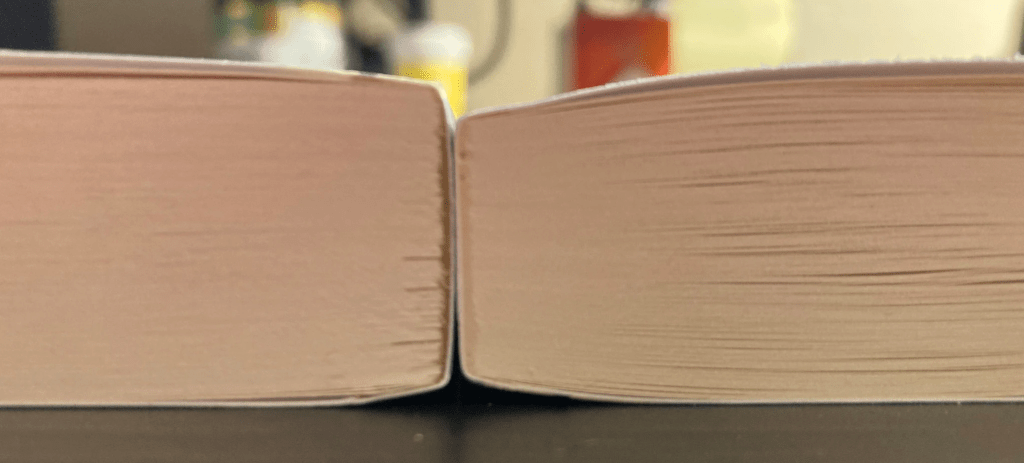
**You can opt to post your book at multiple PODs. You can then buy author copies from a cheaper one (to get that higher royalty) and still have it at a POD that local shops will buy from. Just realize that these copies WILL be different. This is the same book from two different POD companies:
 Ami Maxine