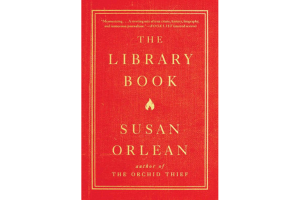
Title: The Library Book
Author: Susan Orlean
Genre: nonfiction, history, true crime
Pages: 336
Publication Date: 16 Oct 2018
StoryGraph* Moods: informative, reflective, inspiring
How I Stumbled Upon This Book: Susan Orlean was a keynote at the book and author festival
Other Books by this author: Joyride, On Animals, Rin Tin Tin, My Kind of Place: Travel Stories from a Woman Who’s Been Everywhere, The Orchid Thief, Saturday Night, The Bullfighter Checks Her Makeup: My Encounter with Extraordinary People,
*StoryGraph also offers content warnings.
Normally, I do recommendations on the first Friday of the month, but I also schedule ahead because my life as a teacher means certain times of the year, I’m buried under a pile of student writing that I need to review and remark on, and the last thing I have time for is sleep, let alone writing. (Ok, that might be a slight exaggeration. But only slight.)
I read a book recently that has been sitting on my shelf since April 2019, though it had been published six months prior to that. I’ve been wanting to read it ever since, but life got in the way. So when the opportunity presented itself (I was tasked the title for one of my book clubs), I settled in – both prepared and not quite prepared enough for the content within its pages.
I first learned of Orlean when I was tasked with reading her book The Bullfighter Checks Her Makeup in grad school – it’s a collection journalistic “profiles of eccentric and fascinating individuals.” I remember enjoying it, so when her name appeared on the roster for my city’s book and author festival UntitledTown (a clever spin on Green Bay’s nickname of Title Town due to the football team housed here), I was excited to hear her speak.
The book Orlean was coming to promote was The Library Book, a nonfiction book about libraries in general but about the burning of the Los Angeles Central Library specifically. (She arrived at the venue via Green Bay fire truck, lights swirling.)
I’ve been fairly clear on this here blog about my life-long love of libraries. I’ve been a patron since I was a child. First, the large library of the city where I was born (including their bookmobile that visited the other end of my block). Next, the tiny one-room library of the tiny town we moved to when I was ten. Currently, I have cards at three different libraries – the one at the college where I work, my county library system, and the local university. In my eyes, libraries are priceless and should be protected at all costs.
Same with the people who work there. If you are a librarian, chances are that I’ll want to be friends with you. The librarians I’ve encountered thus far in my life have all been wonderful people. The reference librarian at my work is a literal magician – I have asked for some pretty specific resources over the years, and she’s never let me down. It is my personal goal to stump her before she retires, which is actually a goal I hope I fail. (She also helped me in creating my nerdiest poem title ever, the Library of Congress call numbers for a metaphorical book contained within the poem. Later, she helped me piece together the LOC numbers for my first two books and was present when I was given the privilege of shelving my own book onto the library’s shelf – a childhood dream come true.)
Because of my experience with libraries and librarians (and any books about them), it’s probably surprising that I’d not yet read this book nearly seven years after I slipped it (signed!) onto my shelf. But sometimes, books wait until we are ready or we need them most.
I have to be honest and say that the charged existence we are living right now, especially when it comes to things like history and books and, yes, libraries, this one hit hard. I have to imagine it would have always tug at my heartstrings, but there were moments I was drawn to literal tears. Yes, the fire at that Central Library (and the others mentioned in the book) was heartbreaking. But the moments that got me were the ones that came after, in the stories of the people trying to preserve, evolved, and protect the libraries.
In fact, Orlean talks about the over TWO THOUSAND volunteers who came to the Central Library to help in the days after the fire. There were hundreds of thousands of books that had to be removed from the decimated stacks – some were dry and smoky, others were damp (and immediately frozen before mold could corrupt the pages). These volunteers spent long days standing in line and handing these books from one to the other, packing them up for the trucks that would take them to their storage (local fishing operations cleared spaces in their freezers to house the wet ones, with no idea how long they may have to take up residence). So many people who understood the importance of books and libraries. It warms the heart, even in the face of tragedy. (Well, it warmed this heart. And these tear ducts.)
Orlean also discusses the many other things that libraries do. The LA Central Library created a first-of-its-kind Career Online High School (the first accredited library-based high school program in the U.S.), where community members could take any of the nine hundred COHS online classes for free and graduate with a diploma, rather than a high school equivalency certificate. They created a resource center for the unhoused population to learn about and access resources. They preserve (and digitize) our history. The provide computers and internet to those that may not otherwise have access (even today where it is assumed that all people do). They has literacy centers that help English language learners navigate a world speaking a language they may not fully understand. And, yeah, they have books, too.
It’s not always apparent to a lot of folks the positives that libraries bring when they exist within communities (though, “On average, a new public library results in increases to student reading achievement that are 29% of the size of those associated with the opening of a new elementary school building, at 15% of the cost of the new school“), but the impacts when one closes are. These things can include everything from a drop in the values of surrounding homes to access to internet (“One in five Americans use public libraries for Internet access“) to access to a ‘third space’ that doesn’t cost money (like cafes and bars do) to a decline in both reading and math scores.
Libraries are more than just shelves filled with books, and Orlean’s book, through the examination of this specific library and community (as well as touching on many others), helps to paint the picture of their importance. Now, more than ever, we need our libraries.
“Books are the culture DNA, the code for who, as a society, we are, and what we know. All the wonders and failures, all the champions and villains, all the legends and ideas and revelations of a culture last forever in its books. Destroying those books is a way of saying that the culture itself no longer exists; its history has disappeared; the continuity between its past and its future is ruptured. Taking books away from a culture is to take away its shared memory. It’s like taking away the ability to remember your dreams. Destroying a culture’s books is sentencing it to something worse than death: It is sentencing it to seem as if it never lived.”
“In Senegal, the polite expression for saying someone died is to say his or her library has burned. When I first heard this phrase, I didn’t understand it, but over time I came to realize it was perfect. Our minds and souls contain volumes inscribed by our experiences and emotions; each individual’s consciousness is a collection of memories we’ve cataloged and stored inside us, a private library of a life lived. It is something that no one else can entirely share, one that burns down and disappears when we die. But if you can take something from that internal collection and share it – with one person or with the larger world, on the page or in a story recited – it takes on a life of its own.”
~ Susan Orlean, The Library Book
 Ami Maxine