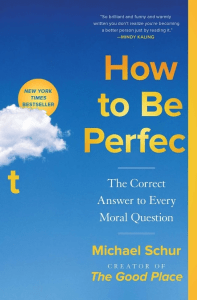
Title: How to Be Perfect: The Correct Answer to Every Moral Question
Author: Michael Schur
Genre: Nonfiction, Philosophy, Humorous
Pages: 304
Publication Date: 18 Apr 2023
StoryGraph* Moods:
How I Stumbled Upon This Book: I’m a fan of his shows The Good Place and Brooklyn Nine-Nine. When he was interviewed on a podcast (can’t remember if it was Armchair Expert or Smartless – maybe both), he mentioned his book was coming out, so I had to give a shot.
Other Books by this author: None at the time of writing this.
*StoryGraph also offers content warnings.
Description: From Bookshop.org: “Schur starts off with easy ethical questions like “Should I punch my friend in the face for no reason?” (No.) and works his way up to the most complex moral issues we all face. Such as: Can I still enjoy great art if it was created by terrible people? How much money should I give to charity? Why bother being good at all when there are no consequences for being bad? And much more. By the time the book is done, we’ll know exactly how to act in every conceivable situation, so as to produce a verifiably maximal amount of moral good. We will be perfect, and all our friends will be jealous. OK, not quite. Instead, we’ll gain fresh, funny, inspiring wisdom on the toughest issues we face every day.”
Why I recommend this book: Maybe you hear ‘philosophy’ and think, nope – no way. No thank you, next. Or you hear comedy and think ‘How dare he? Philosophy is not a joke!’ Well, I say to both – give it a shot. Yes, Schur approaches philosophical questions with a humorous bent, but I promise this does nothing more than make the conversation accessible. He cares about the content – the humor is a tool to make it palatable, not as something used to make fun of philosophy.
It’s a quick and fun read – a good entry into a topic that can sometimes get overly confusing and convoluted.
“The complete freedom that existentialists shove down our throats – the insistence that we can’t defend our choices using any external structure – keeps us from using those structures as a crutch. …we’re tempted to look for something solid to hand onto, a reason that justifies what we’re going to do as though that were really the only possible choice. Reasons make us feel better because the reframe our choices as inevitable, this absolving of responsibility.”
~ Michael Schur, How to Be Perfect
 Ami Maxine