Kurt Vonnegut said, ‘I don’t plot my books rigidly, follow a preconceived structure. A novel mustn’t be a closed system – it’s a quest.’ Others, like the author of Room Emma Donoghue, prefer to have a guiding base structure. She notes that ‘Some writers can produce marvelous plots without planning it out, but I can’t. In particular I need to know the structure of a novel: what’s going to happen in each chapter and each scene.’
While some folks work best by letting their story romp around the page (like Vonnegut), and some are planners (like Donogue), all need to have an understanding of the structure of a story. I think my favorite way of looking at it was stated by Khaled Hosseini – “Writing fiction is the act of weaving a series of lies to arrive at a greater truth.” You can weave however you’d like – but to have something that is functional, you need to eventually make sure the structure is sturdy.
When it comes to NaNoWriMo, even if you are a pantser, it is a good idea to have a general idea of the plot and structure of your overall story. This doesn’t mean you can’t make changes as you go – but this can cut down on writer’s block quite a bit.
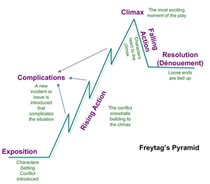
If you are a pantser, you might benefit from Freytag’s pyramid – it can help you lay out a general arc for your story without having to nail down all the details that might make you antsy as a pantser.
If you aren’t a pantser, something like the 15 Beats or the three-act structure might be more your speed. If you are new to writing novels, or you’re a planner who has never done NaNo before, the 15 Beats will give you the most structure in advance. This breaks the story down into specific pieces – sort of like a paint by numbers.
The three-act structure is somewhere in between Freytag’s and 15 Beats. It can be helpful to sit with the Three Act Structure template when you are planning out your story – fill in your plot points so that you know what you are writing to and what scenes you will need to develop. (This does not mean you can’t change the story as you write.) How detailed you want to be is up to you.
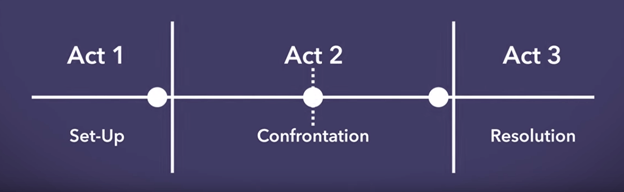
The “Acts” Structure:
- Set Up –
- Exposition: establishes main characters, their relationships, and their world
- “the inciting incident” – later in the first act, a dynamic on-screen incident occurs – this is the catalyst that sets the protagonist’s adventure in motion
- Plot Point One – sometimes, the inciting incident and plot point one happen in the same scene – think of plot point one as the spring board that launches your character into Act Two.
- Confrontation –
- Rising Action – typically depicts the protagonist’s attempt to resolve the problem initiated by the first turning point, only to find themselves in ever worsening situations. (Part of the reason protagonists seem unable to resolve their problems is because they do not yet have the skills to deal with the forces of antagonism that confront them.)
- Midpoint – A significant event should take place here, usually involving something going horribly wrong.
- Second plot point – Give them some time to reflect on the story’s conflict here. The aftermath of the Midpoint crisis will force the protagonist to pivot from being a “passenger” to a more proactive force to be reckoned with.
- Resolution –
- Pre-climax – this is where we get our first glimpse of the antagonist’s true strength, and it usually catches the main character off guard.
- Climax – signifies the final moments of the story’s overarching conflict
- Denouement – If the protagonist’s goal is not immediately obtained during the Climax, the denouement is where this should be achieved (or redefined, if their goal changed during Act Three). Along with this, the denouement should also:
- fulfill any promises made to the reader (as Anton Chekhov notes, “If in Act One you have a pistol hanging on the wall, then it must fire in the last act.”),
- tie up significant loose ends,
- underscore the theme, and
- release the tension built up during the climactic sequences of events.
 Ami Maxine
I’m more of a pantser, and I do like Freytag’s pyramid. I’m hoping to do some writing for NaNoWriMo! 🤞
LikeLike