For some of you, when writing your stories, you may be doing more than just inventing characters and their lives. You may choose to take on creating a brand new, never before seen world for them to live in. The biggest piece of advice I can give you in this endeavor is just to make sure your characters treat the world as natural – as normal. As A.D. Jameson notes, “In world-building, there isn’t any supernatural, not really — just a different order of the natural.” The world just IS. And your characters don’t know any other way. Of course, it takes a bit more than this, but we’ll get to all that.
If you are choosing to create a brand-new world for your story, you will want to make sure that you get to know it as well as, if not better than, you know your characters. Remember, the setting, your world, is more than just streets and houses – it includes weather, local customs, and even what your characters do for a living. All of things these may have different rules from what we know in the reality of where we live – but they still must have rules. You get to decide what those rules are – and then you have to be vigilant in making sure the story follows those rules.
So for this week, if you are creating a fictional world for your NaNo story, I encourage you to answer the following questions as they pertain to your world (being as detailed as you can, but know that you can add as you write the actual story). These questions come from a previous professor of mine (I am unsure where they acquired them from):
First, think about basic infrastructure. How do they eat? What do they eat? Who takes away the garbage? Who deals with their bodily wastes? How do they get around? What do the majority of people do to survive? Consider water. Without water on our planet, there wouldn’t be life on Earth. What is water to your world? Maybe your characters don’t need water like we do – but they need something. Also, remember that you are not just creating a society – you are also creating an economy. People don’t oppress each other for fun (well, some do, but that’s a conversation for another time) — usually, systems of hierarchy and oppression have an economic component to them. What’s their money? How is it used? How is it divided?
Again, give your world concrete rules – and make sure you stick to them. Nature in this new world may not act like it does on our Earth – so what does it act like? If your world has two suns that are up at different times and give off different colors, yellow during the day and blue at night, then any time light is referenced at night, it’s got to have a blue hue. The way that it becomes believable to the reader is that the narrator treats it like it is a matter of fact and is consistent. So whether it’s a magical system or a societal mores, be sure that once you establish a convention, you stick to it.
Under the umbrella of rules, you have a few systems to consider – such as magic, religion (if it exists in your story), social interactions, politics, just to name a few. Most fantasy novels involve magic – and rules for this are important. You can create whatever system you’d like, but you need to have some sort of system. Maybe it’s based on numbers – or plants – or words – or something else entirely. Maybe your characters are born with magic – or they have to study for years to become proficient. Whatever you decide, it has to be consistent – characters cannot deviate from the system you have created.
There are many other systems to consider, as well – What is the power system like? (Meaning in-group/out-group power dynamics, but also literal power – how do they keep the lights on?) What does their government look like? Is there religion? Multiple religions? What about art and entertainment? Is this a brand new world? If not, what are significant events from its history? What technology exists in your world?
You may also want to consider creating a map of this new world (and including it with the story, if possible) so that the reader can easily follow along where events are taking place. This can help your reader stay oriented as your characters move around your world.
—
If you are creating a story in the world as we know it, or a historical version of it, you can ask/answer a lot of the same questions above. When it comes to historical fiction, however, you will want make sure you do the necessary research. The more research you can get out of the way now, the more you can then focus on writing in November. Immerse yourself now in that time period. Read books and watch movies that take place in those times/settings (nonfiction/documentaries are best). Go to a museum (if possible) and see artifacts from that time in person – make sure you take notes while you are there. Listen to music they would have listened to. Read archived newspapers (if available) that they would have read. If your story takes place after catalogs were in use, get hold of reprints of old catalogs. Old Montgomery Ward Catalogs will have descriptions of, and prices for, almost every personal item used by people of that time: hardware, books, stationery, toys, guns, toiletries, wallpaper, stoves, laundry equipment, saddles/harnesses. If you can, find an expert on that time/place.
Yes, use the internet – but be weary of the internet. There is a lot of flawed information out there. (Seriously – be cautious about information from places like Wikipedia.) Check everything you find against at least two sources. BUT don’t assume finding a piece of information in a lot of places means it’s factual – if a story or definition is repeated nearly verbatim in more than one source, there’s a good chance someone simply copied the information without verifying the accuracy. This is how a lot of bad information gets passed along and taken as “true.”
Regardless of the world you are using for your story, make sure you don’t let the setting overwhelm the story. The setting should be positioned behind the characters and events. It should add atmosphere and context – but don’t let it get in the way of the action. A little snippet here and there, in between the action and dialogue, is good. A three-page essay on how your artist protagonist prepares a canvas, with the characterization and events put on hold while you write it, will make your novel sound more like non-fiction. You want to make sure you do your research – but then keep most of it to yourself. Let it inform the story – don’t make it the story. For example, if it normally snows in December, you don’t need to detail the amount of snow they get – BUT your character will likely need to bundle up before they leave the house.
Remember, only leave stuff out because it doesn’t add anything to the story – not because you don’t know it or didn’t research it.
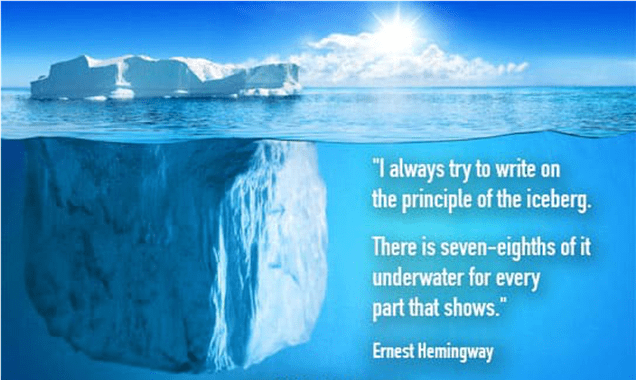
“If a writer of prose knows enough of what he is writing about, he may omit things that he knows, and the reader, if the writer is writing truly enough, will have a feeling of those things as strongly as though the writer had stated them. The dignity of movement of an iceberg is due to only one-eighth of it being above water. A writer who omits things because he does not know them only makes hollow places in his writing.” ~ Hemingway
 Ami Maxine